Q3 Fundraising for 2026 Elections – How Much Money You Need?
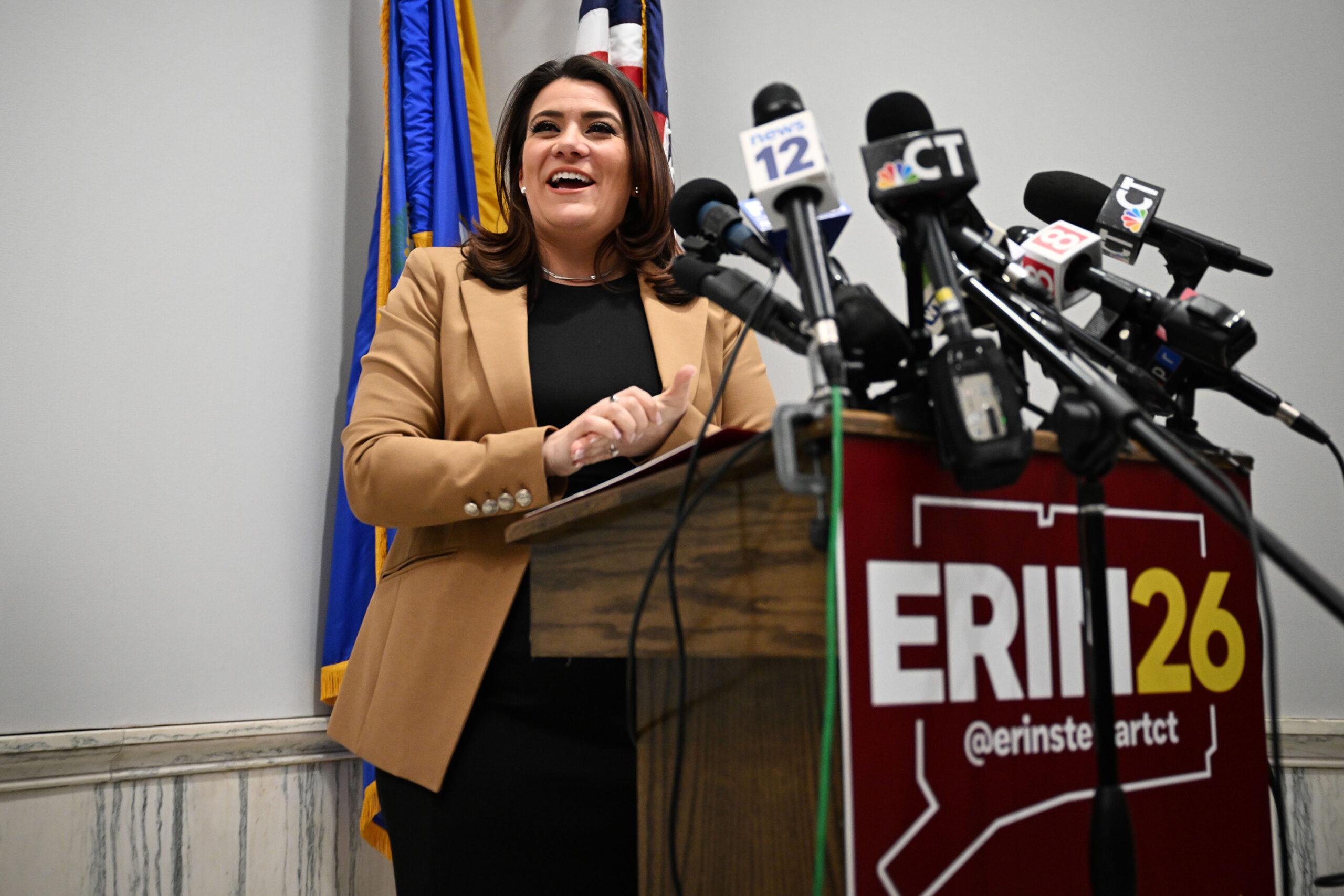
New Britain Mayor Erin Stewart announced her exploratory campaign for governor on Jan 28th, 2025, at New Britain City Hall. Source: Connecticut Public Radio
Table of Contents
Overview
Fundraising reports for Q3 were due in early to mid-October for both statewide candidates and candidates for federal office. Finance reports give credentials to more serious candidates, demonstrating they have funds for increasingly expensive primary campaigns, and for candidates to demonstrate they are the ones to take the mantle for the party.
Q3 Finance Reports allow voters to see how candidates for governor are faring, including what is looking like a competitive Republican primary between New Britain Mayor Erin Stewart and State Senator Ryan Fazio. We will also look at State Rep. Josh Elliott’s campaign for governor.
Additionally, we are looking to see how viable Democratic primary challengers to Rep. John Larson are in CT-01.
Q3 Republican Primary for Governor Fundraising
Erin Stewart – $102,000
Overall Campaign – $350,000+
Ryan Fazio – $157,769
Republican Primary Governor Discussion
When Fazio launched his campaign, I was curious how the Republican coalitions would react around the state. Would they split between Stewart and Fazio, or would they consolidate behind Stewart? Based on fundraising and endorsements, it seems to be the former.
Fazio now has the most money raised by a Republican for a single quarter in the history of the state’s Citizens’ Election Program for public financing. Though a very specific accomplishment that may not mean a lot in the long run, it shows that he is able to raise enough money to compete against Stewart.
He has raised money from more than 1,000 individuals across 114 towns across the state.
The race has turned into a head-to-head, as Westport Selectwoman Jennifer Tooker dropped out of the race last month, after struggling to raise funds. She did not rule out running for another office on the ballot, however.
Stewart’s exploratory campaign has raised over $350,000 since her entry into the race in late January. She is still the frontrunner, as she has far more name recognition than Fazio. Her run for Lieutenant Governor in 2018 and being a mayor for more than a decade mean voters are more familiar with her. She has also been expected to run for governor for years, keeping her name in conversations for a long time.
The question still is, who can win over MAGA voters? Stewart and Fazio have both expressed support for Trump. Stewart told members of the Republican State Central Committee in April that her campaign would get the endorsement.
Fazio, in particular, made it a point not to mention Trump in his campaign last year in his Harris +16 state senate seat. That’s not too surprising, but Fazio has been more willing to talk about Trump while pursuing statewide office. He told guests at a fundraiser for Republican candidate for New Haven Mayor Steve Orosco last month that he voted for Trump, but emphasized a focus on local issues. Fazio’s endorsements from the state legislature, including firebrand Rob Sampson, show that Fazio also has some institutional support from conservative
As we have mentioned before, both Fazio and Stewart are aware of the power of a Trump endorsement, even in a blue state like Connecticut. In addition to how the CT Republican Party has failed to get their preferred candidates over the line in a Republican primary. Trump’s late endorsement of businesswoman Leora Levy in the 2022 US Senate Race gave her the necessary boost to beat out State House Minority Leader Themis Klarides.
Fundraising has shown it will be a competitive race, as we head into next year, we will get a clear look to see at how voters feel between the two candidates.
Q3 Democratic Primary Governor Fundraising
Josh Elliott – $45,834
Is Elliott Viable against Lamont?
State Rep. Josh Elliott has raised just above $45,000 in his campaign for governor. Governor Ned Lamont has not confirmed he would run for a 3rd term, though he is expected to announce his campaign after local elections on November 4th.
Lamont garnered the ire of statewide progressives when he vetoed two bills, one that would provide funds for striking workers, and an affordable housing bills over concerns about how local control would work. Progressives, angry about the bill that was expected to pass, told the media that Lamont would get a challenge from the left.
Elliott, who entered the race in July, has not garnered a lot of attention in his bid, however. Though there is still plenty of time before the late-summer primary, Lamont’s veto did not lead to an overwhelming string of donations protesting him.
A poll from UNH in September demonstrated some of Elliott’s struggles. 71% of voters did not know about him to give an opinion. And the ones that did, his approval was -6, with 5% approval, 11% unfavorable.
Polling has shown that Lamont is still popular, with the same UNH poll showing Lamont with a +18 Job Approval rating.
Elliott also needs to change the narrative, as only 20% of voters said that Lamont’s views were to the right of their own. This included a majority of both socialists (82%) and progressives (53%). On the question if Lamont deserves to be re-elected, it was 43% yes, 40% no. But 62% of Democrats said that Lamont deserves to be re-elected, only 19% said he doesn’t.
It is important to note that this was only one poll, but it reinforces the narrative that Lamont will be difficult to beat.
What Josh Elliott still has in his favor is some support from the state legislature, notably from many other progressives. Looking through his donation list, Elliott has received donations from 1 state senator and 11 state representatives.
The list includes
State Sen. Saud Anwar (D-South Windsor)
State Rep. Mary Fortier (D-Bristol)
State Rep. Nick Gauthier (D-Waterford)
State Rep. Eleni Kavros DeGraw (D-Avon)
State Rep. Sarah Keitt (D-Fairfield)
State Rep. Renee Muir (D-Deep River)
State Rep. Jillian Gilchrest (D-West Hartford)
State Rep. Laurie Sweet (D-Hamden)
State Rep. Robin Comey (D-Branford)
State Rep. Frank Smith (D-Milford)
State Rep. Anne Hughes (D-Easton)
State Rep. Mary Welander (D-Orange)
The 2026 Environment
The 2026 environment for Democrats seems to be leaning more towards anti-establishment/anti-incumbent. There is definitely an energy for a more aggressive posture from some Democrats. But Elliott needs to find a way to garner more attention, either through social media or otherwise. He also needs to find more national or statewide groups to endorse him, as they might be able to help him out with fundraising. It might be a long shot, but even trying to get an endorsement from a progressive member in Congress. Anything to bring some momentum and attention to his campaign.
Elliott will need a lot of money if he faces the wealthy Lamont. Elliott did tell the New Haven Independent in an interview in early September that he has enough delegates to force a primary and that Lamont is not as popular as people believe. He also mentioned he won’t pursue a primary “if he fails to win the convention outright”. He noted he promised his family that he wouldn’t go through a Line B candidacy unless the results are close.
It’s hard to say how much it matters if Elliott does not fully commit to a primary. It is not uncommon for legislators to form exploratory committees and not go to the primary if they don’t think they can win. Elliott faced the same issue when he ran for Secretary of State in 2022. Once he lost at the convention and didn’t have enough delegates to make the primary. Elliott was able to run for his state house seat, as town committee endorsements for his state house seat took place after the convention. A similar thing can happen in 2026.
Elliott also said he didn’t want to risk his legislative position in the State House, so we will see if the race gets closer for Elliott to change his mind.
Q3 Fundraising Democratic Primary in CT’s 1st Congressional District
Luke Bronin – $1,192,798 (In 8 Weeks)
John Larson (Inc.) – $804,557
Jillian Gilchrest – $54,392 (In 4 Weeks)
Ruth Fortune – $41,353
Jack Perry – $28,810 (Did Take Out a $500k Loan) (9 Weeks)
Bronin Emerging as Main Challenger
Bronin’s fundraising brought him ahead of incumbent John Larson. Both have been trading barbs with each other.
Bronin has attacked Larson for taking PAC money and encouraged him not to do so. Larson has attacked Bronin for not actually representing a change at all. Larson and his team continue to say that Larson is the best person to represent the district.
He hasn’t exactly been enthusiastic about the prospect of fundraising. Something he hasn’t been forced to do for decades. He has complained that the money spent in Connecticut should be spent in swing districts across the country, not wasted here.
Bronin, however, raised $500,000 on the first day of his campaign and over a million for the quarter, putting him on par with many competitive campaigns across the country. With his fundraising, Bronin has established himself as Larson’s primary challenger.
Larson received $495,057 from individuals. He raised the additional $309,500 from PAC money. Bronin has raised all of his money from individuals. He has not spent much of his money yet.
Larson’s fundraising is expected to increase in Q4, and Bronin said he will likely be behind. He did say early fundraising shows “we’re going to have what we need to compete and make a powerful case for change,”.
Jillian Gilchrest’s Op-Ed
State Rep. Jillian Gilchrest said in a statement, “This fundraising pissing contest doesn’t surprise me, but bragging about how much money you can drag into politics is completely out of touch.” She also marked how the money should be used for other causes. She spent her first month in the race talking to voters.
Her comments did make sense, considering her paltry $54,000 fundraising. The amount is not nearly enough for a competitive Democratic primary in the Hartford Media market.
Though Gilchrest makes good points about the issues of how expensive it is to run for office. She also brought up the importance and need of public financing in Congressional Campaigns. Both her major opponents, Larson and Bronin, said they agree that the system needs to be reformed.
In her Op-Ed, Gilchrest notes that she would not have been able to run for office, especially against a 23-year incumbent, without Connecticut’s public financing system, the Citizens’ Election Program. She explains how the wealthy control our government, and the continuation of corruption, and how billionaires avoid paying taxes, making the rest of us pay more. Gilchrest also said she understood the importance of fundraising as a means to compete, but she won’t run playing by “old rules that got us in this mess in the first place”. She will raise money in a way that fits the character of the campaign.
Gilchrest has noted that instead of fundraising, she has spent her time going around the district and talking with residents. She did not ask people for money during her conversations, marking to change how politics works, “we need to elect people who think about politics differently”.
This contrasts with Bronin’s approach so far. Bronin isn’t a progressive insurgent in the mold of Gilchrest or Elliott, but he’s playing the traditional political game effectively — raising large sums quickly, cultivating credibility with national donors, and leveraging institutional networks. He’s not rejecting the system, just adapting it to appear reform-minded, notably by rejecting PAC money, unlike Larson. Ideologically, he’s not as left-leaning as Gilchrest, but sits somewhere between the state’s moderate establishment and its progressive base.
The Reality of Fundraising
Gilchrest is notable in her cause; she makes great points about the difficulties faced by first-time candidates. This is also why Gilchrest is still a dangerous candidate; she has the makings of what the Democratic Primary electorate is looking for in 2026, a progressive anti-establishment candidate. This is a mantle that she can take from Bronin, but the primary will come up quickly. They are also likely to split the vote at this rate from Larson.
However, she can’t ignore the realities of congressional fundraising. When Congresswoman Alexandria Ocasio-Cortez pulled off a shocking upset in 2018 against No. 4 House Democrat Joe Crowley, she raised around $300,000, less than 1/10 of Crowley’s chest.
AOC set up a shockwave of progressive challengers to come, a model that many hope to replicate. Though none have come near the scale of AOC’s upset, you need a few things to happen. Joe Crowley openly admits that he was not tuned into his district in 2018 and did not actively campaign during his primary campaign.
John Larson, on the other hand, has been barnstorming the district. Larson told the Courant that the challenges have made him more energetic, and have led Larson to frenzied campaigning, unlike he has done in years.
The point is, Gilchrest cannot ignore the realities of fundraising. Donors and national fundraisers need to hear about the candidate and their ideas. Also, understand that the candidate’s campaign is to be taken seriously. Gilchrest has the endorsement of Indivisible CT, a notable progressive group.
But despite her complaints about money, Democrats have notably outraised Republicans across the country in many races. Democrats know that backing down from spending would only fail to get their message out. For Gilchrest, I would argue that Progressive organizations, especially national ones, are stockpiled with money ready to spend on upstart progressive candidates, who would love a candidate like Gilchrest. They also have far more resources and can help nationalize the race.
AOC, who struggled fundraising in 2018, has raised nearly $10 million in Q1 of this year (nearly $21 million for the year) as a well-known figure going against President Trump. The opportunity is there.
Similar to what I explained about State Rep. Josh Elliott (who Gilchrest gave a donation too), she needs to tap into national groups and endorsements to garner some attention and momentum. Though it is good that she is communicating with people, garnering attention is important, and that will lead to funds without having to force the conversation.
Scenairos
Both Jack Perry and Ruth Fortune raised similar numbers. It is not too surprising that Gilchrest, Perry, and Fortune are struggling. They are not as well-known and represent local town offices. Though Gilchrest is a state representative, the issue is that Connecticut has some of the smallest state house districts in the country by population. Only 23,000 residents live in each district. Scaling up an effort to a 700,000+ person Congressional house district is not easy; it becomes an issue of name ID, especially as she is not that well-known outside of her hometown of West Hartford.
Fortune’s $40,000 is not bad, and honestly, more than I expected from Fortune, who only came into office as an appointed candidate last year. Perry has taken out a $500,000 loan, but how he will use his money will be the deciding factor for him. I have doubts that Fortune and Perry can make the ballot, but we will see what happens on that front.
There is still plenty of time for this race to change. All candidates will have to face a very energetic Larson and prove to voters that age concerns are enough to take out an incumbent. Gilchrest needs to garner attention and try to get more progressive groups to seize on the opportunity to back her, instead of Bronin, as Larson’s main challenger, and Larson himself, who is fairly progressive himself. The federal delegation is backing Larson, so they need to look to the state legislature, local offices, or start going to House or Senate members.
Bronin needs to continue fundraising, attacking Larson, but also come up with some policy points, as his name seems to be mentioned more in the national political media as a Democrat primarying an incumbent (Downballot and Former White House Press Secretary Jen Psaki’s Podcast, as some examples). He has to capitalize to ensure that he remains Larson’s main challenger. For Perry and Fortune, they need to garner more attention and differentiate themselves from other challengers.
It’s Larson’s race to lose! He’s the frontrunner.
It could be a two-way race, a three-way race, or even a larger field. But it seems highly unlikely that Larson won’t have at least one challenger on the ballot. We are still more than 6 months away from the convention and 9 months away from a primary, so a lot can change.
Thanks for Reading!
Mayoral Races Are Heating Up In The State’s Largest Cities
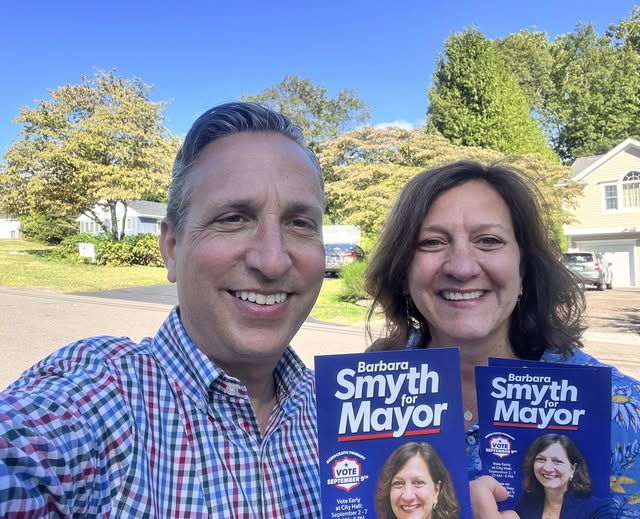
Barbara Smyth, Democratic nominee for Norwalk mayor, door-knocking with State Senate Majority Leader Bob Duff on September 8th, before the Democratic primary. Source: Bob Duff/Facebook
Table of Contents
Early Voting
Early Voting begins today, October 20th, for local municipal elections. This offers registered voters two weeks to cast ballots for local mayors, selectmen, council members, and board of education members ahead of Election Day. Election day will be on November 4th.
The times of Early Voting are listed below:
Mon Oct 20th to Mon Oct 27th, Oct 29th, Oct 31st to Nov 2nd – 10:00am to 6:00pm
Tuesday Oct 28th, Thursday Oct 30th – 8:00am to 8:00pm
Election Day – Nov 4th – 6:00am to 8:00pm
Early voting locations can be found here. Each town has one designated location for early voting.
Voter registration is offered at early voting sites, and absentee ballots can be requested by visiting myvote.ct.gov/getmyab.
Overview
Though I cannot cover all elections taking place on November 4th, I would love to dive into elections in the state’s six largest cities.
I will have another article later in the week discussing some competitive races across the state.
By population, the state’s largest cities are Bridgeport, Stamford, New Haven, Hartford, Waterbury, and Norwalk.
It is important to note that not every city or town has a mayoral race this year. In those cities, we will talk about council races and other local races if applicable.
Let’s dive in!
Bridgeport
Longtime incumbent Democrat Joe Ganim is not up for re-election this year. Ganim ran in four separate elections in 2023-24 to claim another term after his initial Democratic primary win was marked with ballot irregularities in a race that garnered national attention.
Secretary of State Stephanie Thomas launched a special advertising blitz to remind city residents how to properly cast their ballots. This is an effort to not have another election marked by allegations of ballot fraud. 13 Individuals have been charged in connection with the misuse of mail-in ballots in the last two mayoral elections. Thomas wants voters to know the legal rules of returning absentee ballots.
There are races this year for the positions of Board of Education, City Sheriff, and Councilmen.
There are also two charter revision questions. Question 1 asks voters to approve a charter amendment to strengthen ethics, reform civil service, and establish uniform standards for departments and boards. Question 2 asks voters to discontinue the election of the positions of Town Clerk, City Clerk, and Municipal Sheriffs by 2031, after which they will be filled by a non-partisan civil service selection process.
Board of Education
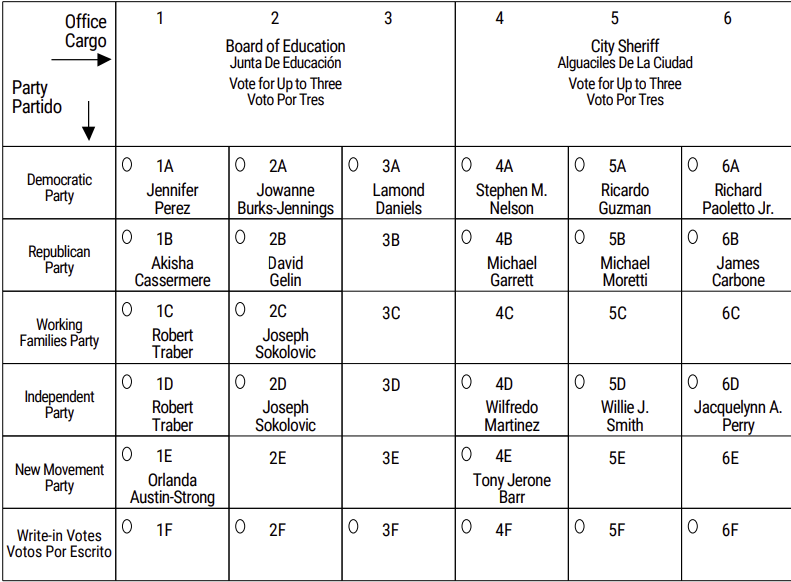
Bridgeport 2025 Ballot for Board of Education and City Sheriff. Source: Secretary of State
Bridgeport is a very Democratic city. Kamala Harris won here 73-26 last year. However, unlike some other towns, Independents have gotten a decent portion of the vote across all races, running ahead of the Republican ticket.
Mayoral challenger John Gomes was about 200 votes short of Joe Ganim on their election day bout as an independent. The Independent candidates for city sheriff got more votes than the Republicans also in 2023. Independents all got about 3,000 votes, while Republicans got around 1800 votes. The result was similar on the Board of Education.
This year, incumbents Joseph Sokolovic and Robert Traber are running on both the Independent and Working Families ballot lines.
Chair Jennifer Perez will run as a Democrat. She was named chair last year after former chairperson Christine Baptiste-Perez faced criticism and lost a vote. She was supported by Traber and Sokolovic, along with two other members. Democrats are basically a lock for the three majority seats available this election.
The two minority seats will be between the Republicans and incumbents Sokolovic and Traber. Joe Sokolovic won on the Working Families line 4 years ago, and Independent Willie Medina won 2 years ago. As seen in the 2023 results, Republicans have been lagging behind Independents for the last two seats. This year will be another test, but Sokolobic and Traber are likely favored.
Councilmen
Democrats are heavily favored in all council districts. Though they are independents running in some districts, they will struggle despite the controversies with some incumbent council members. Of the 13 individuals charged with the absentee ballot investigation, this includes incumbents Alfredo Castillo and Maria Pererira. Despite this, Pereria won her primary in September, and both have continued to win re-election despite their controversies and the ongoing investigation.
Stamford
Mayor
Incumbent Democrat Mayor Caroline Simmons is running for a second term. She faces Republican former Board of Education member Nicola Tarzia. Simmons will also be on the Independent Ballot line.
Simmons won a difficult 2021 campaign against Independent former MLB manager Bobby Valentine. After successfully primarying Incumbent Mayor David Martin in a landslide 63-36 victory. Simmons won a close 53-47 victory against Valentine in the general election.
Simmons and her faction have won multiple battles on issues ranging from charter revisions to city committee primaries. She and her allies were also able to oust two local state representatives who disagreed with them. In the recent Democratic primaries, Simmons endorsed allies all won their primaries, as she has successfully installed her allies in all committees across the town through multiple primary elections.
At a recent debate, Simmons and Tarzia both said they were interested in developing the South End of the city. A question on the train station in the south end, Simmons talked about continuing parking opportunities and rezoning land around the station to create new housing. Tarzia mentioned how he said there should also have been more amenities around the station.
Tarzia, a former member of the board of education for a decade (from 2000 to 2004, and 2016 to 2022), told the CT Examiner how the city’s government is a monopoly dominated by Democrats, and due to that, the party dominance has meant the city government isn’t improving. He hopes to bring ‘balance’ and bring other voices into the mayoral-appointed committees.
Since this is a typical party-line race, unlike her 2021 race, Simmons is expected to easily beat Tarzia in this 63-36 Harris-won city. Pavia had optimism he could win in an upset, in his interview with the examiner. The last Republican to win the mayoral office in Stamford was Michael Pavia in 2009, who served for one term.
Boards/Town Clerk/Constable
There are several other races on the ballot in Stamford. This includes the Town Clerk, Board of Finance, Board of Education, Constable, and Board of Representatives.
Democrats are favored in the races for Town Clerk, Board of Finance, Board of Education, and Constables.
For the Board of Representatives, some districts are closer than others. In 2023, District 18 had a 7-vote margin of victory for Democrat Karen Camporeale against Republican Stephen Garst.
In 2021, there was a close race in District 17 where Democrat Bobby Pavia beat Republican Maria Fedeli 52-48, showing how it really depends on the district.
New Haven
Mayor
In New Haven, Democratic Incumbent mayor Justin Elicker is running fourth term against Republican challenger Steve Orosco.
Elicker will also be on the Working Families Ballot Line. Orosco will also be on the Independent Party Line.
This was the first time in his tenure that Elicker did not face a Democratic opponent in a primary.
At their September 30th debate, Elicker and Orosco discussed topics ranging from crime to affordable housing to federal government intervention.
Orosco said he intends to improve crime statistics by fulling staffing and funding the police department. He said, “Everything is a band-aid, we are not attacking the root of the problem,” while discussing why more police enforcement is needed. Orosco also discussed making sure Yale is accountable to pay more taxes. Elikcer said Yale has been accountable.
Elicker talked about the city’s ongoing effort to increase affordable housing.
On discussions about ICE, the two candidates varied. Orosco said he believes ICE activity will be a non-issue after recent changes on enforcement, and said he would accept help from the National Guard if needed. Elicker said ICE is not welcome to the city, and help from the National Guard is not needed or wanted.
Elicker is heavily favored to win a fourth term in one of the most liberal cities in the state. Kamala Harris won New Haven in an 81-17 landslide last year. The last time a Republican was elected mayor of New Haven was in 1953. Elicker has also never gotten less than 70% of the vote in his last three mayoral races.
Alderperson/City Clerk/Board of Education
Democrats are heavily favored to hold all of their seats. Republicans don’t hold any seats on the 30-member board of Alders.
Republicans are also only running candidates in Ward 3, Ward 8, Ward 12, Ward 13, Ward 18, and Ward 30.
The reddest Ward in New Haven is the 18th, but even the 18th Ward was 59-41 for Kamala Harris. This will likely be the most competitive race of the Alderperson races due to partisan lean, but Moore is expected to win. Zelma Harris, who lost to Moore in the September 9th primary, is on the ballot as a petitioning candidate.
An Independent is running in Ward 16, Rafael Funtes Jr.
There is a race for City Clerk between Democrat Michael Smart and Republican Deborah Reyes-Quinones. Smart is also on the Independent ballot line.
There is also a race for the Board of Education District 1 between Democrat Edward T Joyner and Republican John Carlson.
Democrats are favored in both races.
Hartford
Board of Education
There is only one race on the ballot in the state’s capital city. Hartford Mayor Arunan Arunanpalam won a 4-year term in 2023, so he won’t be on the ballot this year along with the rest of the council.
In the Board of Education race, the four candidates running are Democrats Francoise Deristel-Leger, Cristher Estrada-Perez, Tyrone Walker, and Working Families Candidate Shonta Browdy.
Voters can vote for up to 3 candidates, but since there are 3 majority seats and 1 minority seat, all four candidates will win. No Republicans filed for this office.
Waterbury
Democratic Incumbents Michael Dalton and Stephen Conway are both running unopposed for the positions of City Clerk and City Sheriff.
Incumbent Democratic Mayor Paul Perenerswki won’t be on the ballot this year, as he secured a four-year term in 2023.
Board of Aldermen/Board of Education
After a contentious primary on the Republican side, where seven of the ten endorsed Republican candidates prevailed over primary opponents, Republicans hoped to unite in the hope of making gains on the Board of Aldermen.
The current make-up of the fifteen-seat board is Democrats hold ten seats, Republicans hold three, an independent holds one, and an unaffiliated voter holds the last one.
In District 4, Republican incumbent George Noujaim and his running mate Paul Konas won their primary after not getting the Republican endorsement. Noujaim did not receive the endorsement of the Republican Town Committee because he was seen as “too cozy” with the Democratic majority. The 3rd challenger that will be on the ballot is Brian McEntree in the 5th district.
Though GOP chair of Waterbury, Dawn Maiorano, is hopeful to make gains on the boards, the issue is that Waterbury voters haven’t elected a Republican mayor or a Republican Board of Aldermen majority is the last 25 years. Republicans, though, see an opportunity since 4 Democratic incumbents on the Board of Aldermen, and 2 on the Board of Education, are not running again
In 2023, Democrats did the best in District 2 and District 5, winning by large margins. The margin in District 3 was smaller, but comfortable. Republicans did well in District 1 and District 4. The closest races will likely be in those two districts. 4 candidates are running in each district (Five in District 2), and the top 3 will win a seat on the board.
On the Board of Education, five seats are up for grabs. Six candidates are running: three Democrats and three Republicans. The top five of the six candidates will win a seat on the Board of Education.
Norwalk
Mayor
The marquee race on the ballot in Norwalk is the open-mayoral race being vacated by Democrat Harry Rilling, who is retiring. Democrat Barbara Smyth is facing off against Republican Vinny Scicchitano.
Common Council President Smyth won a tough Democratic primary against Common Council member Darlele Young by a mere 75-vote margin. She will also be on the Working Families ballot line.
Petitioning Candidates John Kydes and Erik Vitagilone will also be on the ballot. Kydes is a former council president.
At a recent debate with the four candidates, they shared their visions of the city’s future. Smyth noted how her experience in both the classroom (as a former teacher) and in city government gives her a unique perspective to understand the city’s needs. Scicchitano said he is there to represent the 40% of the community who feel like they are disenfranchised from the process. He said he was the most qualified to unify the community.
Vitaglione said he is there to represent the households that make less than $75,000 a year, the renters who are cost-burdened, and the residents who haven’t participated in city politics before. Kydes said he joined the race because he felt the city is going down the wrong path, and his experience is necessary.
They all cited affordability, education, and taxes among the city’s challenges. However, they had different approaches to some of the issues. On affordable housing, Vitaglione called for a more diverse array of “housing stock”. Kydes questioned how the new developments affect schools and affordability. Smyth proposed a housing consortium, Scicchitano said the city needs to define its goals before expanding any further.
Norwalk’s Democratic delegation endorsed Smyth for mayor, including State Senate Majority Leader Bob Duff.
Though Norwalk is also very blue at the federal level, voting for Kamala Harris by a 64-35 margin. In the 2023 mayoral race, Rilling won a 55-45 victory over Scicchitano. Since Scicchitano is running a second time, he might benefit from name recognition among voters. Smyth is still favored, but the mix of petitioning candidates along with a strong challenge from Scicchitano could lead to a closer race than expected.
Ballot Questions and Other Offices
Norwalk has a long two-page ballot this year. There are several races, including City Sheriff, Councilmen-At Large, Councilman, Board of Education, Constable, Taxing District Commissioner, and Treasurer.
The one race without much anticipation is for Incumbent Town Clerk Richard McQuaid. McQuaid is on both the Democratic and Republican ballot lines after being cross-endorsed, so he will be victorious on election day.
For the Councillmen and Board of Education, there is a slate of Independent candidates running. Though this could make the margins between Democrats and Republicans more competitive, during the 2023 race, however, the Independent candidates only got about 1% of the vote, far behind the other two parties on the ballot.
A district-by-district guide can be found here from the Publication Nancy on Norwalk.
There are also three ballot questions this year. There seems to be a movement in some cities to move elections to 4-year terms instead of two. This passed in New Haven last year, and some other towns also have these questions on their ballots. Question 2 will create a four-year term for Mayor and Town Clerk in 2029, and the Council in 2031. Another change on Question 3 will amend the charter to provide council members with compensation of 3% of the mayor’s budgeted salary from 2029.
Question 1 on the Charter Change is longer and includes a couple of changes, so I will put the text here below.
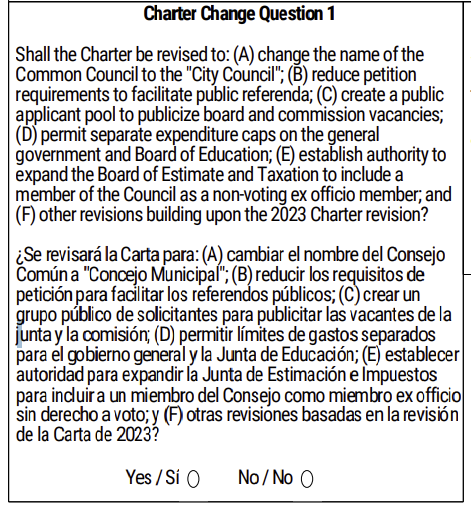
Democrats are favored in most races in Norwalk, though it will be interesting to see how the petitioning candidates do in the mayoral race.
Thanks for Reading!