The Ultimate Guide for Connecticut Legislative Primaries
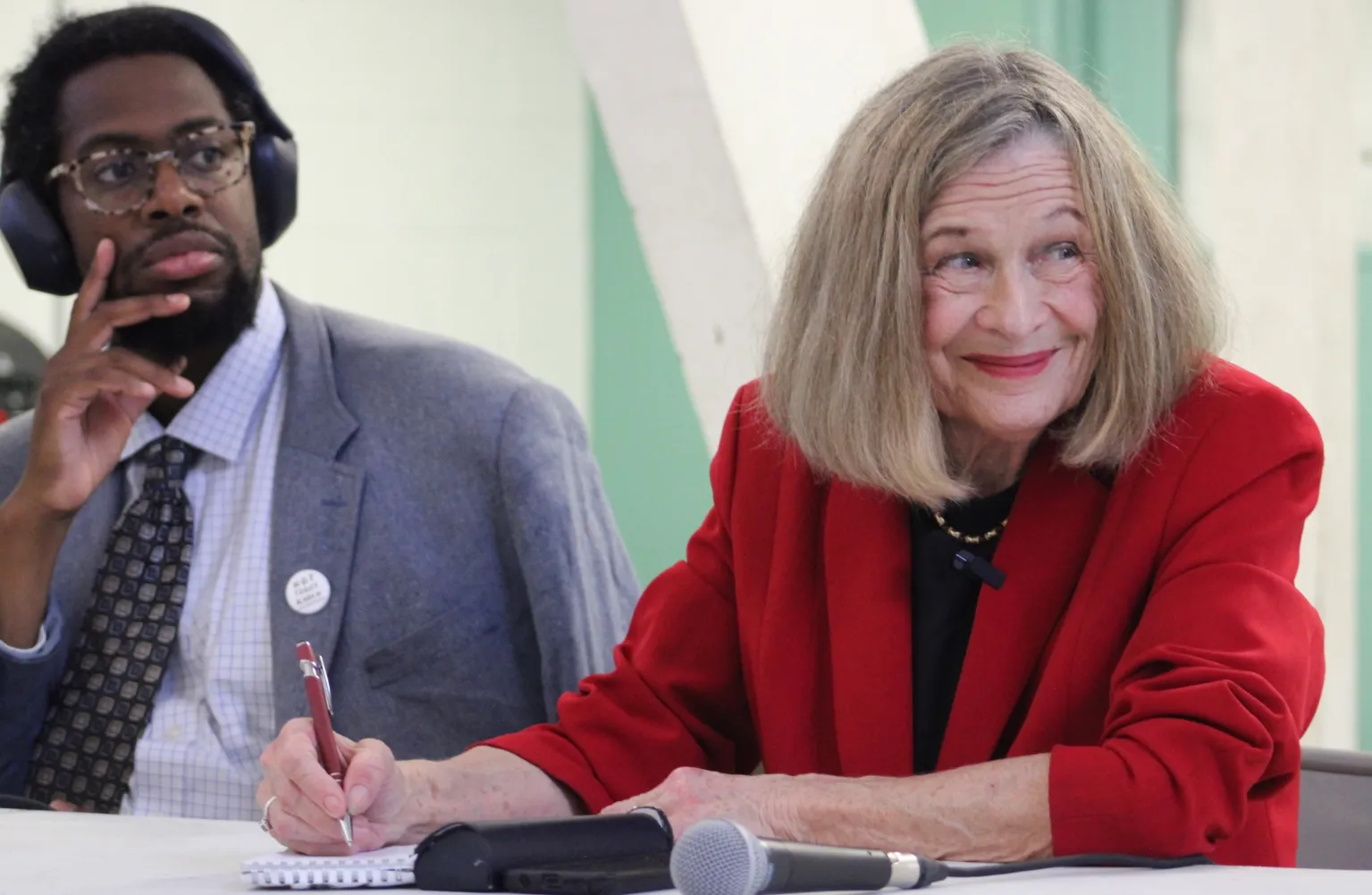
State Rep. Pat Dillon (right) at a debate in the Coogan Pavilion on July 28th, 2026, with one of her two opponents, Justin Farmer (left). Credit to Paul Bass | New Haven Independent
Overview
Welcome to the CT Election Guide’s August 11th Ultimate Primary Guide.
In Part 2 of the guide, I will cover primaries in the state legislature. Read Part 1 if you are interested in the primaries for Governor and Congress.
There are a number of primaries to cover.
I will also give a rating for each race and a prediction of who I think will emerge victorious on the 11th. There are several competitive races on the ballot, so expect some fascinating results.
Let’s get started!
Voting Information
Per state rules, Connecticut is a closed primary state. This means only registered voters of that party can vote in a primary election on August 11th. In Connecticut, a plurality of voters are registered unaffiliated (about 42.2% as of 2025); that proportion of state voters will be unable to vote in the election. However, unaffiliated voters have until August 10th at noon to register with a party, if they plan to vote on primary day.
If a voter wants to switch parties to vote in a primary (From Democratic to Republican, or vice versa), they had to do so by May 11th. If a voter wanted to vote during early voting and they are unaffiliated, they had until July 31st at Noon. A new voter can file a voter application in person with the registrar of voters in their town by noon on the business day prior to the day they want to vote.
In Connecticut, only contested primaries take place on the ballot. If a race is uncontested, there is no primary in that district. Due to a Democratic primary for Governor, every registered Democrat in the state can vote in the primary.
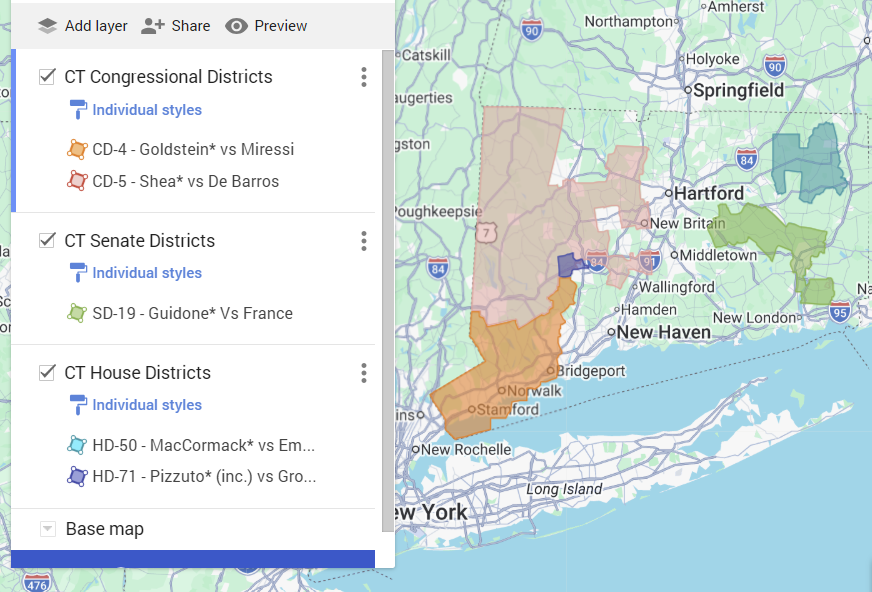
There are no statewide primaries for Republicans, as all statewide offices were decided at the May Convention, and no challengers met the requirements or attempted to force a primary. There are primaries in some congressional districts and legislative seats. If you’re a Registered Republican looking to vote, you can use this map to see if you live within the district boundaries. There are primaries in the 4th and 5th Congressional Districts, the 19th State Senate Seat, and the 50th and 71st State House Seats.
Early voting is available for this election. Early voting takes place from August 3rd to August 9th. Extended voting hours will take place on the 4th and 6th.
Monday, August 3rd – 10:00 am to 6:00 pm
Tuesday, August 4th – 8:00 am to 8:00 pm
Wednesday, August 5th – 10:00 am to 6:00 pm
Thursday, August 6th – 8:00 am to 8:00 pm
Friday, August 7th – 10:00 am to 6:00 pm
Saturday, August 8th – 10:00 am to 6:00 pm
Sunday, August 9th – 10:00 am to 6:00 pm
Voters must vote in the assigned early voting location for their town of voter registration. The list of early voting locations can be found here. The majority of the early voting locations are in Town Hall, community centers, or the library.
Absentee ballots are also available for this election. One can request a ballot at the online portal here. Starting this cycle, after a 2024 voting referendum passed, voters no longer need to provide a specific excuse to vote in any election. Voters can request an absentee ballot for any reason. If voters need a paper application for an absentee ballot, use this link and scroll down to print a paper application. The deadline to request an absentee ballot is August 10th.
If you need to hand out an absentee ballot application to someone, please follow the state’s strict rules concerning this action. There are limits on who you can get an absentee ballot application for (immediate family), and the number of ballots you can request.
CT Election Guide Race Rating System
These ratings represent my assessment of each race based on available polling, fundraising, endorsements, campaign activity, geographic strengths, and the overall political environment. They are forecasts—not guarantees—and races can shift before Election Day.
- Solid – Expected margin of 15% or more
- Likely – Expected margin of 8–15%
- Lean – Expected margin of 3–8%
- Toss-Up – Expected margin of less than 3%
State Senate
2nd State Senate District – Democratic Primary
Incumbent: Doug McCrory (D)
Candidates: Sen. Doug McCrory (Inc.) vs Maryam Khan vs Ayana Taylor
Type of Primary: Incumbent vs Challenger
Background and Candidates
Incumbent State Sen. Doug McCrory (D-Hartford) faces two challengers for renomination in this deep blue District that contains parts of Hartford, Windsor, and Bloomfield for a sixth 2-year term. State Rep. Maryam Khan (D-Windsor) and Windsor Board of Education Chair Ayana Taylor. Khan won the party endorsement in May at the district convention and will be on Row A of the ballot. Taylor ran against McCrory in the 2024 primary, where she lost by a 32-60 margin.
McCrory, who has been a longtime state legislator, was first elected to the State House in 2004. He served for 11 years before winning a special election to the 2nd State Senate seat in 2017. Though he handily won his primary two years prior, McCrory has since found himself as the subject of a federal criminal investigation.
The grand jury investigated the millions of taxpayer dollars McCrory steered towards a non-profit in his district. An audit showed that McCrory directed how one of the nonprofit, Blue Hills Civic Association, spent the majority of the money allocated. He also told them not to tell the state about money stolen through a fraudulent wire transfer. McCrory was also investigated for the relationship he had with the leader of some of the nonprofits, Sonserae Cicero.
Khan and Taylor are running against McCrory due to his scandals. Khan said during the convention, “The district is ready for strong leadership and possibly new leadership, but regardless, leadership that’s not distracted.” Ayana Taylor has said her campaign is centered on integrity and trust. Both candidates have also brought their backgrounds as a campaign tool. Taylor as the chair of the Windsor Board of Education, and Khan as an “active educator, mother and focused leader”.
The three candidates are aligned on most major policy issues, though one notable exception is on school choice and education funding. McCrory advocates for school choice (charter, magnet, etc), while Khan remains firmly opposed. Taylor has expressed some skepticism on school choice, but supports quality alternatives.
Race Rating
Though Khan has the party endorsement, it’s not unprecedented for an incumbent to lose a party convention, but in Connecticut it is rare. A few incumbents have won without the party endorsement before. In 2024, in the 15th State House Seat (which overlaps with this district), State Rep. Bobby Gibson lost the party endorsement, but won his primary 70-30.
Though the FBI investigation has brought scrunity to McCrory, Khan and Taylor will be splitting the anti-McCrory vote. In addition, both Khan and Taylor are from Windsor, meaning they both will likely be splitting their home base. Taylor won Windsor in her 2024 matchup against McCrory, but got swamped by large margins in the Hartford and Bloomfield sections of the district.
Khan does have grassroots support and is one of the two primary candidates this cycle supported by CT DSA. However, i’m skeptical she can win over the large older black voter contingent in the district. Taylor has good name recognition from her previous run in the seat, but her base of support overlaps with Khan. At the end of the day, Khan and Taylor both will likely split the opposition vote, and will struggle in McCrory’s base of votes in Bloomfield and Hartford. So I give the edge to McCrory.
Race Rating: Likely McCrory
13th State Senate District – Democratic Primary
Incumbent: Jan Hochadel (D)
Candidates: Jack Fazzino vs Jim Jinks
Type of Primary: Open Seat
Background and Candidates
State Sen. Jan Hochadel announced her retirement late last year after only two terms in the State Senate. This district has had close races within single digits the last two cycles, though Democrats are expected to easily retain the seat this cycle. State Rep. Jonathan “Jack” Fazzino faces off against Cheshire Town Council member Jim Jinks. The district contains Meriden and parts of Cheshire, Middlefield, and Middletown.
Fazzino won the party endorsement in May. He currently represents the 83rd State House seat, which he first won a narrow victory in 2022 by a 50.6-49.4 margin. Fazzino works as an attorney. Jinks on the other hand works is marketing. He is presenting himself as more of an “outsider” looking to bring change to Hartford. Jinks was first elected to the Cheshire Town Council in 2019. Jinks ran for the State House in 2020 against Rep. Craig Fishbein in the 90th state house seat, where he lost by 7 votes out of over 14,000 votes casted.
Both candidates support raising taxes on the wealthy, protecting residents from aggressive ICE tactics, and state investment into education. Both are similar on most major policy issues, though broadly Jinks has placed himself to the left of Fazzino. Jinks is supporting progressive challenger Josh Elliott in the governor’s race, while Fazzino supports incumbent Governor Ned Lamont. Jinks argues that Fazzino is a “political insider” and is benefiting from outside PAC money. Fazzino says Jinks’ argument is “bad faith, desperate attack…” noting the outside group is spending with no knowledge from him, or coordination.
Fazzino is running on his record as a state legislator, including education funding for Meriden and Cheshire schools. Jinks focuses his platform on affordability, shared values and civil rights. Both have noted their success running in a region of the state that is more of a toss-up in federal and local races.
Race Rating
Both candidates will likely do well in their hometowns. Fazzino in Meriden, and Jinks will do well in Cheshire. Fazzino does have name recognition in Cheshire as his district contains part of the town. Meriden has the largest number of Democrats in the district, which will likely benefit Fazzino.
Jinks’ progressive challenge will have a fair amount of support. Jinks has the support of many town council members in Cheshire. Fazzino has a number of prominent endorsements with strong support from Middletown officials, including Middletown Mayor Gene Nocera, State Rep. Kai Belton and State Rep. Brandon Chafee. Fazzino also has the backing of the party endorsement, Working Families Party, and Connecticut AFL-CIO. In addition, statewide officials, Attorney General William Tong, Treasurer Erick Russell and Comptroller Sean Scanlon have backed Fazzino.
Though Jinks will have a good performance in Cheshire, Fazzino’s more establishment backing and prominent labor organizations will likely win out in an older Democratic electorate.
Race Rating: Solid Fazzino
19th State Senate District – Republican Primary
Incumbent: Catherine Osten (D)
Candidates: Jason Guidone vs Mike France
Type of Primary: Opposing Party Nomination
Background and Candidates
Incumbent Democrat State Sen. Catherine Osten has managed to comfortably hold this Harris +6 seat since 2012. She ran ahead of the national ticket, winning 57-43 in 2024. Osten is one of the more moderate Democrats in the State Legislature. The 19th State Senate represents Columbia, Franklin, Lebanon, Hebron, Ledyard, Lisbon, Marlborough, Norwich, Sprague, and part of Montville.
Osten is widely favored in the Fall, but two Republicans, Jason Guidone and Mike France, seek to deny Osten an 8th term in the State Senate.
Guidone was the 2024 Republican nominee and is making a second bid for the seat. He is a former ESPN executive who lives in Hebron. Guidone is running on a standard Republican platform of lowering costs, protecting taxpayers, backing police and public safety, and putting families first. He states on his website that he is “not a career politician”.
France was the 2022 and 2024 Republican nominee for the 2nd Congressional District. He lost both races by wide margins to Rep. Joe Courtney. France is a former State Representative who served from 2015 to 2023 in the 42nd State House seat. He spent two decades in the Navy, before working as an engineer at the Submarine base. France is running on reducing government spending, ensuring a skilled workforce for the defense industry, and telling “people the truth”.
France was originally running for the 2nd Congressional District for a third try, though he dropped out of the race citing internal discontent with local Republican leaders. He said one of the reasons he entered the race was he felt he had a better chance to win in November than Guidone due to his experience and resume. Guidone has focused his attacks on France’s record in the legislature.
Race Rating
With both candidates not having much of a difference on policy, this is a race more based on perceived electability. Guidone has the party endorsement and a large support of the delegate base. Guidone got 77% of convention delegates, and France’s falling out with some local GOP officials likely does not help.
However, France does have more name ID due to his runs for Congress. The question is if voters will run it back, or go with France. I expect it to be a win for Guidone due to local support.
Race Rating: Likely Guidone
State House
4th State House District – Democratic Primary
Incumbent: Julio Concepcion (D)
Candidates: Julio Concepcion (Inc.) vs Venice Sotomayor
Type of Primary: Incumbent vs Challenger
Candidates and Background
In this deep-blue Hartford-based seat, Democratic incumbent Julio Concepcion faces Chef Venice Sotomayor. Concepcion first won his seat in a special election in 2018 after Incumbent Rep. Angel Arce resigned from the seat due to scandal.
This was one of two primaries in the state affected by mistakes made by the Secretary of State’s office. The CT Supreme Court ruled that Sotomayor could be on the ballot after Concepcion sought to have her petitions thrown out due to an administrative error. The CT Supreme Court ruled that Sotomayor should not be blamed for a mistake made by election officials. It’s common in Connecticut for incumbents to try to challenge signature petitions to prevent primaries. Sotomayor’s lawyer Alex Taubes accused Concepcion of trying to prevent the election unfairly.
As far as the race goes, there has been almost no coverage whatsoever. Concepcion does not have a campaign website or seem to be actively campaigning. Sotomayor has been running her campaign mostly on Facebook. She is running a challenge broadly on change and shaking up the status quo. Many of her posts lack much detail, and all her videos are just images with music of nothing specific. In one of her posts, she does list a few issues she’s running on; Real solutions, supporting business in underserved neighborhoods, affordable rentals/housing stability, and ensuring people don’t have to pick between their health and fresh food.
Race Rating
Sotomayor has a picture of Rep. John Larson holding one of her mailers, and has a graphic that Larson stands with her campaign. Though not the most formal of endorsements (and nothing says Larson explicitly endorsed Sotomayor), the reason for any involvement from Larson could be the fact that Concepcion endorsed Bronin over Larson in the congressional primary.
With a district with one of the lowest turnout rates in the state and a lack of active campaigning from Concepcion, Sotomayor could get a surprise upset. However, as the incumbent with the party endorsement, and Sotomayor relatively unknown, Concepcion remains favored.
Race Rating: Solid Concepcion
10th State House District – Democratic Primary
Incumbent: Henry Genga (D)
Candidates: Angie Parkinson vs Tyron Harris
Type of Primary: Open Seat
Background and Candidates
Longtime Incumbent Henry Genga decided to retire after 20 years in office. Genga is currently the oldest member of the State Legislature. He leaves behind a deep-blue Open Harris +38 seat based in East Hartford.
Two candidates face off, Angie Parkinson and Tyron Harris. Parkinson is an East Hartford Town Councilor, who also spent 25 years teaching social studies. Harris serves as the chair of the East Hartford Board of Education. He also serves as the town’s Human Resources Director.
Parkinson is running on healthcare for all, affordability, protecting/strengthening public education, tax fairness, fair wages, and protecting rights and democracy. Harris lists his campaign priorities as lowering the cost of living, strong public schools, affordable healthcare, prosperity/good jobs, and safe/united communities.
Race Rating
Parkinson won the party endorsement in the district. She also has the endorsements of Connecticut Working Families Party, AFL-CIO, American Federation of Teachers (AFT), and Building Trades.
Harris has the endorsement of East Hartford Mayor Connor Martin. Both candidates are prominent and are elected officials. Parkinson has a slight edge due to institutional support, but Harris should not be underestimated, holding the mayor’s endorsement. This race will likely be very close.
Race Rating: Lean Parkinson
31st State House District – Democratic Primary
Incumbent: Jill Barry (D)
Candidates: Moise “Moses” Carelus vs Anthony DiLizia
Type of Primary: Open Democratic Nomination, Incumbent running in Fall as Independent
Background and Candidates
Now why the long type of primary description. It’s a bit complicated. Out of nowhere, moderate Democrat State Rep. Jill Barry lost her party convention for her district by a large margin to Moses Carelus. Barry, who is one of the most conservative Democrats in the caucus, has found herself on the wrong side of progressives in her Glastonbury district who quietly saw her as vulnerable, as the district has shifted rapidly to the left in the Trump era. Barry’s voting with Republicans on a gun-safety measure, voting against the state budget, against paid family and medical leave, among other priorities, made her vulnerable.
Barry was caught off guard at the convention; as a single-town district, the party endorsement was open for any Democrat in the 31st State House Seat to cast a delegate vote. Organization took place behind the scenes without much attention, as to not alert Barry. We’ll cover more of this later, but Barry is cross-endorsed by Republicans, running as an Independent in the Fall after electing not to run in the primary, and has been on the campaign trail with Republican nominee for Governor Ryan Fazio in a Harris +25 seat.
With Barry not running in the primary, and Carelus holding the party endorsement, Glastonbury Town Councilor Anthony DiLizia decided to petition to jump into the race. DiLizia, an Army veteran, also serves as the executive director of a healthcare non-profit that delivers affirming/compassionate healthcare for the LGBTQIA+ community. Carelus, a former teacher and soccer coach, was recruited by a coalition of Democrats unhappy with Barry.
Carelus’ priorities include funding public education, affordability, holding Eversource accountable, and supporting Glastonbury’s future/standing up for Glastonbury’s values. DiLizia’s priorities include protecting CT from Trump’s policies, delivering lower costs, funding schools, supporting seniors, defending women’s rights, and fighting for affordable healthcare.
Race Rating
Though Carelus has the party endorsement and the early start to the campaign. DiLizia is well-known as an elected official, and petitioning indicates a level of baseline support. Also the convention was with a small group of voters, meaning that DiLizia might have a larger name ID than Carelus. However, due to Carelus’ early start, I would give the edge to him in this race, but DiLizia will make this a close race.
Race Rating: Likely Carelus
50th State House District – Republican Primary
Incumbent: Pat Boyd (D)
Candidates: Jadon MacCormack vs Anthony “Tony” Emilio
Type of Primary: Opposing Party Nomination
Background and Candidates
The most competitive general election district on the docket tonight with a primary. Incumbent Democrat Rep. Pat Boyd was unopposed last cycle in this seat based in Eastern Connecticut that Kamala Harris carried by a narrow 50-48 margin. Republicans were hoping to put a good nominee in this competitive seat.
This seat has garnered the most attention of any legislative primary in the state, for all the wrong reasons. Republicans at the district party convention nominated religious podcaster and political newcomer Jadon MacCormack as their nominee. Republicans did not do much vetting of MacCormack, so when MacCormack started posting about “Happy Straight Month” and calls for an “anti-pride month”, attention came to his previous posts. One of which included sharing an image of a noose in reaction to a gay marriage story, along with other horrid views such as saying women should not hold political power, and questioning the Holocaust death toll.
After the posts came out, Republicans immediately condemned MacCormack for his comments and told him to withdraw from the race. Unfortunately for them, MacCormack seemed to be enjoying the attention and stood by his “biblical beliefs. He went onto the radio show, WTIC News/Talk 1080’s “Reese on the Radio” program, where he called for the government to put people to death who are “sodomites”, a comment that got national attention.
With MacCormack refusing to withdraw, and spending his time blasting Republican leaders for condemning him. Republicans scrambled to find a candidate to put on the ballot with days left until the petition deadline. Pomfret Businessman Anthony Emilio joined the race in light of MacCormack’s comments, saying “That’s not who our party is, and so I think it’s important that he – that someone runs against him and he loses.”Emilio, with efforts from the local and state GOP, rapidly gathered the signatures needed before the deadline. Emilio wants to focus on other issues. He said he wants the focus to be on Republican efforts to shrink government.
Race Rating
Republicans are in an awkward position, as MacCormack is the endorsed candidate on the ballot. With attention on the race in June and July, the hope for the GOP is that enough attention was put onto the race that Republicans voting in the primary know not to vote for MacCormack. The quick scramble, and Emilio having basically every Republican in the district, state Republican, and neighboring Republican state Reps and Senators’ endorsement should be enough to put him well ahead of MacCormack. Republicans do not want to be associated with MacCormack in any fashion, and having him as a general election candidate would not help.
Race Rating: Solid Emilio
71st State House District – Republican Primary
Incumbent: William Pizzuto (R)
Candidates: William “Bill” Pizzuto (Inc) vs Michael Grosso
Type of Primary: Incumbent vs Challenger
Background and Candidates
Rep. Bill Pizzuto (R-Middlebury) is the only Republican incumbent facing a challenge in the Legislature today. Pizzuto, who first won his seat in a 2022 special election, faces Waterbury Alderman Michael Grosso. The district contains all of Middlebury and part of Waterbury.
Pizzuto has won the last two general elections of this seat uncontested in a seat Donald Trump won 54-45. Pizzuto is a retired administrator who worked at UConn. Grosso, who is his first term as a Waterbury Alderman, is a driver groundsman and equipment operator.
Grosso has gone after Pizzuto for putting language in a bill that blocked a major warehouse development in Waterbury instead of letting local officials decide on the next steps for the project. He is running to ensure that local officials and residents have more say over projects instead of state officials. Grosso is also running on rejecting the status quo.
Grosso is running on lower taxes, more accountability, and economic growth. Pizzuto’s campaign platform also calls for fighting for lower property taxes, driving down energy prices, holding the line on spending, and backing emergency responders.
Race Rating
This should be an interesting race. I am unsure how much Republican primary voters have been focused on the warehouse project, or how they perceive Pizzuto’s reasons for blocking it. But local issues can be very salient in primaries such as this one.
Due to holding the party endorsement and being the incumbent , I give the edge to Pizzuto, though it’ll be interesting to see how each candidate performs in their hometown.
Race Rating: Likely Pizzuto
92nd State House District – Democratic Primary
Incumbent: Pat Dillon (D)
Candidates: Pat Dillon (Inc) vs Eli Sabin vs Justin Farmer
Type of Primary: Incumbent vs Challengers
Background and Candidates
Longtime State Rep. Pat Dillon faces two challengers in former New Haven Alder Eli Sabin and former Hamden Legislative Council Member Justin Farmer.
Dillon is the longest-serving House member seeking reelection this cycle. Dillon was first elected all the way back in 1984, when Ronald Reagan was on the ballot for a second term. 57 votes were all that separated Dillon from her first bid for the seat in 1982 against Republican incumbent Rep. Rosalind Berman. She later beat Berman in a rematch in 1984 by a 52-48 margin.
No Republican was able to recreate Berman’s unique coalition, as Dillon would win 80-20 in 1986 and never face a close race. The district is one of the most Democratic in the state, voting for Kamala Harris by a massive 84-13 margin. Dillon faced a primary once in her 42-year tenure before this year, in 2010 when she beat Sergio Rodriguez by a comfortable 66-34 margin.
Dillon, who is 77, faces primary challengers that are decades younger than her. Eli Sabin, 26, a former Alder who resigned in January to launch his campaign. He moved to Westville to establish residency. He represented Ward 1 (which contains Yale University) and Ward 7 (Downtown and East Rock) during his 6 years on the board. The district contains part of Ward 3, and Wards 23, 24, 25, 26. Sabin is running on generational change, casting his campaign as about “new energy” needed in the party.
Farmer, 32, a former three-term Hamden city councilmember, is a founding member of Connecticut DSA. He is one of two primary candidates backed by CT DSA this cycle (Maryam Khan is the other). He works as an environmental consultant. Farmer also casts his challenge on generational change with “different takes on what kinds of new leaders will emerge“.
Candidates agree on major issues, though Farmer positions himself to both Sabin and Dillon’s left as a DSA member. All three candidates are progressives who said they will push back against the Trump administration. Candidates are also running on affordability concerns and efforts to rein ICE.
Dillon is running on her record and ability to bring funding to the district, while Sabin and Farmer argue that the current political environment demands change.
Race Rating
With three candidates running, this will divide the vote up quite a bit. I believe that Sabin and Farmer will divide the anti-Dillon vote, leading Dillon to win with a large plurality or close to 50% of the vote. Neither Sabin or Farmer have been running to minimize the other candidate, so both will bring their bases to the polls. Farmer’s support from the DSA, for example, will give him a solid floor in the race.
Pat Dillon has the endorsements of the local Democratic Party with the party endorsement, its town chair, unions, advocacy groups, and a large number of elected officials. Sabin has the endorsements of a number of ward committee members but more notably New Haven Mayor Justin Elicker.
Due to Sabin and Farmer splitting the opposition vote, I expect Dillon to win somewhat comfortably tonight.
Race Rating: Likely Dillon
97th State House District – Democratic Primary
Incumbent: Al Paolillo
Candidates: Leland Moore vs Wildaliz Bermudez
Type of Primary: Open Seat
Background and Candidates
After Longtime State Sen. Martin Looney announced his retirement, it set off a quick game of musical chairs. Incumbent State Rep. Al Paolillo was Looney’s chosen successor. Paolillo faced no challenge for the seat. Paolillo left his State House seat, where two candidates quickly jumped into the race: Morris Cove Alder Leland Moore and Executive Director of New Haven Fair Rent Commission Wildaliz Bermúdez.
Moore, only five months into his first term as Alder, found himself running for a newly open State Representative seat. He won the Ward 18 Alder seat in a Democratic primary by a wide margin last year before easily winning the general election. Moore works as Assistant Attorney General, working under Attorney General William Tong. He has previously worked as a legislative advisor for the Board of Pardons and Paroles and as a staff attorney for the Connecticut Sentencing Commission.
Wildaliz Bermúdez is a former member of the Hartford City Council, where she was elected as part of the Working Families Party. She was on the council for 6 years before resigning to move to New Haven. On the council, she, along with other Working Families members, tried to move the council far left of center on issues such as immigration, tenant rights, police reform, and accountability. As Director of the Fair Rent Commission, Bermúdez operates the system behind the commission, from mediation of conflicts to investigation to educating city residents.
Both Moore and Bermúdez have similar policy positions on major issues. In a radio interview, both agreed on a number of goals such as more local education aid, higher marginal taxes on millionaires, ditching a $45 million+ plan for a pool, reconsidering Yale’s special state-given tax breaks if they cave to the Trump administration, and that the state should pursue stricter regulation of private utilities. Both praised each other’s work in the community during the interview.
Race Rating
Moore won the party endorsement earlier this year. He also has the endorsement of President Pro Tempore of the Sen. Martin Looney and current Rep. Al Paolillo. Moore has also received support from CT AFL-CIO and AFT Connecticut. Moore also recieed the endorsement of his boss, Attorney General William Tong.
Bermúdez has the support of New Haven Mayor Justin Elicker. Notably, the second candidate Elicker has backed, who doesn’t have the party endorsement. Bermúndz also has the support of Former State Rep. Bob Megan and Former Mayor Toni Harp.
Moore seems to have consolidated establishment support and union support, but the endorsement of Elicker is notable for Bermúdez. I believe Moore is favored, but Bermúdez will keep this a competitive race.
Race Rating: Likely Moore
118th State House District – Democratic Primary
Incumbent: Frank Smith (D)
Candidates: Toni Lombardi vs Chris Saley
Type of Primary: Open Seat
Background and Candidates
Incumbent State Rep. Frank Smith is retiring after three terms in the State House. Smith’s departure in this Milford-based district allowed two Democrats to jump into this open seat: Milford Alderwoman Toni Lombardi and Milford Director of Public Works Chris Saley.
Both candidates’ platforms touch upon similar issues. Lombardi’s platform emphasises public education, tackling the cost of living, and focusing on coastal resiliency, specifically investment in flood mitigation and infrastructure improvements that protect Milford’s shoreline. Saley owns the Bridgewater Restaurant and owns a local real estate development company. His platform focuses on supporting small businesses and encouraging local economic growth, strong schools, affordability, and protecting Milford’s 17+ miles of beaches from chronic erosion (beach resiliency).
Race Rating
Lombardi has the party endorsement. She also has the support of the CT Working Families Party, AFL-CIO, and American Federation of Teachers. Saley has the support of retiring State Rep. Frank Smith
Lombardi’s institutional support should be enough to get her a win here, but Saley could come close with Smith’s endorsement.
Race Rating: Likely Lombardi
Conclusion
Candidates with the party endorsement are still widely favored in Connecticut primaries. Tonight will be a good test to see how much that holds up. Party endorsements in CT lead to wide institutional support from elected officials and labor unions. However, many challengers have chances for upsets tonight, but the focus will likely be on the Democratic incumbents in SD-2 and HD-92, while also seeing what happens in HD-50. There are not too many ideological primaries on the docket, but an opportunity in some districts for change will be watched.
As always, these ratings are forecasts based on the information available before Election Day—not guarantees. I’ll be following the results as they come in tonight and will revisit these predictions afterward to evaluate what I got right, what I got wrong, and what the outcomes reveal about Connecticut politics.
Thanks for Reading!
Follow me on Twitter for Connecticut Politics Updates and Live Election Analysis – https://x.com/ctelectionguide
If you have a question, tip, corrections, or want to contact me for any reason. Please email contact@ctelectionguide.com
The Ultimate Primary Guide for Connecticut Primaries Part 1
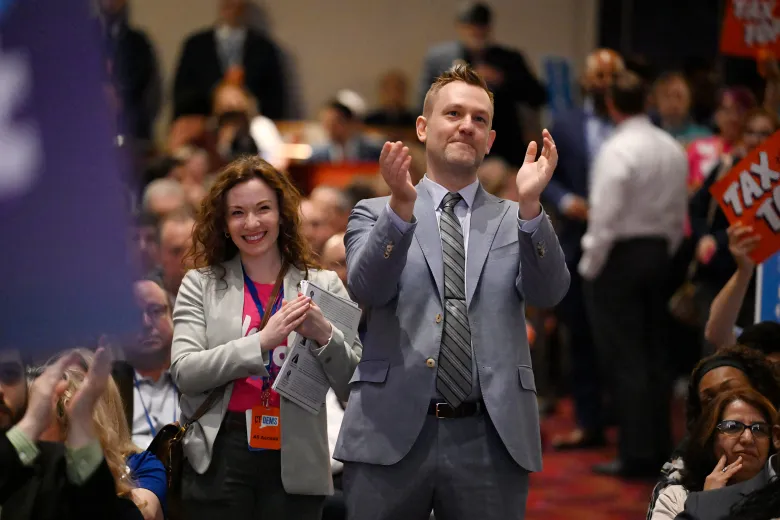
Rep. Josh Elliott celebrates at the state Democratic Convention, Saturday, May 16, 2026, in Hartford, Conn. Credit to: Jessica Hill / CT Mirror
Overview
Welcome to the CT Election Guide’s August 11th Ultimate Primary Guide.
In Part 1 of the guide, I will cover statewide and congressional primaries. In Part 2, I will cover primaries in the state legislature.
There are four primaries to cover. We will start with the Democratic primaries for Governor and the 1st Congressional Distrct. Governor Ned Lamont and Rep. John Larson face challengers for renomination. Than we will cover two Republican primaries where Republican challengers hope to challenge Democratic incumbents in the 4th and 5th Congressional Districts
I will also give a rating for each race and a prediction of who I think will emerge victorious on the 11th. There are several competitive races on the ballot, so expect some fascinating results.
Let’s get started!
Voting Information
Per state rules, Connecticut is a closed primary state. This means only registered voters of that party can vote in a primary election on August 11th. In Connecticut, a plurality of voters are registered unaffiliated (about 42.2% as of 2025); that proportion of state voters will be unable to vote in the election. However, unaffiliated voters have until August 10th at noon to register with a party, if they plan to vote on primary day.
If a voter wants to switch parties to vote in a primary (From Democratic to Republican, or vice versa), they had to do so by May 11th. If a voter wanted to vote during early voting and they are unaffiliated, they had until July 31st at Noon. A new voter can file a voter application in person with the registrar of voters in their town by noon on the business day prior to the day they want to vote.
In Connecticut, only contested primaries take place on the ballot. If a race is uncontested, there is no primary in that district. Due to a Democratic primary for Governor, every registered Democrat in the state can vote in the primary.
There are no statewide primaries for Republicans, as all statewide offices were decided at the May Convention, and no challengers met the requirements or attempted to force a primary. There are primaries in some congressional districts and legislative seats. If you’re a Registered Republican looking to vote, you can use this map to see if you live within the district boundaries. There are primaries in the 4th and 5th Congressional Districts, the 19th State Senate Seat, and the 50th and 71st State House Seats.
Early voting is available for this election. Early voting takes place from August 3rd to August 9th. Extended voting hours will take place on the 4th and 6th.
Monday, August 3rd – 10:00 am to 6:00 pm
Tuesday, August 4th – 8:00 am to 8:00 pm
Wednesday, August 5th – 10:00 am to 6:00 pm
Thursday, August 6th – 8:00 am to 8:00 pm
Friday, August 7th – 10:00 am to 6:00 pm
Saturday, August 8th – 10:00 am to 6:00 pm
Sunday, August 9th – 10:00 am to 6:00 pm
Voters must vote in the assigned early voting location for their town of voter registration. The list of early voting locations can be found here. The majority of the early voting locations are in Town Hall, community centers, or the library.
Absentee ballots are also available for this election. One can request a ballot at the online portal here. Starting this cycle, after a 2024 voting referendum passed, voters no longer need to provide a specific excuse to vote in any election. Voters can request an absentee ballot for any reason. If voters need a paper application for an absentee ballot, use this link and scroll down to print a paper application. The deadline to request an absentee ballot is August 10th.
If you need to hand out an absentee ballot application to someone, please follow the state’s strict rules concerning this action. There are limits on who you can get an absentee ballot application for (immediate family), and the number of ballots you can request.
CT Election Guide Race Rating System
These ratings represent my assessment of each race based on available polling, fundraising, endorsements, campaign activity, geographic strengths, and the overall political environment. They are forecasts—not guarantees—and races can shift before Election Day.
- Solid – Expected margin of 15% or more
- Likely – Expected margin of 8–15%
- Lean – Expected margin of 3–8%
- Toss-Up – Expected margin of less than 3%
Statewide Primaries
Governor – Democratic Primary
Incumbent: Ned Lamont
Candidates: Gov. Ned Lamont (Inc.) vs State Rep. Josh Elliott
Type of Primary: Incumbent vs Challenger
2022 Election Result: Lamont +13 – Ned Lamont (D) – 56.0%, Bob Stefanowski (R) – 43.0%
2024 Presidential Results: Harris +14.5 – Kamala Harris (D) – 56.4%, Donald Trump (R) – 41.9%
2026 General Election Rating: Solid D
Background
On March 13th, 2006, a wealthy businessman from Greenwich, Ned Lamont, launched a primary campaign to challenge sitting Senator Joe Lieberman for his seat in the U.S Senate. Lieberman was heavily criticized for his support of the war in Iraq and his close relationship with President Bush at the time. This challenge would start the beginning of Ned Lamont’s prominent place in Connecticut politics.
Lamont’s candidacy at the time became more of a single-issue primary against the War, and Lamont was able to seize the progressive energy of the 2006 cycle, culminating in an upset win over Lieberman in the primary. He later lost the general election that November. Lamont was able to grasp the state’s progressive flank; his challenge to the left of Lieberman was notable in a state that rarely saw contested primaries against incumbents.
Now, two decades later, Lamont, the two-term governor, is attempting a third four-year term in this solidly Democratic state. Lamont now finds himself as part of the “establishment” facing the irony of being challenged to his left by State Rep. Josh Elliott (D-Hamden). The first primary against an incumbent Governor since 1978.
Who is Josh Elliott?
State Rep. Josh Elliott first came into the legislature after winning a seat in the legislature in 2016. Elliott holds a BA from Ithaca College and received a JD from Quinnipiac School of Law. He entered the race before House Speaker Brendan Sharkey announced his retirement. Elliott’s campaign says he is the reason he pushed Sharkey into retirement, which is prominently claimed on his website, though Sharkey disagrees with that assertion in strong terms.
Elliott is a founder of the Progressive caucus in the legislature, which has slowly grown over the last few cycles. Elliott has played a large role in supporting economic and labor protections. Two of the bills he sponsored were for Paid Family & Medical Leave and for Paid Sick Days. He has pushed for Connecticut to be the first state to remove the cost for incarcerated individuals to make phone calls to loved ones. He currently serves as Deputy Speaker and Majority Caucus Co-Chair.
This is not Josh Elliott’s first attempt at higher office. In 2022, Elliott ran for the open Secretary of State race. It did not go so well for him. He was the only candidate who failed to qualify for the ballot at the convention. Elliott was also running to maintain his seat in the legislature during that race. He bowed out, electing not to gather signatures to petition, and ran for re-election to his state house seat. Candidates returning to their state legislative seats around convention time when they don’t do well is common in Connecticut.
However, during Elliott’s second attempt for higher office. Elliott is simultaneously running for both his State House Seat (88th District) and the Governor’s Race. Elliott was noncommittal about his run for governor for most of the cycle. He at one point said he would only challenge Lamont only if he won the party endorsement at the convention, saying he didn’t want to run a Line B candidacy. Earlier this year, however, Elliott decided that he spent so much time on his campaign that he has to see it all the way. He also did not risk losing his House seat, something Elliott said is important to him to help make change in the state.
Elliott successfully raised the $335,000 needed to qualify for public financing. This qualified him for $3.75 million grant. He got the money about 5 weeks before the August primary, leaving him a quick turnaround to get his message on the airwaves. Though he was allowed to run for both his State House seat and Governor at the same time, he could not spend any of his grant money on his State House seat. To avoid any issues with campaign finance rules, Elliott hasn’t even formed a campaign committee for his State House Race, as he plans to spend no money. Elliott doesn’t face any Democratic opposition in the primary and was nominated for another term at the convention for his seat. Though he faces a Republican opponent, Elliott’s 88th State House Seat is one Kamala Harris won 70-28, so he doesn’t need to spend much of anything in the general.
Campaign Issues
Elliott’s campaign has been defined by anger towards Lamont’s refusal to tax the rich more. Progressive anger towards the Governor also increased when Lamont vetoed two bills during the 2025 legislative session. One on affordable housing, and another on benefits for striking workers. Elliott’s vowed that the Governor would face a challenge after those vetoes, and eventually he became the candidate to challenge the Governor. Lamont did pass a version of the affordable housing bill later in 2025, though some argue the bill wasn’t as strong as the initial one. Though many agreed it was still beneficial. Lamont did not pass the bill for striking workers.
Elliott has proposed a similar millionaire tax to Massachusetts, though at it’s core Elliott hopes for a “fair tax structure” that taxes those who make $1 million annually. Elliott also does not support the state’s fiscal guardrails, enacted in 2017 to force the state to pay down pension debt. He believes it should be changed to allow easier investments for infrastructure, investment, and housing. Elliott has also proposed less reliance on local property taxes.
One of Elliott’s more aggressive proposals is to take on Eversource by allowing towns to individually own their utility infrastructure. To allow a public option that can allow municipalities cheaper rates, or for towns to form or join electric utilities in an effort to cut Eversource’s power away. The governor has argued that this proposal will cost tens of billions of dollars that the state does not have.
Elliott has also attacked the Governor in more personal terms, saying “his campaign is where good ideas go to die”. He also has advertisements on air attacking Lamont’s wealth and how his family has been rich for generations. Due to his personal wealth, Elliott says Lamont cannot understand the state’s affordability. He also heavily critiqued the governor for taking credit for policies passed by the legislature, saying the Governor didn’t actually do anything. “That’s what a billionaire does. They take other people’s ideas and say ‘Well, this was his all along.’” Elliott said. He also called the Governor “dangerously naive” during the debate, and said Lamont’s campaign is the “Temu version” of his. Elliott did attack Lamont as a billionaire a few times, though the very wealthy Ned Lamont is not known as a billionaire specifically.
Ned Lamont spent the majority of the cycle ignoring Josh Elliott, trying to avoid pushing attention to his challenger. However, Elliott slowly gained some momentum and qualified for a primary with 25% of convention delegates. Lamont has had to be more on the defensive end.
The Governor has touted his accomplishments during his tenure as Governor, including a minimum wage increase, actions to replace SNAP benefits, and investments in early childhood education. The governor has also emphasized fiscal responsibility as he has focused on paying off the state’s heavy pension debt. Lamont, in the last few weeks, has ramped up his attacks on Elliott, specifically at the debate, dismissing Elliott as someone full of sound bites and no accomplishments. In the final week of the campaign, Lamont has started to go more negative on Elliott, attacking him for missed votes during his campaign.
Race Rating
Nationally, primary season this cycle shows there is an energy in the Democratic Party for more progressive policy and overall change. In addition, any person running for a third governor term is likely to face some level of opposition for “overstaying their welcome”. I believe this race will be closer than many people expect.
Governor Lamont is favored in this race. I see him winning by around 20 points. I do believe Elliott will win Hamden and likely New Haven. He will maintain steady support around the state, with a few pockets of winning towns. It’ll be interesting to see how Elliott does in the Farmington Valley, with a lot of upper-middle-class Democratic voters showing more progressive bona fides; Elliott may be able to get some strong performances in towns like West Hartford, Glastonbury, Farmington, and Avon. Connecticut hasn’t had too many primaries with a clear “establishment vs progressive” battle. The closest was the 2018 Lt Gov Democratic primary between former Secretary of State Susan Bysiewicz and labor organizer Eva Zimmerman. Bysiewicz won 62-38, but Zimmerman was commended for a great performance against a longtime statewide figure. I think Elliott will have a similar performance and pattern: outright winning a few towns, but holding a steady 35%-40% in a majority of towns.
Lamont holds very strong support from the legislature, though a few members of the progressive caucus back Elliott, including State Rep. Jillian Gilchrest and State Rep. Laurie Sweet. This is the only race with a substantial amount of recent polling (for a Connecticut race at least). The latest poll from Impact CT had Lamont leading Elliott 48-21. A decrease for Lamont, who led their earlier poll 58-20, but notably didn’t show much of an increase for Elliott. Many voters are undecided, and I suspect many of those voters will go to Elliott.
The governor does have a few things in his favor; all polling indicates a stark age divide. Elliott does very well with younger voters; Lamont dominates with older voters. The latter come out at much higher rates in late summer primaries. In addition, Lamont still remains popular with Democratic primary voters overall, holding a 63% favorable, 20% unfavorable rating in the same poll.
Most polling has shown Lamont in the 48-55% range, though Elliott has steadily risen from 7% in the first UNH poll in November to 23% in the one from Late June. Lamont led 53-23 in that poll. A final poll from Sacred Heart University/WFSB/CT Insider showed Lamont with a massive 57-22 margin over Elliott.
Lamont is heavily favored, but don’t count out a strong performance from Josh Elliott. An outright win would break CT politics, but stranger things have happened.
Race Rating: Solid Lamont
Prediction: Lamont +20 (Lamont 60%, Elliott 40%)
Congressional Primaries
1st Congressional District – Democratic Primary
Incumbent: John Larson
Candidates: Rep. John Larson (Inc.) vs Luke Bronin vs Jillian Gilchrest vs Ruth Fortune
Type of Primary: Incumbent vs Challengers
2024 General Election Result: Larson +28.3 – John Larson (D) – 63.1%, Jim Griffin(R) – 34.8%
2024 Presidential Results: Harris +22.9 – Kamala Harris (D) – 60.6%, Donald Trump (R) – 37.7%
2026 General Election Rating: Solid D
Background
For the first time in modern state history, an Incumbent member of the U.S. House of Representatives faces a battle for renomination. Connecticut was the last state to adopt legally regulated primaries, which passed in the legislature in 1955. However, this method only allowed a challenge based on convention delegates, not signatures. In 2003, the General Assembly ruled that candidates can petition their way onto the ballot if they fail to meet the convention delegate threshold.
Rep. John Larson of East Hartford has had nothing much to worry about electorally after he won his primary in 1998 in an open seat by a close 46-42 margin against Secretary of State Miles Rapoport. A primary challenger has never made the ballot against Larson, though former Capitol Hill Staffer Muad Hrezi made a solid attempt in 2022. He fundraised over $500,000, but did not gather enough delegates or signatures to make the ballot.
Larson, a mainstay of Connecticut politics, has held top positions in the House of Representatives during his nearly three-decade-long tenure, including a stint as the Chair of the House Democratic Caucus from 2009 to 2013. His main issue has been Social Security, an issue he has worked hard to promote with his landmark bill Social Security 2100 Act.
The congressman now faces three challengers looking to deny him a 15th term in Congress.
Candidates
Larson’s most prominent challenger is Former Hartford Mayor Luke Bronin. Bronin, who was the mayor of the capital city from 2016 to 2024, won his 2015 Democratic primary by knocking out the incumbent Mayor Pedro Segarra by a 55-45 margin. He easily won his 2015 and 2019 mayoral races in a deep-blue city.
Bronin is known for his high-profile background. A BA and JD from Yale University, Rhodes Scholar, a deployment in Afghanistan where he worked on the US Military Anti-Corruption task force. He was Deputy Assistant Secretary of Terrorist Financing and Financial Crimes at the US Department of the Treasury during the Obama Administration. Before launching his mayoral campaign, he served as Chief Legal Counsel to Governor Dannel Malloy.
Larson’s other opponents include State Rep. Jillian Gilchrest (D-West Hartford) and Hartford Board of Education member Ruth Fortune.
Jillian Gilchrest entered the political scene in 2018 after she ousted 12-term incumbent State Rep. Andy Fleischmann in a Democratic Primary in a 52-48 victory. Gilchrest is known as one of the most progressive members in the Connecticut Legislature, championing reproductive freedom and establishing Connecticut’s paid family and medical leave program. Before she entered state politics, she worked in women’s health, safety, and social justice organizations in leadership and advocacy roles. She also has previously served on the West Hartford Board of Education and works as an adjunct faculty member at the University of Saint Joseph and the University of Hartford.
Ruth Fortune was the first person to enter the race to challenge Larson. Appointed to the Hartford Board of Education in 2024, she came to the United States from Haiti as a young undocumented immigrant. She testified in favor of financial aid for undocumented students before the General Assembly in 2016. Fortune, a graduate of UConn School of Law, is an associate at Wiggin & Dana. She specializes as a trust and estate lawyer.
Campaign
John Larson thought Luke Bronin was kidding when he told him he was planning to run for his congressional seat. Bronin told Larson to reconsider seeking a term at his age. Larson told him that he would run for another term. The formerly close allies have headed towards a brutal primary.
The race didn’t receive a ton of attention until Bronin upset Larson at the convention for the party endorsement. After Larson’s allies maneuvered to ensure Jillian Gilchrest made the ballot with 15% of delegates, an effort to hopefully split the challenger vote, Bronin took a lead in the second round in a room with about 400 delegates and won the party endorsement 52-48 over Larson. This meant that Bronin would appear on top of the ballot in the primary. Challengers are sorted alphabetically, which meant Larson would appear at the bottom.
Fortune had to take the difficult path and gather signatures to qualify for the ballot as she did not receive enough delegates. She successfully did, and made history as the first person to successfully petition onto the ballot against an incumbent member of Congress.
In a race where candidates agreed on the majority of issues, the campaign focused on the few differences they had in policy. Overall, the candidates are all progressives, though Gilchrest and Fortune are to the left of Bronin and Larson.
Campaign fundraising emerged as a main issue in the primary. Larson has attacked Bronin for being a “corporate moderate” candidate of the billionaires, saying Bronin is there to their bidding. Bronin fought back, saying he is progressive, saying he wants to tax the rich and abolish ICE, attacking Larson for also taking donations from billionaires, and saying he’s not there to do anyone’s bidding. Bronin has attacked Larson for fundraising with PACs money, which is about half of Larson’s fundraising. With Larson and Bronin dominating fundraising, Gilchrest has attacked both of them for having big money in politics, saying she is the only candidate working to get “big money out of politics”.
Though Larson argued for months that his challengers weren’t different from him on policy, running on his experience and his leadership on Social Security. He has changed his argument to position Bronin to the right of him, saying he’s the true progressive. His initial argument led Bronin to focus his bid on a generational argument for change, as Bronin hasn’t staked out any major issue different from Larson’s record. Bronin says in his ads that John Larson is a good man, but “I’m running for Congress right now because I think we’ve got to bring a whole different type of energy to this fight…” Bronin says in one of his ads.
Race Rating
Gilchrest and Fortune have struggled to fundraise in this race. Both have raised $160,000 and $105,000 respectively over the course of their campaigns. Though admirable, both have focused on grassroots efforts and talking to voters. The issue is they’ve been drowned out by the $3,000,000 fundraising of Bronin, and $2,700,000 fundraising of Larson, leaving this race as between two candidates.
Larson has the endorsements of the federal delegation and House Minority Leader Hakeem Jeffries. He has focused on his labor support, touting endorsements from Labor, Trade, Planned Parenthood, Etc. Larson also holds many endorsements from his hometown of East Hartford and from multiple state legislative members.
Bronin did get a national endorsement from former South Bend Mayor Pete Buttigieg. In Connecticut, Bronin has received local endorsements from several elected officials in Hartford, including Mayor Arunan Arunanpalam and Council President TJ Clarke. Bronin has also received endorsements from Newington Mayor Jon Trister, Rocky Hill Mayor Allan Smith, Cromwell Mayor James Demetriades, and Wethersfield Mayor Ken Lesser.
Gilchrest has received a number of endorsements in the State Legislature, including a group endorsement signed by 18 of her female legislative colleagues. Gilchrest also holds endorsements from progressive groups such as Indivisible CT and Citizens Impeachment.
My expectations for the primary are a narrow win for Larson. I 100% believe a Bronin upset is possible. Larson, however, has an edge due to the opposition vote being split between three candidates. There were only two polls in the race. One was a Larson internal from January (Larson 49-26), and one was a VoteVets poll (an organization that supports Bronin) that had Bronin leading Larson (Bronin 38-30), but both are months old. Although private polls have shown Bronin with a lead, nothing has been publicly released in months. One thing Bronin has going for him is that, unlike the Governor’s race, the VoteVets poll had him doing well with both older and younger voters, indicating, unlike Elliott, he doesn’t need to rely on younger voters for victory.
Larson will get a large margin out of East Hartford. Bronin will likely win Hartford. The question is how the rest of the 27-town district will go. West Hartford is a bit of a toss-up as Gilchrest will get a fair amount of the vote in her hometown. Larson will do well in towns like Bristol with a large working-class population. The more rural towns in the northern part of the district will likely favor Larson, though Bronin has been making a play there as well. Middletown is a toss-up with a mix of both progressive university voters (Wesleyan) and working-class voters. Expectations from polling are that Ruth Fortune will get about 5% of the vote, and Jillian Gilchrest will get about 10% of the vote.
Overall, this appears to be a highly competitive primary between Larson and Bronin. Larson enters Election Day with a slight advantage due to his established political network and the likelihood that the anti-Larson vote remains divided among multiple candidates. However, Bronin’s fundraising, endorsements, and reported private polling suggest an upset would not be surprising. The race is likely to be decided by turnout and the margins in the larger towns in the district (away from the candidates’ bases), including West Hartford, Middletown, Manchester, Windsor and Bristol.
Race Rating: Lean Larson
Prediction: Larson +3 (Larson 45%, Bronin 42%, Gilchrest 9%, Fortune 4%)
4th Congressional District – Republican Primary
Incumbent: Jim Himes (D)
Candidates: Michael Goldstein vs Daniel Miressi
Type of Primary: Opposition Party Nomination
2024 General Election Result: Himes +23.8 – Jim Himes (D) – 61.1%, Michael Goldstein (R) – 37.3%
2024 Presidential Results: Harris +23.4 – Kamala Harris (D) – 60.9%, Donald Trump (R) – 37.5%
2026 General Election Rating: Solid D
Candidates
Michael Goldstein, a physician and attorney from Greenwich, faces Daniel Miressi, a hockey coach and former professional hockey player, for the right to take on Democratic Rep. Jim Himes in the 4th Congressional District in November. No Republican has won the district since former Rep. Chris Shays won the district in 2006. Himes would unseat Shays in 2008.
Goldstein was the 2024 Republican nominee in the District. He also ran for the nomination in 2020 and 2022. In 2020, he did not qualify for the primary after forming a campaign committee. In 2022, Goldstein lost the Republican primary to party-endorsed Jayme Stevenson by a 40-60 margin. Goldstein has the party endorsement for the second time in a row.
Miressi qualified for the primary at the party convention. Miressi considered running in the district in 2024, but ultimately did not. He was also the Republican nominee for the 25th State Senate against Connecticut State Senate Majority Leader Bob Duff in 2022. He lost the general election 35-61 to Duff
On his campaign website, Goldstein emphasizes his experience as both a doctor and lawyer to pinpoint issues residents face. He also proposes the Goldstein Plan on issues he supports and opposes. Some of these include restoring the SALT deduction, ending cashless bail, focusing on parental rights, unwavering support for Israel, securing our borders, and protecting the Second Amendment.
On his campaign website, Miressi first explains that Republicans are the “big tent party” in Connecticut. His campaign platform is Family, Community, and Economy. He says Himes has forgotten what it means to be a “Nutmegger”. He says he will fight to lower the cost of living, parental rights, and will focus on election integrity and trust, while focusing on accountability in Washington.
Race Rating
Due to two recent primaries in this district, we do actually have some information on how a primary could go. Goldstein is favored due to the party endorsement and name ID from repeated runs in the seat. Goldstein’s primary victory in 2024 was supported by winning 79% of the vote in Greenwich, which made the margin of difference in the race.
It should be noted that turnout has been very low in recent primaries in the seat. Low-profile primaries in a Safe Democratic district likely contributed to low turnout. Only 16,517 ballots were cast in the 2022 Republican primary, and only 8,025 ballots were cast in the 2024 Republican primary. This could lead to an unexpected result.
Neither candidate has raised much money. Goldstein has raised 21k, and taken a 25k loan, and Miressi has raised 10k. Goldstein’s numerous runs may lead voters to want a different alternative, especially as this is his fourth run for this office. Despite having the party endorsement in 2024, Goldstein only won 54-46. Due to this, Miressi may have a chance at an upset, but Goldstein is favored.
Race Rating: Likely Goldstein
5th Congressional District – Republican Primary
Incumbent: Jahana Hayes (D)
Candidates: Chris Shea vs Jonathan De Barros
Type of Primary: Opposition Party Nomination
2024 General Election Result: Hayes +6.8 – Jahana Hayes (D) – 53.4%, George Logan (R) – 46.6%
2024 Presidential Results: Harris +6.2– Kamala Harris (D) – 52.0%, Donald Trump (R) – 46.4%
2026 General Election Rating: Solid D
Candidates
Chris Shea, a firefighter and retired Navy Seal, faces community leader Jonathan De Barros for the right to take on Rep. Jahana Hayes in Connecticut’s most competitive congressional seat. After almost unseating Hayes in 2022, the CT GOP spends most of their limited resources in the 5th District.
Chris Shea is the preferred candidate by the CT GOP. He has fundraised far more than any other Republican congressional candidate in the state, raising $311,000 this cycle. He did raise about the same amount of money as Rep. Hayes in Q1 this year, 163k to 166k. Shea founded the organization Hero to Hero, a nonprofit that encourages military veterans to consider second careers as first responders. Since retiring from his military career, Shea works as a firefighter lieutenant at the North Haven Fire Department. His military career started when he joined the US Navy in 1991. His time in service included operational tours with deployments and various joint special operations in Sarajevo, Afghanistan, and Mexico.
Jonathan De Barros is the founder of the Phoenix Youth Foundation, a nonprofit that works to mentor at-risk youth, promote vocational training, and teaching conflict resolution. De Barros has received attention for his role in the shooting and killing a young man in October 1996. De Barros was convicted of murder, attempted murder, and assault with a firearm. In 2000, the Connecticut Appellate Court overturned his original murder conviction, ruling that a trial judge blocked critical evidence supporting De Barros’s claim of self-defense in the shooting.
His manslaughter charge went to trial again, but ended in a hung jury. De Barros eventually accepted a plea bargain under the Alford Doctrine, which stated he could maintain his innocence, but the state had enough evidence to potentially convict him. The Connecticut Board of Pardons and Paroles issued De Barros an absolute pardon in 2022. De Barros says he was wrongfully incarcerated for 19 years due to flawed prosecution and maintains his self-defense view.
De Barros filed a defamation suit during his campaign against four supporters of Shea for allegedly calling him a “murderer”. Shea is not a defendant in the suit. The suit seeks a gag order to stop the four defendants from repeating statements about him being a murderer. De Barros says the supporters said those statements on Facebook Live broadcasts, social media, and during the Republican nominating convention.
Campaign Issues and Race Rating
Both Shea and De Barros align themselves as conservative Republicans. De Barros calls himself a “MAGA patriot”. De Barros has heavily critiqued other Republicans in the state. Last year, the Capitol Police investigated him for social media posts about Republican State Chair Ben Proto, Senate Minority Leader Stephen Harding, and Sen. Rob Sampson, but the Capitol Police determined nothing De Barros said was a threat.
Shea’s campaign website shows issues focusing on protecting families. Specifically, stopping illegal immigration and “standing against woke ideologies that threaten our children’s future”. He also emphasizes lowering the cost of living by reducing the tax burden and promoting practical housing solutions. He also says America should stand with Israel, advocates for American military strength, and will fight to improve the VA.
De Barros stakes out similar positions on immigration, dedicating effort to keep borders secure. He does add more specific positions, adding that any governor or elected official who obstructs immigration and customs enforcement should be removed from office and arrested by Homeland Security. He also takes positions on improving the VA and wants to enact laws that would prevent bills in Connecticut that allow parents not to be informed. De Barros promotes charter schools as an alternative to a failing education system. He stakes out his plans as a “New Reconstruction for the 5th district,” akin to the Reconstruction after the Civil War to rebuild trust in institutions.
Shea is favored here on Tuesday. His strong support from local officials and strong fundraising should give him a solid victory. However, similar to the 4th Congressional District, turnout will be low, so an upset isn’t impossible depending on who can get their base out.
It’s unknown how the defamation lawsuit will play out with voters. It is one of the few things in this primary that has broken into the news cycle. De Barros may be able to generate some excitement among his base supporters. Also, with Shea being stronger with party support, De Barros may be able to generate an “Establishment” vs “Outsider” message, which can be effective in a Republican primary where many primary voters are unhappy with the state party leaders for continued losses in the state.
De Barros has to use more of a grassroots approach, having fundraised only $25,000 this cycle, about 1/12 of Shea’s haul. The money Shea has will likely allow him to get his name more in front of voters. Shea’s profile is also appealing for a district close to the federal level that may attract voters.
Race Rating: Solid Shea
Summary
Connecticut’s August 11th primaries offer a snapshot of where both parties head going into the general election. Notably for Democrats, the Governor’s race will test the strength of the party’s progressive wing against an incumbent who remains broadly popular. The 1st Congressional District could produce one of the most watched contests of the night. Luke Bronin can truly upset Rep. John Larson, but structural advantages remain for both incumbents. If Bronin wins, it would create a shock for incumbents across the country, as Congressman Larson has faced no scandals or a prominent reason to be out of office. In addition, this is not a race that has faced an ideological argument for change. Races on generational change on its own rarely take out incumbents.
Primaries for prominent offices in Connecticut are a rare occasion, and against incumbents is almost unheard of. An incumbent Governor hasn’t faced a primary since 1978. An incumbent member of the House in Connecticut has never faced a primary at all. It’s no secret that we are in a political environment where we may see more primaries in Connecticut’s future.
Low-turnout primaries in the 4th and 5th Congressional Districts could lead to unexpected results, and upsets have been common in recent Connecticut Republican primaries. Whether these contests reaffirm the political status quo or signal shifting coalitions within Connecticut’s parties, the results will provide valuable insight into the state’s political landscape heading into November.
As always, these ratings are forecasts based on the information available before Election Day—not guarantees. I’ll be following the results as they come in on August 11 and will revisit these predictions afterward to evaluate what I got right, what I got wrong, and what the outcomes reveal about Connecticut politics. Stay tuned for Part 2, where we cover legislative primaries.
Thanks for Reading!
Follow me on Twitter for Connecticut Politics Updates and Live Election Analysis – https://x.com/ctelectionguide
If you have a question, tip, corrections, or want to contact me for any reason. Please email contact@ctelectionguide.com

Connecticut 2025 Elections in Review, with a Competitive Look at 2026
Norwich Mayor Swarnjit Singh was sworn in on Dec. 2 by CT Lt. Governor Susan Bysiewicz, alongside his family and Gov Ned Lamont. Source: Norwich Bulletin
2025 Elections Nationally in Review
It’s the last day of the year; therefore, everyone likes to reminisce on what happened in the past year. Election-wise, it was another crazy year. The year started with President Donald Trump being inaugurated as the country’s 47th President in a political comeback. Nationally and statewide, Republicans were jubilant at the gains they made across many minority communities and younger voters. Democrats struggled to figure out how Trump made his political comeback, with a lot of soul-searching … and pointing blame on their political misfortune.
By the end of the year, Trump’s approval rating had dropped to 36% (Gallup), and Republicans across the country and in Connecticut could feel it. Democrats have dominated numerous special elections. According to the election publication, The Downballot‘s 2025 Big Board, Democrats have overperformed the 2024 Presidential Results by 13.9 points across 65 races ranging from the State Legislature to Congress.
In November, Democrats saw hope. Zohran Mamdani won the mayorship in New York City, giving progressives a new voice on the national stage. Democrats Abigail Spanberger and Mikie Sherrill won dominantly in their gubernatorial victories in New Jersey and Virginia last month. Spanberger won by over 15 points against Republican Lt. Gov Winsome Sears. Sherrill, despite narrowing polls, won by an unexpectedly large 14-point margin against former State Assemblyman and 2021 Republican Nominee Jack Ciattarelli.
Things can change quickly in one year. Not uncommon in politics, but you never know which trends will stay and which political trends will disappear within a political cycle. Politics is fairly cyclical; it’s up to the opposition to use it to their advantage, especially at a time when voters are unhappy.
2025 Elections in CT
Connecticut Democrats had an amazing 2025 cycle. Democrats flipped the top office and control in 29 towns across the state. Numbers came from CT Mirror and CT Secretary of State Website. Notable wins for Democrats include
- Democrat Swarnjit Singh won 59-41 over Republican Stacy Gould for Norwich Mayor. Swarnjit also became the first Sikh mayor in Connecticut.
- Democrat Laurie Bursten won in an upset 52-48 against Republican incumbent Lori Spielman in the First Selectman race in Ellington.
- Democrat Bobby Sanchez won 58-40 against Republican Sharon Beloin-Saavedra in the New Britain Mayor Race. Sanchez flipped the seat for Democrats for the first time in 12 years.
- Democrat Rich Smith won against Republican incumbent Tony Giannattasio 55-45 in the Milford Mayoral Race.
- Democrat David Chess knocked out two-term Republican incumbent Laura Hoydick 55-45 in the Stratford Mayoral Race. Though Kamala Harris won by 19 points in 2024 in Stratford, Hoydick won by 26 points in 2021. Hoydick seems to have lost from Democrats not crossing over this year, unlike her previous victories.
- Democratic challenger Bruce Walczak knocked out Republican incumbent Jeff Capeci in Newtown’s First Selectman race. Walczak won 56-44.
- Former Mayor Democrat Ellen Zoppo-Sassu narrowly won back her seat against Republican incumbent Jeffrey Caggiano 50.5-49.5 in Bristol.
Republicans, despite a lot of losses, held some important races and flipped a mayoral race in one town.
- Republican incumbent mayor Vincent Cervoni won over Democratic challenger Alida Cella 58-42 in the Wallingford Mayoral Race
- Republican Molly Spino beat Democrat Stephen Ivain 54-46 in the open Torrington Mayoral Race.
- Incumbent Republican First Selectman Fred Camillo comfortably wins over Democratic challenger Anthony Moor 56-44 in Greenwich.
- Republican Dan Lent won over Democrat Nicholas D’Addario in a 50.1-49.9 squeaker for First Selectman in Easton. The lone Democrat to Republican flip of the night.
These are just some of the examples of wins from both Democrats and Republicans.
Many officials and reporters described the 2025 local races as a “blue wave”. Democrats did better than their most optimistic predictions. A big trend was the decline in split-ticket voting, as many Republican incumbents won by 10-20 points in previous races in 2021 and 2023, only to lose in 2025.
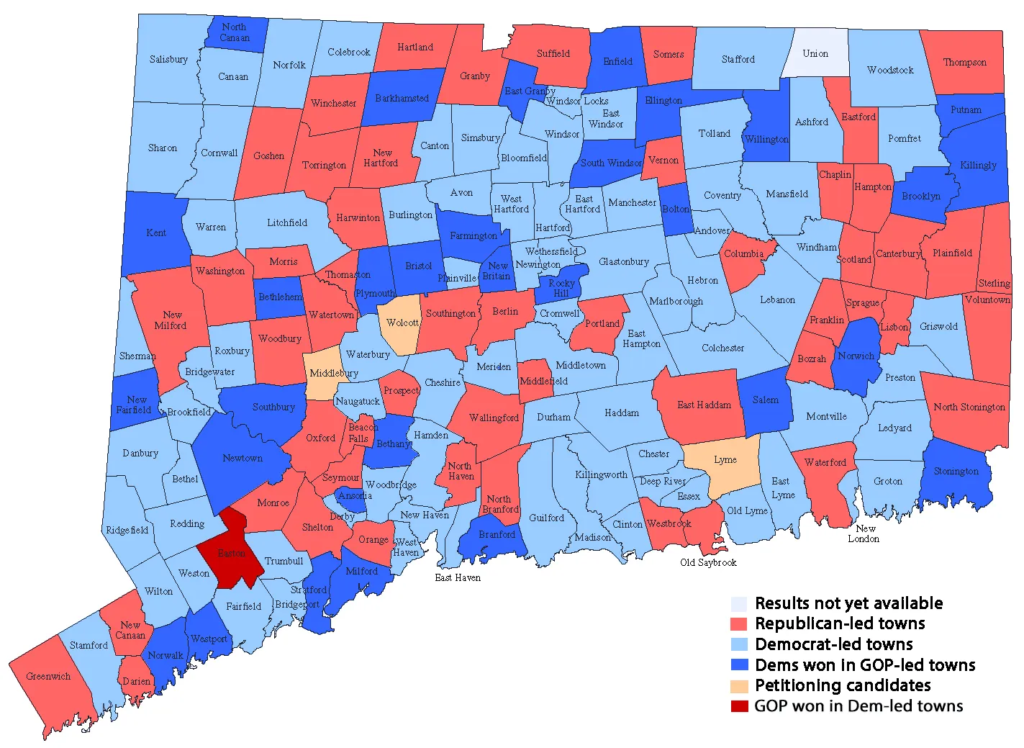
A map of Connecticut towns showing wins and losses by party in the 2025 elections based on unofficial results from the Secretary of the State’s office. Credit to Viktoria Sundqvist / CTNewsjunkie
What to Expect in 2026? To Start – A Barrage of Special Elections
No one has to wait too long for elections in Connecticut. Due to a variety of circumstances, there will be 3 special elections taking place in Connecticut from early January to early February.
On Jan. 5th, there will be a special election for the 25th State House Seat. The seat was vacated by Rep. Bobby Sanchez, who resigned after winning the mayorship of New Britain in November.
The 25th State House Seat is likely to stay in the Democrats’ hands. Kamala Harris won this seat 64-34 in 2024. The district contains parts of New Britain.
On Jan. 13th, there will be a special election for the 139th State House Seat. The seat was vacated by Rep. Kevin Ryan due to his death in late November.
The 139th State House Seat could potentially be competitive, but leans towards the Democratic Party. Kamala Harris won this seat 53-47 in 2024. The districts contains parts of Montville, Ledyard, and Norwich.
On Feb. 3rd, there will be a special election for Fairfield First Selectman. Democratic First Selectman Bill Gerber sadly passed away in July. The two remaining Selectmen, Democrat Christine Vitale and Republican Brenda Kupchick, could not pick a successor. The town charter specified that the party that held the seat, the Democrats, could appoint a replacement. Democrats picked Vitale. However, the charter also allowed a special election to take place if enough signatures were gathered. Republican State Sen. Tony Hwang successfully gathered enough signatures to force this special election for the remainder of the term.
The Fairfield First Selectman special election will be competitive, despite Kamala Harris winning the town 59-40 in 2024. Republicans have frequently performed better on the local level, and State Sen. Tony Hwang has won over Democratic voters in his State Senate elections, where he represents a district Kamala Harris won by 18 points. I mark the race as a toss-up.
2026 Primary Elections
It will be an active cycle during the 2026 primaries this year. It will start at the convention, where it will be a competitive race for delegates, and continue into the late summer for the primary.
The main event is the expected competitive Democratic primary in Connecticut’s 1st Congressional District, where incumbent Rep. John Larson faces multiple challengers in former Hartford Mayor Luke Bronin, State Rep. Jillian Gilchrest, Hartford Board of Ed. Member Ruth Fortune and perennial candidate Mark Greenstein. Though not all the challengers are expected to make the ballot, if anyone makes the ballot, it will mark the first primary against an incumbent member of the U.S. House in Connecticut since the modern system was put in place over 50 years ago.
Larson faces his strongest competition, but if his challengers don’t consolidate, it is likely that Larson can easily win with a plurality. Larson has endorsements from most elected officials in the district as well as the state’s entire federal delegation. The race can get unpredictable, but it’s Larson’s race to lose. The race has already been pretty negative between Larson and his challengers, and I don’t expect that to change anytime soon, with everyone throwing jabs at each other.
No other Incumbent House Democrat faces a significant challenger; time will tell if any emerge. All the attention will be on CT-01 until that changes.
There is also a competitive Republican primary for governor. This race is currently between State Senator Ryan Fazio and former New Britain Mayor Erin Stewart. Both represent a generational shift in the party, as both are more than three decades younger than current Democratic Governor Ned Lamont. There have been reports that former Lt. Gov of New York, Betsy McCaughey, might enter the race as well. This primary can also get messy.
On the Democratic side, State Rep. Josh Elliott hopes to stop Ned Lamont from securing a 3rd term. Elliott, who has struggled to gain traction and fundraise, still has time to prove to voters why Lamont shouldn’t be the nominee. He hopes for a breakthrough moment, and maybe as the race approaches, he finds it somewhere.
There will be expected primaries in the state legislature against both incumbents and in open races. The incumbent most likely to have a primary challenge is State Sen. Doug McCrory of the 2nd district, who has been linked to state spending under investigation by federal investigators. Coverage will increase as we get closer to the primary cycle, as most state legislature members haven’t filed for re-election yet, but it should be a busier primary cycle than usual. I expect a real test of Democrats’ appetite for younger challengers/fighting mentality, as well as a sign of how State Republicans want to proceed to make some gains across the state.
2026 Statewide Elections
All statewide Democratic incumbents are expected to run again next November. This includes Gov. Ned Lamont, Lt. Gov Susan Bysiewicz, Attorney General William Tong, Comptroller Sean Scanlon, Secretary of State Stephanie Thomas, and Treasurer Erick Russell.
If anyone decides not to run, it will open up a competitive Democratic primary, but it is not expected.
Republicans have not won a statewide race since 2006, and will have to field numerous strong candidates if they hope to take any statewide race. They lost every race except for Treasurer in 2022 by double-digits, and still lost Treasurer by nearly 8 points. It will take a lot for Republicans to do well in what is expected to be a blue year. Republicans might again take a similar strategy to 2024, where they put all their resources on CT’s 5th Congressional District Race, but a blue year may make that strategy unsustainable.
Remember to expect the unexpected in politics.
It will be another crazy year of elections. I deeply appreciate everyone who reads the blog. This was the first year of the blog project, and I will call it a success. We hope to continue to grow the blog, and hope to gather more readers, and expand the coverage on Connecticut Elections.
- Follow the blog on Twitter/X @ctelectionguide,
- Email me at contact@ctelectionguide.com with feedback or questions.
- Or Comment down below
Thanks for Reading!
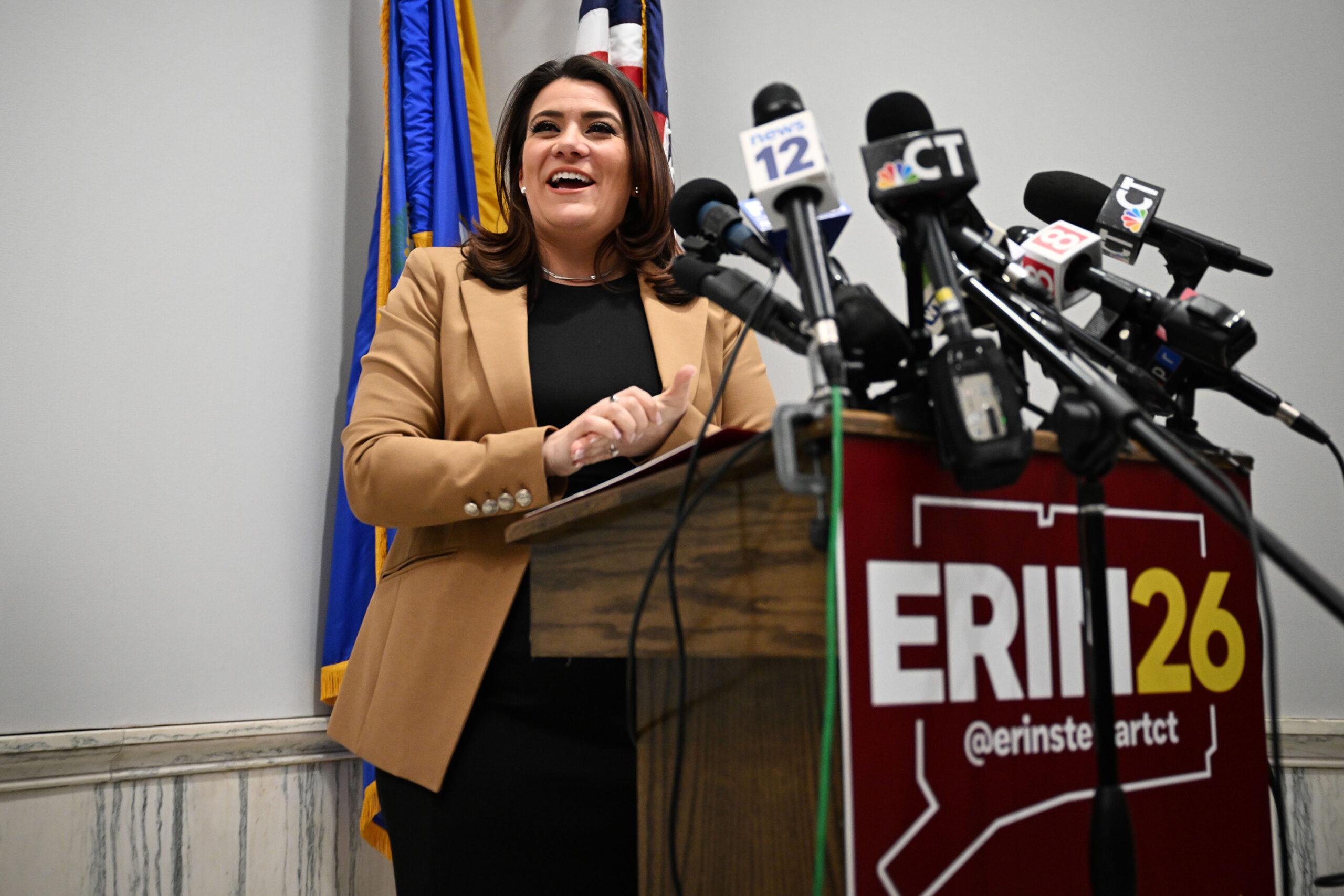
Q3 Fundraising for 2026 Elections – How Much Money You Need?
New Britain Mayor Erin Stewart announced her exploratory campaign for governor on Jan 28th, 2025, at New Britain City Hall. Source: Connecticut Public Radio
Table of Contents
Overview
Fundraising reports for Q3 were due in early to mid-October for both statewide candidates and candidates for federal office. Finance reports give credentials to more serious candidates, demonstrating they have funds for increasingly expensive primary campaigns, and for candidates to demonstrate they are the ones to take the mantle for the party.
Q3 Finance Reports allow voters to see how candidates for governor are faring, including what is looking like a competitive Republican primary between New Britain Mayor Erin Stewart and State Senator Ryan Fazio. We will also look at State Rep. Josh Elliott’s campaign for governor.
Additionally, we are looking to see how viable Democratic primary challengers to Rep. John Larson are in CT-01.
Q3 Republican Primary for Governor Fundraising
Erin Stewart – $102,000
Overall Campaign – $350,000+
Ryan Fazio – $157,769
Republican Primary Governor Discussion
When Fazio launched his campaign, I was curious how the Republican coalitions would react around the state. Would they split between Stewart and Fazio, or would they consolidate behind Stewart? Based on fundraising and endorsements, it seems to be the former.
Fazio now has the most money raised by a Republican for a single quarter in the history of the state’s Citizens’ Election Program for public financing. Though a very specific accomplishment that may not mean a lot in the long run, it shows that he is able to raise enough money to compete against Stewart.
He has raised money from more than 1,000 individuals across 114 towns across the state.
The race has turned into a head-to-head, as Westport Selectwoman Jennifer Tooker dropped out of the race last month, after struggling to raise funds. She did not rule out running for another office on the ballot, however.
Stewart’s exploratory campaign has raised over $350,000 since her entry into the race in late January. She is still the frontrunner, as she has far more name recognition than Fazio. Her run for Lieutenant Governor in 2018 and being a mayor for more than a decade mean voters are more familiar with her. She has also been expected to run for governor for years, keeping her name in conversations for a long time.
The question still is, who can win over MAGA voters? Stewart and Fazio have both expressed support for Trump. Stewart told members of the Republican State Central Committee in April that her campaign would get the endorsement.
Fazio, in particular, made it a point not to mention Trump in his campaign last year in his Harris +16 state senate seat. That’s not too surprising, but Fazio has been more willing to talk about Trump while pursuing statewide office. He told guests at a fundraiser for Republican candidate for New Haven Mayor Steve Orosco last month that he voted for Trump, but emphasized a focus on local issues. Fazio’s endorsements from the state legislature, including firebrand Rob Sampson, show that Fazio also has some institutional support from conservative
As we have mentioned before, both Fazio and Stewart are aware of the power of a Trump endorsement, even in a blue state like Connecticut. In addition to how the CT Republican Party has failed to get their preferred candidates over the line in a Republican primary. Trump’s late endorsement of businesswoman Leora Levy in the 2022 US Senate Race gave her the necessary boost to beat out State House Minority Leader Themis Klarides.
Fundraising has shown it will be a competitive race, as we head into next year, we will get a clear look to see at how voters feel between the two candidates.
Q3 Democratic Primary Governor Fundraising
Josh Elliott – $45,834
Is Elliott Viable against Lamont?
State Rep. Josh Elliott has raised just above $45,000 in his campaign for governor. Governor Ned Lamont has not confirmed he would run for a 3rd term, though he is expected to announce his campaign after local elections on November 4th.
Lamont garnered the ire of statewide progressives when he vetoed two bills, one that would provide funds for striking workers, and an affordable housing bills over concerns about how local control would work. Progressives, angry about the bill that was expected to pass, told the media that Lamont would get a challenge from the left.
Elliott, who entered the race in July, has not garnered a lot of attention in his bid, however. Though there is still plenty of time before the late-summer primary, Lamont’s veto did not lead to an overwhelming string of donations protesting him.
A poll from UNH in September demonstrated some of Elliott’s struggles. 71% of voters did not know about him to give an opinion. And the ones that did, his approval was -6, with 5% approval, 11% unfavorable.
Polling has shown that Lamont is still popular, with the same UNH poll showing Lamont with a +18 Job Approval rating.
Elliott also needs to change the narrative, as only 20% of voters said that Lamont’s views were to the right of their own. This included a majority of both socialists (82%) and progressives (53%). On the question if Lamont deserves to be re-elected, it was 43% yes, 40% no. But 62% of Democrats said that Lamont deserves to be re-elected, only 19% said he doesn’t.
It is important to note that this was only one poll, but it reinforces the narrative that Lamont will be difficult to beat.
What Josh Elliott still has in his favor is some support from the state legislature, notably from many other progressives. Looking through his donation list, Elliott has received donations from 1 state senator and 11 state representatives.
The list includes
State Sen. Saud Anwar (D-South Windsor)
State Rep. Mary Fortier (D-Bristol)
State Rep. Nick Gauthier (D-Waterford)
State Rep. Eleni Kavros DeGraw (D-Avon)
State Rep. Sarah Keitt (D-Fairfield)
State Rep. Renee Muir (D-Deep River)
State Rep. Jillian Gilchrest (D-West Hartford)
State Rep. Laurie Sweet (D-Hamden)
State Rep. Robin Comey (D-Branford)
State Rep. Frank Smith (D-Milford)
State Rep. Anne Hughes (D-Easton)
State Rep. Mary Welander (D-Orange)
The 2026 Environment
The 2026 environment for Democrats seems to be leaning more towards anti-establishment/anti-incumbent. There is definitely an energy for a more aggressive posture from some Democrats. But Elliott needs to find a way to garner more attention, either through social media or otherwise. He also needs to find more national or statewide groups to endorse him, as they might be able to help him out with fundraising. It might be a long shot, but even trying to get an endorsement from a progressive member in Congress. Anything to bring some momentum and attention to his campaign.
Elliott will need a lot of money if he faces the wealthy Lamont. Elliott did tell the New Haven Independent in an interview in early September that he has enough delegates to force a primary and that Lamont is not as popular as people believe. He also mentioned he won’t pursue a primary “if he fails to win the convention outright”. He noted he promised his family that he wouldn’t go through a Line B candidacy unless the results are close.
It’s hard to say how much it matters if Elliott does not fully commit to a primary. It is not uncommon for legislators to form exploratory committees and not go to the primary if they don’t think they can win. Elliott faced the same issue when he ran for Secretary of State in 2022. Once he lost at the convention and didn’t have enough delegates to make the primary. Elliott was able to run for his state house seat, as town committee endorsements for his state house seat took place after the convention. A similar thing can happen in 2026.
Elliott also said he didn’t want to risk his legislative position in the State House, so we will see if the race gets closer for Elliott to change his mind.
Q3 Fundraising Democratic Primary in CT’s 1st Congressional District
Luke Bronin – $1,192,798 (In 8 Weeks)
John Larson (Inc.) – $804,557
Jillian Gilchrest – $54,392 (In 4 Weeks)
Ruth Fortune – $41,353
Jack Perry – $28,810 (Did Take Out a $500k Loan) (9 Weeks)
Bronin Emerging as Main Challenger
Bronin’s fundraising brought him ahead of incumbent John Larson. Both have been trading barbs with each other.
Bronin has attacked Larson for taking PAC money and encouraged him not to do so. Larson has attacked Bronin for not actually representing a change at all. Larson and his team continue to say that Larson is the best person to represent the district.
He hasn’t exactly been enthusiastic about the prospect of fundraising. Something he hasn’t been forced to do for decades. He has complained that the money spent in Connecticut should be spent in swing districts across the country, not wasted here.
Bronin, however, raised $500,000 on the first day of his campaign and over a million for the quarter, putting him on par with many competitive campaigns across the country. With his fundraising, Bronin has established himself as Larson’s primary challenger.
Larson received $495,057 from individuals. He raised the additional $309,500 from PAC money. Bronin has raised all of his money from individuals. He has not spent much of his money yet.
Larson’s fundraising is expected to increase in Q4, and Bronin said he will likely be behind. He did say early fundraising shows “we’re going to have what we need to compete and make a powerful case for change,”.
Jillian Gilchrest’s Op-Ed
State Rep. Jillian Gilchrest said in a statement, “This fundraising pissing contest doesn’t surprise me, but bragging about how much money you can drag into politics is completely out of touch.” She also marked how the money should be used for other causes. She spent her first month in the race talking to voters.
Her comments did make sense, considering her paltry $54,000 fundraising. The amount is not nearly enough for a competitive Democratic primary in the Hartford Media market.
Though Gilchrest makes good points about the issues of how expensive it is to run for office. She also brought up the importance and need of public financing in Congressional Campaigns. Both her major opponents, Larson and Bronin, said they agree that the system needs to be reformed.
In her Op-Ed, Gilchrest notes that she would not have been able to run for office, especially against a 23-year incumbent, without Connecticut’s public financing system, the Citizens’ Election Program. She explains how the wealthy control our government, and the continuation of corruption, and how billionaires avoid paying taxes, making the rest of us pay more. Gilchrest also said she understood the importance of fundraising as a means to compete, but she won’t run playing by “old rules that got us in this mess in the first place”. She will raise money in a way that fits the character of the campaign.
Gilchrest has noted that instead of fundraising, she has spent her time going around the district and talking with residents. She did not ask people for money during her conversations, marking to change how politics works, “we need to elect people who think about politics differently”.
This contrasts with Bronin’s approach so far. Bronin isn’t a progressive insurgent in the mold of Gilchrest or Elliott, but he’s playing the traditional political game effectively — raising large sums quickly, cultivating credibility with national donors, and leveraging institutional networks. He’s not rejecting the system, just adapting it to appear reform-minded, notably by rejecting PAC money, unlike Larson. Ideologically, he’s not as left-leaning as Gilchrest, but sits somewhere between the state’s moderate establishment and its progressive base.
The Reality of Fundraising
Gilchrest is notable in her cause; she makes great points about the difficulties faced by first-time candidates. This is also why Gilchrest is still a dangerous candidate; she has the makings of what the Democratic Primary electorate is looking for in 2026, a progressive anti-establishment candidate. This is a mantle that she can take from Bronin, but the primary will come up quickly. They are also likely to split the vote at this rate from Larson.
However, she can’t ignore the realities of congressional fundraising. When Congresswoman Alexandria Ocasio-Cortez pulled off a shocking upset in 2018 against No. 4 House Democrat Joe Crowley, she raised around $300,000, less than 1/10 of Crowley’s chest.
AOC set up a shockwave of progressive challengers to come, a model that many hope to replicate. Though none have come near the scale of AOC’s upset, you need a few things to happen. Joe Crowley openly admits that he was not tuned into his district in 2018 and did not actively campaign during his primary campaign.
John Larson, on the other hand, has been barnstorming the district. Larson told the Courant that the challenges have made him more energetic, and have led Larson to frenzied campaigning, unlike he has done in years.
The point is, Gilchrest cannot ignore the realities of fundraising. Donors and national fundraisers need to hear about the candidate and their ideas. Also, understand that the candidate’s campaign is to be taken seriously. Gilchrest has the endorsement of Indivisible CT, a notable progressive group.
But despite her complaints about money, Democrats have notably outraised Republicans across the country in many races. Democrats know that backing down from spending would only fail to get their message out. For Gilchrest, I would argue that Progressive organizations, especially national ones, are stockpiled with money ready to spend on upstart progressive candidates, who would love a candidate like Gilchrest. They also have far more resources and can help nationalize the race.
AOC, who struggled fundraising in 2018, has raised nearly $10 million in Q1 of this year (nearly $21 million for the year) as a well-known figure going against President Trump. The opportunity is there.
Similar to what I explained about State Rep. Josh Elliott (who Gilchrest gave a donation too), she needs to tap into national groups and endorsements to garner some attention and momentum. Though it is good that she is communicating with people, garnering attention is important, and that will lead to funds without having to force the conversation.
Scenairos
Both Jack Perry and Ruth Fortune raised similar numbers. It is not too surprising that Gilchrest, Perry, and Fortune are struggling. They are not as well-known and represent local town offices. Though Gilchrest is a state representative, the issue is that Connecticut has some of the smallest state house districts in the country by population. Only 23,000 residents live in each district. Scaling up an effort to a 700,000+ person Congressional house district is not easy; it becomes an issue of name ID, especially as she is not that well-known outside of her hometown of West Hartford.
Fortune’s $40,000 is not bad, and honestly, more than I expected from Fortune, who only came into office as an appointed candidate last year. Perry has taken out a $500,000 loan, but how he will use his money will be the deciding factor for him. I have doubts that Fortune and Perry can make the ballot, but we will see what happens on that front.
There is still plenty of time for this race to change. All candidates will have to face a very energetic Larson and prove to voters that age concerns are enough to take out an incumbent. Gilchrest needs to garner attention and try to get more progressive groups to seize on the opportunity to back her, instead of Bronin, as Larson’s main challenger, and Larson himself, who is fairly progressive himself. The federal delegation is backing Larson, so they need to look to the state legislature, local offices, or start going to House or Senate members.
Bronin needs to continue fundraising, attacking Larson, but also come up with some policy points, as his name seems to be mentioned more in the national political media as a Democrat primarying an incumbent (Downballot and Former White House Press Secretary Jen Psaki’s Podcast, as some examples). He has to capitalize to ensure that he remains Larson’s main challenger. For Perry and Fortune, they need to garner more attention and differentiate themselves from other challengers.
It’s Larson’s race to lose! He’s the frontrunner.
It could be a two-way race, a three-way race, or even a larger field. But it seems highly unlikely that Larson won’t have at least one challenger on the ballot. We are still more than 6 months away from the convention and 9 months away from a primary, so a lot can change.
Thanks for Reading!
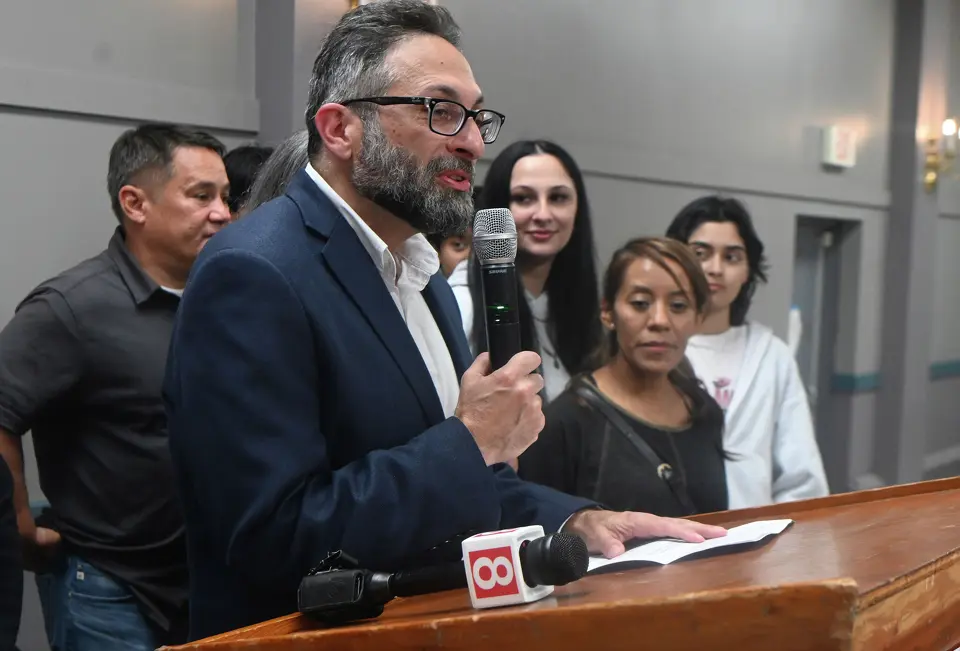
What Happened in the September 9th Primary: Results and Analysis
Adam Sendroff addresses the crowd after winning the Democratic primary for mayor on Tuesday, September 9, 2025, at the Knights of Columbus in Hamden. Credit to Jim Michaud/Hearst Connecticut Media
Overview
21 Towns and Cities held local municipal primaries last night. Let’s go through some of the notable results and how candidates fared during an off-year September primary.
We did live-tweet the results throughout the night. To get updates, either local election news or announcements of the publication of written articles, you can find us on Twitter, which is linked here.
For additional information on any races, before I go into results, please use our Ultimate September 9th Primary Guide as a reference.
In the top races of the night…
Adam Sendroff and Barbara Smyth both won Democratic mayoral primaries in Hamden and Norwalk, respectively.
Republican Incumbent First Selectman George Temple and Kevin Cunningham survive tough primaries in Oxford and Plainfield
Just a note, in some race summaries, my screenshots will come from the Secretary of State’s Website Election Database. The results are unofficial and are not certified. However, many candidates have leads that won’t be changed with recounts.
Turnout
Turnout was low as expected. On the Republican side, the turnout was 23.36% (note – turnout for the Griswold Republican primary is not noted on the website). On the Democratic side, turnout was only 19.35%.
However, turnout varied among different towns. On the Republican side, turnout varied from 47.28% in Oxford to 12.98% in Greenwich. On the Democratic side, turnout was as high as 45.33% in Chester, to as low as 11.95% in Stamford.
Note – All turnout numbers were found on the Secretary of State’s Website.
Differences in turnout were usually due to the type of race. Races for First Selectman or Mayor were much higher than in towns that had races only for boards or councils.
Hamden
Former Board of Education member Adam Sendroff won a convincing victory last night over party-endorsed Dominique Baez and three others.

Sendroff won 46.57% of the vote, securing more than one thousand votes more than party-endorsed Legislative Council President Dominique Baez.
All the candidates demonstrated levels of support. It was a large field that included multiple elected officials in Hamden.
Some candidates had controversies that were difficult to overcome. City Council President Dominique Baez was perceived as the frontrunner for many weeks. However, the New Haven Register reported that Baez’s workforce development company was evicted due to 40k in unpaid rent in 2021.
This was unwelcome news in a town where voters were looking for someone to lead them on fiscal responsibility.
I underestimated Sendroff’s level of support by a fair amount. My race rating was a Toss-Up after Baez’s issues because I wasn’t sure what to expect. I did not expect an overwhelming win for Sendroff.
Sendroff impressively not only won against another elected official in Democratic Registrar of Voters Lushonda Howard, but two former mayoral candidates in Walter Morton IV and Peter Cyr.
What to Expect in November
Normally, in a town that Kamala Harris won 73-25, we’ll call it a day, and tell Adam Sendroff, congrats, you’re the mayor in November.
However, Republicans see an opening due to the financial crisis plaguing the city.
In addition, we highlighted in a previous article that Incumbent Mayor Lauren Garrett only won in 2023 by 12 points, and only 10 points in 2021. So we expect a much closer race than the federal toplines suggest.
Adam Sendroff’s convincing victory, though, should give Democrats some much-needed confidence. Sendroff will face 24-year-old Jonathan Katz, a political newcomer, in November.
Hamden Councilmen Districts
In our primary guide, I said that out of all the challengers to the endorsed candidate in Hamden. I thought that Grace Teodosio had the best chance of an upset over an endorsed candidate, since Renee Hoff was an appointed incumbent who hadn’t run in a primary prior, and Teodosio had an in-depth campaign website.
Teodosio proved my suspicions correct and won over party-endorsed and incumbent Renee Hoff 54-46.
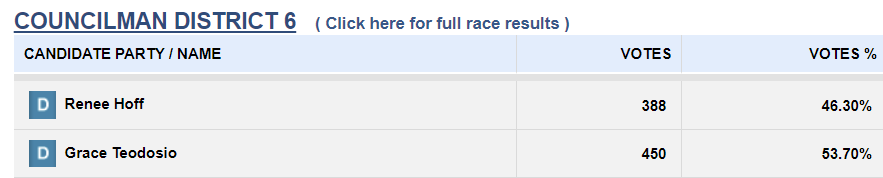
As expected, incumbents in Districts 7 and 8, Adrian Webber and Ted Stevens, comfortably won over their challengers.
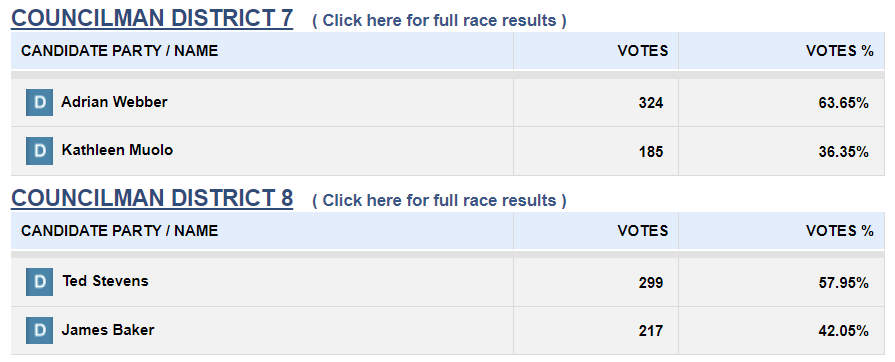
District 9, however, will absolutely go to a recount. I thought the race could be unpredictable as the 2023 Democratic Nominee, Barbara Walker, was against party-endorsed Tameeka Parks.
I also thought the race would narrowly favor Tameeka Parks, though I did not expect this close of a margin. As of right now, Tameeka Parks has 220 votes. Walker has 218. A recount could shift that narrow of a margin, but Parks is likely to move on in November; but we will have to wait to see.
In November, Democrats are favored in Councilmen Districts 6,7, and 8. In District 9, the Democratic winner will have to face Republican Jim Anthony in November. Anthony won 55-45 in 2023.
Norwalk
Politicos expected a close race in Norwalk last night, and a close result it was. Common Council President Barbara Smyth took a 77 vote victory over Common Council Member Darlene Young.
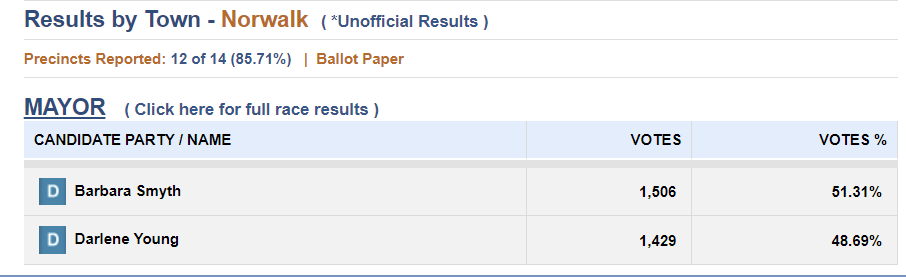
I expected the race to be close due to a couple of factors: Smyth narrowly won the party endorsement from local Democrats, and Young had more than enough signatures to make the ballot.
Local Democrats also remarked that both women have the strength, dedication, and leadership needed to be mayor
What to Expect in November
Norwalk is another town where Democrats have done well on the federal level. Kamala Harris won a comfortable 64-35 victory here last year.
However, similarly to Hamden, Republicans have done better in local races than federal races. Incumbent Mayor Harry Rilling won 55% of the vote against Vinny Scicchitano in 2023. Though he won a larger 64-36 victory two years prior in 2021.
Democrats are likely to win in November, but Republicans can put up a fight. Smyth will face the 2023 Republican nominee Scicchitano in November, who does have name recognition from his previous run.
Chester
Incumbent First Selectman Cynthia Lignar comfortably beat challenger Joe Cohen in an 81-19 landslide.
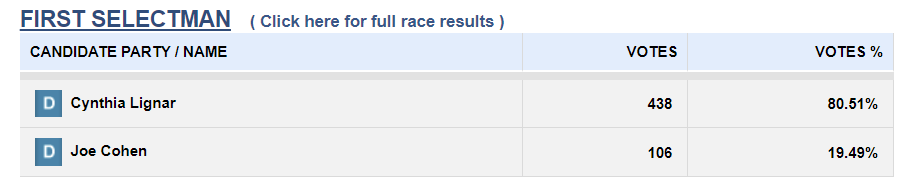
Lignar got 438 votes to Cohen’s 106 votes.
There will be no Republican candidate on the ballot in November, as 2023 Republican nominee Ron Amara says “the Democrats would have glided to victory“. Amara did back Cohen, but Lignar won comfortably and will be unopposed in November.
Stratford
Party-endorsed David Chess won a landslide victory over challenger Linda Manos. Chess won an 87-13 victory. The largest margin of victory of the night.

Chess, a doctor and businessman, won the support of the Democratic Town Committee by a large margin, though I expected a closer race. Manos told the CTPost that she submitted over 1000 signatures in her primary petition, though she barely got 1/4 of that in the primary. Though I think some of those signatures were not registered Democrats, and the number was closer to the 650 needed signatures.
What to Expect in November
Chess faces a very difficult race in November. He will go up against two-term Republican incumbent Laura Hoydick. Stratford is a very Democratic town with Kamala Harris winning 59-40 last year.
However, Laura Hoydick won a landslide 63-37 victory in 2021, so Chess will need to get partisan Democrats to vote for him over Hoydick and prevent voters from crossing over. He definitely has a chance, as 2025 is expected to be a much bluer year for Democrats than 2021. However, one should not doubt Connecticut’s split-ticket voting tendencies.
Bloomfield
As readers know, Bloomfield has had a turbulent couple of years with a lot of infighting amongst local Democrats.
On the Town Council, it looks like the majority of the Row A endorsed party candidates emerged victorious. However, one challenger has made it into the top six.

I expected the Row A candidates to win with a larger margin, but it was a nailbiter of a result. Recent developments and scandals on the new town library and numerous budget amendments meant a lot of turmoil for former Bloomfield Mayor Danielle Wong’s administration and her fellow councilors. This gave an opening for the challengers.
Wong, who resigned last month, was replaced by Mayor Tony Harrington, who led all candidates with 1340 votes. The top six candidates of the twelve on the ballot that will go on to November are (endorsed candidates marked with a *)
Tony Harrington* – 1340
Cindi Lloyd* – 1214
Michael Oliver* – 1188
Darrell Goodwin* – 1172
Suzette DeBeatham-Brown – 1155
Todd Cooper* – 1142
Former Mayor Suzette DeBeatham-Brown looks like she will make a return to the town council after a brutal loss in 2023. Endorsed candidate Ola Aina has fallen short. Another former mayor, Sydney Schulman, was only 19 votes behind Todd Cooper. Other endorsed candidates were within two hundred voters of Todd Cooper, but they fell short.
Bloomfield is one of the most liberal towns in the state, voting for Kamala Harris by an 84-15 margin. This means the six Democrats are virtually assured of their victory in November.
Oxford
A race filled with drama between First Selectman incumbent George Temple and his longtime protege Jeffrey Luff ended in a victory for the seven-term incumbent Temple, who won a comfortable 57-43 victory.
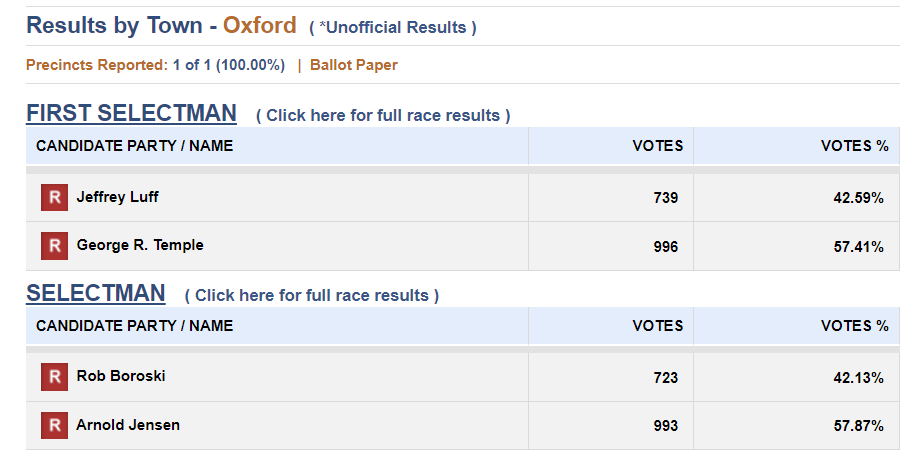
Both incumbents, First Selectman George Temple and Selectman Arnold Jensen, won against their Republican challengers. Temple was surprised that Luff was challenging him, as Luff was a protege he expected to take over once he retired. Luff was not happy that Temple, age 79, was running for an eighth term, saying he “had lost his fastball“.
Temple and Jensen both narrowly lost the party-endorsement vote, but the vote was so close (Temple lost 151-157, Jensen lost 153-155) that the race was expected to be competitive.
Donald Trump comfortably won Oxford by a 60-39 margin, meaning Temple and Jensen are heavily favored to retain their positions in November.
Plainfield
The 20-year political feud between Incumbent First Selectman Kevin Cunningham and former First Selectman Paul Sweet ended in a narrow victory for Cunningham, who emerged victorious by fifteen votes.

Cunningham and Sweet have had a feud going on for so long that both were former Democratic First Selectmen many years ago before finding themselves as Republicans facing off in a September primary. Cunningham had lost to Sweet twice, both in 2007 and 2009, in the general election, but he finally won a race against Sweet in 2025.
However, Incumbent Arthur Gagne has narrowly lost to the party-endorsed Michael Suprenant by 28 votes. It might be a bit awkward in Plainfield as one incumbent and one challenger will be in office together.

Plainfield is another town where Trump did well, winning 61-38 in 2024. So Cunningham and Suprenant are heavily favored in November.
Wolcott
Party-endorsed James Paolino did not think that Paul D’Angelo should represent Republicans on the ballot this year. His goal was to block D’Angelo from winning the nomination. D’Angelo was arrested last year for a domestic dispute and was being sued by Wells Fargo.
Republican voters, however, disagreed with Paolino as D’Angelo narrowly bested him by 21 votes in a 52-48 victory.

Paolino said he would not seriously challenge the incumbent mayor. D’Angelo wanted to offer voters a serious conversation on the town and give a serious challenge to Incumbent Mayor Thomas Dunn, who has been unopposed in the last four elections.
Dunn has never had a difficult contest and is highly favored in November. We’ll see if local Republicans support D’Angelo after this acriminous primary.
Rest of the Races
There were many other races across the state. Results for every primary in the state can be found here.
Some other interesting results were Incumbent Town Clerk Bob Siegrist losing to party-endorsed Sarah Pytlik 45-55.
In New Britain, Incumbent Alderperson Neil Connors lost to party-endorsed incumbent John McNamara and former Alderperson Luz Ortiz-Luna.
In Stamford, all party-endorsed candidates won their primaries for the Board of Representatives, all by pretty large margins. This meant multiple incumbents who did not receive the party endorsement have been ousted from office. This includes Bonnie Kim Campbell (District 5), Denis Paterson (District 6), and Anabel Figeroa (District 8)
In New Haven, Elias Theodore won comfortably over Norah Laughter for the Board of Alder Ward 1. A ward seat that encompasses a good portion of Yale University. Theodore won comfortably 63-36. Party-endorsed incumbent Angel Hubbard won 58-42 in Ward 3 against Miguel Pittman, who she will have to face again in November. Party-endorsed Leland Moore won a landslide 84-16 vote against Zelema Harris in Ward 18.
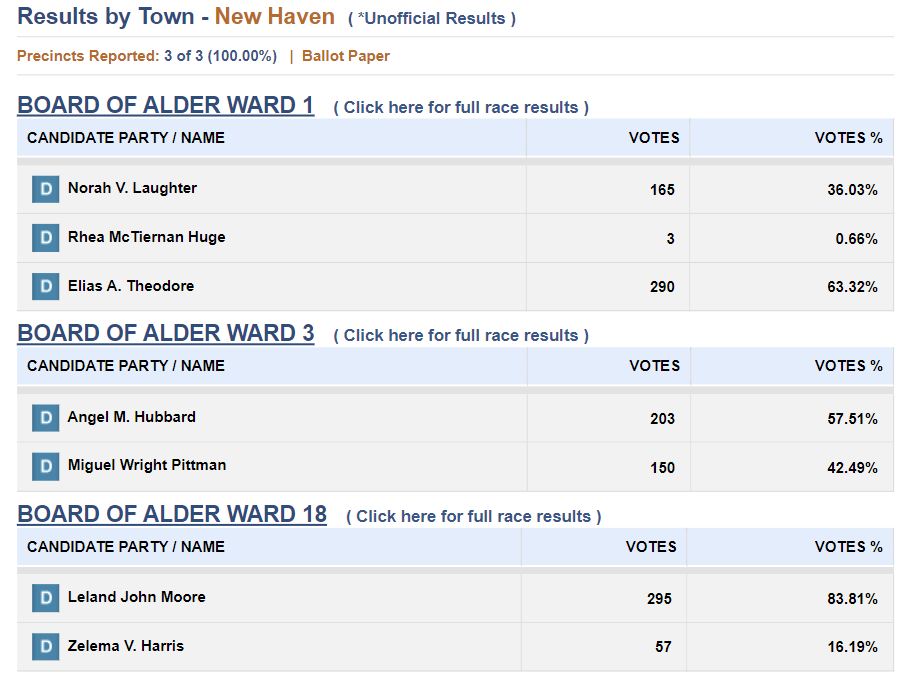
It was an interesting night all around, with some upsets and party-endorsed candidates coming out victorious.
There will likely be a recount in Hamden in Councilman District 9, so we will see what happens in that race and if there are any other developments overall. Other than that, it’s off to the general election, where we will have a lot of competitive races.
Thanks for Reading!
September 9th Ultimate Guide for Democratic and Republican Primaries
A Hartford resident votes at a polling spot in the Pope Park Recreational Center in the 2023 municipal primary. Credit: Shahrzad Rasekh / CT Mirror
Table of Contents
- Overview
- Voting Information
- Race Rating Scale
- Bloomfield Democratic Primary
- Bridgeport Democratic Primary
- Chester Democratic Primary
- Greenwich Republican Primary
- Griswold Republican Primary
- Haddam Republican Primary
- Hamden Democratic Primary
- New Britain Democratic Primary
- New Haven Democratic Primary
- New London Democratic Primary
- North Haven Democratic Primary
- Norwalk Democratic Primary
- Oxford Republican Primary
- Plainfield Republican Primary
- Stamford Democratic Primary
- Stratford Democratic Primary
- Waterbury Republican Primary
- Wolcott Republican Primary
- Overall Race Ratings
Overview
*Updated 8/29 – 18 of 21 Primaries Completed
Welcome to CT Election Guide’s September 9 Ultimate Primary Election Guide.
On September 9th, some towns in Connecticut will have Democratic and Republican primaries for local municipal offices ranging from mayor to board offices.
Some races I have covered in separate articles. This is a guide of who is running and what I expect from each race.
Overall, 11 towns will have a Democratic primary. 10 towns will have a Republican primary.
No town has both a Democratic and a Republican primary.
Per state rules, Connecticut is a closed primary state. This means only registered voters of that party can vote in a primary election. In Connecticut, a plurality of voters are registered unaffiliated (about 42% as of 2024); that proportion of state voters will be unable to vote in the election. However, unaffiliated voters have until August 29th at noon to register with a party. If a voter wants to switch parties to vote in a primary (From Democratic to Republican, or vice versa), they had to do so by June 9th.
Voting Information
New voters must complete their party registration by noon on the business day prior to when they partake in early voting or election day.
There is early voting available for primary voters. Early voting will take place from September 2nd to September 7th. The hours for early voting are listed below.
Regular Weekday: Hours 10:00 a.m. to 6:00 p.m. September 3 & 5, 2025
Extended Weekday: Hours 8:00 a.m. to 8:00 p.m. September 2 & 4, 2025
Weekend Hours: 10:00 a.m. to 6:00 p.m. September 6 & 7, 2025
On September 9th, primary day, polls will open at 6:00 am and will close at 8:00 pm. Any registered voters who are in line by 8:00 pm will be allowed to cast their vote.
Voter turnout is expected to be low for an off-year September primary, so voters are encouraged to come out and vote for a candidate, as even a few votes can change the result in some races. In 2023, out of eligible voters, just 21% turned out to vote.
Let’s start going through primaries and seeing what voters will have to vote on in each race. I will give who is running in each race, some relevant information/context if needed, discuss the candidates, and I will attempt to make a race rating (expected predictions). Some races, I have covered previously in the guide, and will refer readers to those pieces if needed.
All ballot images are from the Primary Election Town Sample Ballots found on the CT Secretary of State website here.
Race Rating Scale
Here is the scale I will use for Race ratings. They are my own personal primary predictions. Colors change based on if it’s a Democratic Primary or a Republican Primary.
Likely/Likely – Race is heavily favored towards one candidate by a large margin. I expect the candidate to win by over 10-15 points.
Lean/Lean – One candidate is favored; however, the race could be close depending on multiple factors. A race with a margin under 10 points is likely. An upset is possible.
Toss-Up – Race is unpredictable or is a potentially close race between multiple candidates. No candidate is favored; anyone can win
Disclaimer: Race ratings are just like predictions. I am by no means a political operative, and I am not on the ground in any race or affiliated with any of the candidates. Some candidates may have much more momentum than I’m aware of. It is also very unlikely that I get all these races correct in my race ratings. Primaries by nature are generally difficult to predict, and the electorates in many of these races will be quite small and will be based more on how candidates get their voters to turn up for a September primary. I’m just someone who enjoys elections and wants to make some educated guesses on what I expect for the 9th. If I’m wrong, that’s okay, and you can hold me to that.
Bloomfield Democratic Primary

I’ve covered a lot of the drama going on in Bloomfield in a previous article I wrote last month. If you want more context on this election, the article is right here.
I expected last month that the Party’s endorsed candidate would have an entire slate against them for Town Council. What I did not expect was that they’ve come up with candidates for every office on the ballot. This includes the Board of Education, Town Plan & Zoning Commission, and the Library Trustees.
The opposing town council slate includes not only Former Mayor Suzette DeBeatham Brown, but another Former Mayor Sydney Schulman. I’m not surprised by Schulman’s entry into the battle due to the very public comments made about the budget referendum. Former Councilman Rickford Kirton is also on the opposing slate. Kirton was instrumental in bringing the referendum to voters by gathering signatures.
Row B cannot be underestimated by any means, as it includes not only former mayors but former council members, and an entire new agenda for the town. It is no secret that former Mayors Schulman and Brown were not fans of Mayor Danielle Wong’s tenure, as seen by their very public infighting. Another year, another battle of the factions.
In 2023, Former Mayor DeBeatham-Brown led an opposing slate on Row B against the party-endorsed candidates.
However, they lost by a 2 to 1 margin. It’s hard to imagine that this attempt would be any different despite all the infighting over the past year. I do think the margin would be a bit closer due to the library and budget disputes, but I still expect the Row A endorsed candidates to win all offices on the ballot. It should be noted that in 2021, a mix of both endorsed and challenger candidates won the Democratic primary. However, I’m leaning more towards a 2023 result.
2023 made it clear, it’s a slate of candidates, not individuals. There isn’t much difference in the vote totals between members of each row, so I believe 2025 will be similar.
Race Rating: Likely Row A (All Offices)
Bridgeport Democratic Primary
District 137
Updated 9/4 – Challengers thrown off ballot by judge due to suspected fraudulent signatures, no race in District 137
Bridgeport has 10 council districts. There are Democratic primaries in two of them. There is no Democratic primary for the school board this year.
Council president Aidee Nieves and Incumbent Maria Valle were both endorsed by the local party committee. They face a challenge from both Ishamel Sanchez and Isaac Dickerson.
Nieves and Valle are described by the publication Only in Bridgeport as being popular with residents for years, so they are likely safe. There was controversy as the two incumbents have asserted that their challengers violated the election law to qualify for the primary.
Their complaint with the State Elections Enforcement Commission states that they believe Sanchez and Dickerson violated state law by submitting fraudulent and forged signature petitions. They also noted that former Democratic Town Committee members Tony Barr and Maria Hernandez were campaign operatives who circulated most of the petition sheets, not the candidates themselves. Hernandez was recently arrested on state charges for alleged absentee ballot fraud from the 2023 Bridgeport Mayoral Race.
Sanchez and Dickerson can only be off the ballot by court action, so they will likely be on the ballot for voters.
Race Rating: Likely Nieves and Valle
District 138
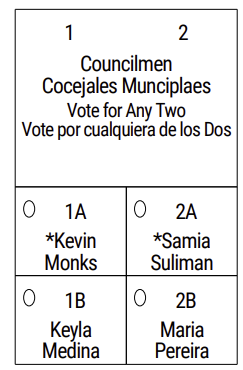
District 138 is a whole other story. Incumbent Maria Perera has not received the endorsement of the town committee. Along with Keyla Media, they will challenge the endorsed slate of City Councilwoman Samia Suliman and District Leader Kevin Monks.
Pereria has had a tumultuous tenure, with a long history of political “divorces”. She ran with Jazmarie Melendez in 2023. They both won the race, but after a few months, they had a falling out. Melendez later resigned from her position.
Pereria has also attracted state officials with her election win in 2023. She lost the in-person vote, but won the absentee ballot, leading to suspicion from state officials. This is not uncommon in Bridgeport, where multiple candidates on the ballot, including Incumbent Mayor Joe Ganim, faced questions about how absentee ballots played a role in their election wins and the legitimacy of those elections.
There were also questions about how Pereria’s part of the district had residents who, according to the state, were pressured to change their absentee votes. Currently, Pereria, who has self-proclaimed herself the piranha of city politics, seems stuck in her own ways. Her district has a suspicious number of absentee ballots requested, around 350. Due to this, and Pereria’s ways of conduct, she and Medina are favored in a city that continually elects Joe Ganim.
Race Rating: Lean Pereria and Medina
Chester Democratic Primary
Cynthia Lignar, the First Selectwoman of Chester, faces a Democratic primary challenge from Consultant Joe Cohen
In Chester, there will be no Republican on the ballot this year for First Selectman, so the Democratic primary is tantamount to victory.
Interestingly, Ron Amara, a Republican who unsuccessfully ran against Lignar in 2023, has given his support to Cohen, saying his experience, knowledge, and trust are why residents should back him. Amara points to Lignar and her selectman partner, Democrat Patricia Bandzes, for increasing taxes.
Lignar has her supporters, including from resident Caryl Horner, who writes in her op-ed, that Lignar’s great communication with the town, her accomplishments in getting numerous grants for town projects, infrastructure improvements, and her leadership are reasons to support her.
Cohen found himself in opposition against Lignar and Bandzes last year in a discussion about the town charter that led to a shouting match. Cohen was also a write-in candidate in the general election for First Selectman in 2021, receiving 14% of the vote. He also won the position of Town Treasurer as a write-in candidate that year.
Due to Lignar’s incumbency advantage, I believe she will likely defeat Cohen on September 9th.
Race Rating: Likely Lignar
Greenwich Republican Primary
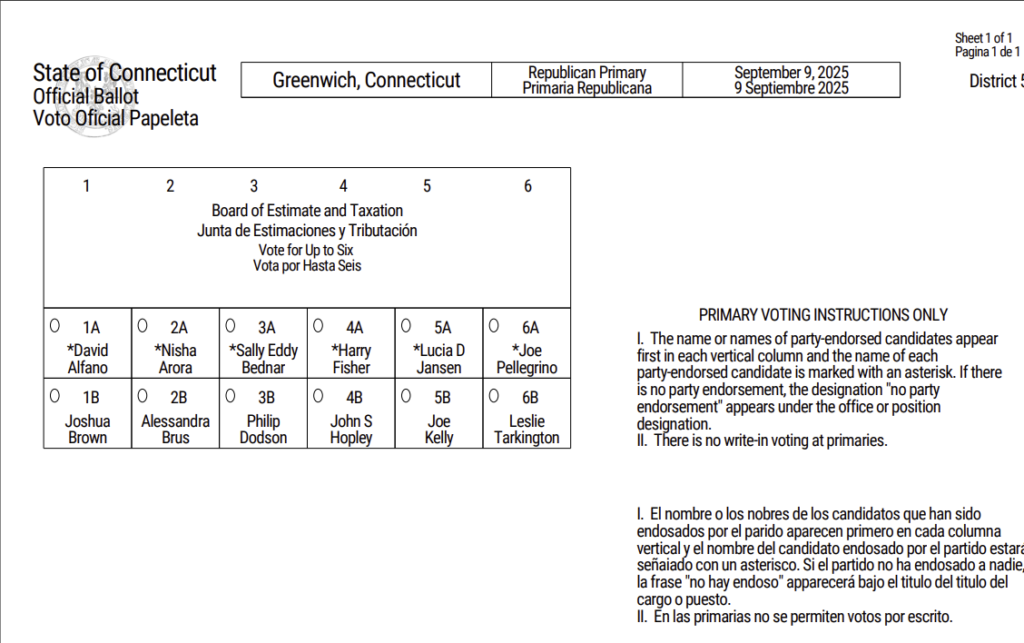
In Greenwich, there is a Republican primary for positions on the Board of Estimate and Taxation (BET).
The board consists of six Democrats and six Republicans. Whichever party gets the most votes in the November election will get to pick a chair and receive a tiebreaker vote. Republicans have controlled the board since 2019.
In Greenwich, the body manages over $600 million of taxpayer money and ensures proper financial management throughout the town.
Similar to Bloomfield, there are two different slates of candidates running, as voters will need to pick six of the twelve candidates on the ballot to advance to the November election. Row A has the party-endorsed candidates, Row B has the challengers.
However, unlike Bloomfield, not all candidates on each of the slates are aligned with one another.
An Op-Ed to the CT Examiner has six candidates aligned with one another. This includes three endorsed candidates, Incumbents David Alfano, Nisha Arora, and Lucia Jansen. They are joined by challengers Alessandra Brus, Phil Dodson, and John Hopley.
In this op-ed, the group explains how they are Independent Thinkers, and they are up against Entrenched Insiders. They blame BET Chair Harry Fisher, who was focused on loyalty and members with long-term tenures. In addition, they accuse Fisher of fostering a hostile work environment. They also explain how entrenched insiders have abandoned integrity and Republican values by also appointing Democrats to key committees. They also cite how the group sides with Democrats on raising taxes.
Another set of challengers, Leslie Tarkington, Joe Kelly, and Joshua Brown, filed together as a slate in their challenge. Tarkington is one of the two incumbents (Along with Karen Faussliotis) who did not receive the party endorsement.
With so many candidates and factions of candidates that are both endorsed and challengers. I expect this primary to be very unpredictable. I expect a mix of both incumbents and challengers to find seats on the board. Some will be endorsed candidates, some will not be. I doubt that the six candidates running together will all get the nomination, but we will see what happens. Due to this, I will label this primary as a toss-up.
Race Rating: Toss-Up
Griswold Republican Primary
In Griswold, there is a Republican Primary, not for the position of First Selectman, but for the position of Selectman. Usually, the partner, and a member of the Board of Selectmen, if there are among the top vote getters in the election.
In Griswold, Incumbent Selectman Martin McKinney did not receive the town endorsement to retain his position. He successfully petitioned to make the ballot against party-endorsed Richard Canova. Whoever wins will run with the Republican nominee for First Selectman.
Griswold is a toss-up town for the position of First Selectman. Democrat Tina Falck had a narrow 48-45 win over Republican Wayne Malin. However, since for the position of Selectman, both McKinney and Democrat Richard Grabowki had more votes than Malin, they won both seats as Selectman over Malin.
McKinney is the incumbent, but falling out of favor with the town committee isn’t a great sign. However, since he won the most votes of any First Selectman or Selectman candidate in 2023, I would not fully count him out. Though he is in a similar position to how former Selectwoman Dana Bennett lost the Republican endorsement in 2023, and lost 42-58 in the Republican primary to Malin.
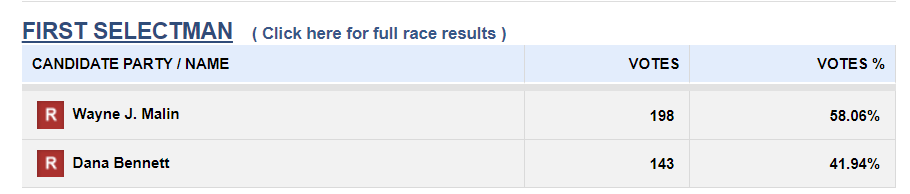
The endorsement does seem to be important in Griswold, but with less than 350 votes in the Republican primary in 2023, it’s unpredictable. However, I would lean towards Canova due to his endorsement.
Race Rating: Lean Canova
Haddam Republican Primary
In Haddam, there is a Republican Primary for the position of Town Clerk. Similar to Griswold, the Incumbent is Bob Siegrist, who did not receive the town’s endorsement. Siegrist had a close 52-47 victory for his 4-year term in 2021.
Siegrist gathered enough signatures to face party-endorsed Sarah Pytlik. Pytlik was selected over Siegrist first at the Republican Town Committee’s Nomination Committee, and then by a Haddam Republican Caucus a few days later. Haddam’s Facebook group has an Admin who noted her dislike of Siegrst, saying he has to go for multiple reasons, which she posted as info. She mentions topics such as stalking, harassment, and DUI, but I could not find any information to substantiate her claims.
Robert Siegrst is well-known to voters of the area, as prior to his win as Town Clerk in 2021, he ran for State Representative in the 36th District. He lost in 2014, but won a tight 51-49 win in 2016. However, he lost re-election in 2018 and again in 2020.
I’m not exactly sure what is happening in this race. Siegrist doesn’t have the endorsement, but he has name ID. Without finding any substantiated information on the claims against Siegrist, I said the race still leans his way slightly.
Race Rating: Lean Siegrist
Hamden Democratic Primary
Mayoral Race
The Hamden Mayoral Race is another primary I have discussed recently. For more information on the race, I’ve listed the article I wrote here.
It is also the most crowded primary of the day, and the primary I will be paying the most attention to. A competitive five-way primary is always fun to see what happens.
Of the candidates I discussed in my previous article, Jameka Jefferies was the only one not to make the ballot, as many of her signatures were rejected. She alleges that the Democratic Registrar of Voters and mayoral candidate Lushonda Howard improperly handled her petition forms. Jefferies will be on the ballot in November as a petitioning candidate.
Due to the open race and the number of candidates running in this deep blue town. I expect turnout for the Democratic primary to be fairly high for a primary. Hamden had a high turnout during early voting last year and has historically had a high turnout overall. With so many primaries on the ballot, it should be one of the highest turnout areas in the state.
The five candidates on the ballot, Dominique Baez, Peter Cyr, Lushonda Howard, Walter Morton IV, and Adam Sendroff, are all viable candidates due to having raised a fair amount of money and making the ballot. All of their campaign platform are extensive, and they have all shown they have support in the race.
Legislative Council President Dominique Baez, I think, is slightly favored in the race due to her position in the town and receiving the party endorsement. This will allow her to get a fair amount of the vote and stand out in a crowded vote. At the moment, though, I think she will win a plurality of the vote, as I expect all five candidates to get at least 5-10% of the vote.
Walter Morton IV, I think, also has a good chance due to his name ID from his previous run two years ago, where he got 44% of the vote, which might help him into second place, primed for an upset win. I’ll be curious how Sendroff, Howard, and Cyr do, though. Cyr got 16% of the vote in a 2021 Democratic primary so he has experience running. Howard is a city official, so many of the candidates are well-known. An upset is definitely possible, but I’m leaning towards Baez at the moment, with Morton in second.
Race Rating: Lean Baez
Councilmen At Large
For the councilmen at Large positions. Delroy Crawford and Marion Regina Mullings are challenging party-endorsed candidates Maurine Crouch, Douglas Foley, Tasha Hunt, and Katie Kiely.
Hamden has had a strong recent history of Democratic Socialists of America (DSA) members winning seats in various town positions.
The endorsed candidates are likely to win these primaries. Kiely and Hunt both were part of the 2023 Democratic primaries, where, as the endorsed candidates, they won comfortably by nearly 800 votes over their challengers (over a 20-point margin between the endorsed and challenger candidates)
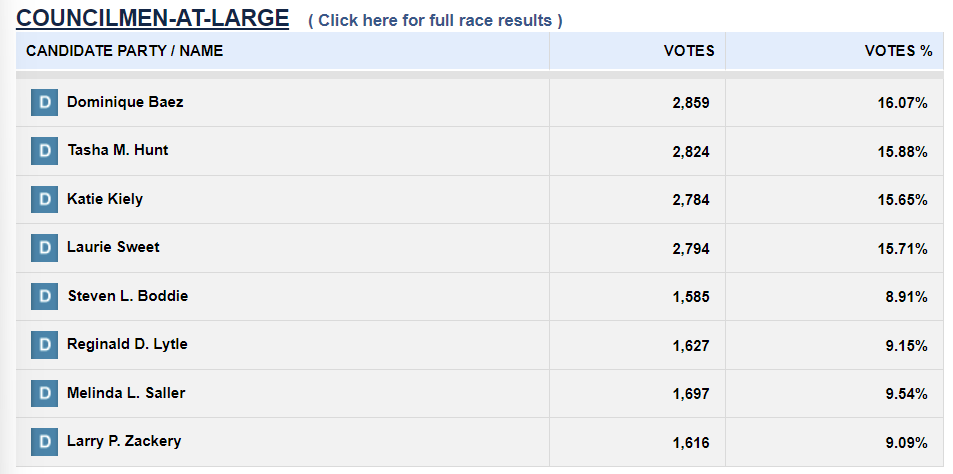
Race Rating: Likely Row A: Crouch, Foley, Hunt, and Kiely
Councilman Districts 6-9
District 6
Endorsed Candidate: Renee Hoff
Challenger: Grace Teodosio
District 7
Endorsed Candidate: Adrian Webber
Challenger: Kathleen Muolo
District 8
Endorsed Candidate: Ted Stevens
Challenger: James Baker
District 9
Endorsed Candidate: Tameeka Parks
Challenger: Barbara Walker
Endorsed candidates are also likely to win in the councilman districts. In 2023, all endorsed candidates won their primaries by at least ten points.
In District 7, Adrian Webber won by over 30 points against his challenger, so he is likely safe. District 8 is a rematch between Ted Stevens and James Baker. Stevens won 57-42.
However, since most of these primaries had around 500 voters, slight changes in turnout can change the races dramatically.
barThe strongest challenge will likely be from Grace Teodosio in the 6th district, whose detailed platform and presence online can help her in a low-turnout primary. She also faces Renee Hoff, who was appointed to the legislative council in April and, therefore, has not run in a Democratic primary.
The District 9 race can also be unpredictable, as Walker was the nominee for District 9 in 2023. However, she lost to her Republican opponent, James Anthony, 45-55. The only Democrat on the ballot to lose the election. Due to this loss, Parker is favored. But Walker still holds her name ID from her previous run.
Race Rating
District 6: Lean Hoff
District 7: Likely Webber
District 8: Likely Stevens
District 9: Lean Parks
New Britain Democratic Primary
Ward 4
In New Britain, the mayoral race will likely take a lot more attention in November. However, for the Democratic primary for Ward 4 Alderperson, Incumbent councilman Neil Connors is challenging the endorsed slate of John McNamara and Luz Ortiz-Luna.
Connors received some attention last month when his wife, Allison Cappuccio, was assaulted after being punched in the head by a woman. This was caught on security footage shortly after the meeting leaders announced that Connors would not be receiving the party’s nomination. The woman was later to be revealed as the daughter of Luz Ortiz Luna, who was a minor, however.
The incident was a reaction to the nomination of Luz Oritz-Luna, who was a Republican turned Democrat. Cappuccio told the CT Examiner that Committee Democrats urged Connors, who is an attorney, to be quiet after being passed for nomination. In return, they promised him legal work.
Later, Ortiz Luna said she was unapologetic about the assault. This was because she accused Alderman Connors’ wife of harassing her and her kids during the entire meeting. She said the harassment was due to Connors not getting the endorsement.
The Republican Committee then blasted Democratic State Leaders Senator Richard Blumenthal and Lieutenant Governor Susan Bysiewicz for participating in the New Britain Democratic Campaign Kickoff following the incident on Cappuccio. They said that they should not be involved with the campaign at all since Cappuccio has a chronic illness, and their decision to campaign with anyone associated with the incident is hypocritical, since they did not talk about it at the event. Not like this criticism makes sense, but this shows how high the tension is amongst both parties in New Britain.
Race Rating
Voters might believe either side of the story. In addition, since the incident didn’t involve either candidate directly, it’s harder to assess the impact of the situation and how much voters will care about it.
I’m not exactly sure how this primary will go. It’s not guaranteed that Democratic primary voters (who tend to be the most partisan) will vote for a Republican turned Democrat, especially one who was recently a Republican. However, it should be noted that Ortiz-Luna was a Republican At-Large member who broke with Erin Stewart’s administration on some issues and was eventually excluded from Stewart’s slate 2 years ago. This impressed many Democrats, as she stood up. Connors, on the other hand, was considered by many local legislators to be unreliable on key Democratic values.
I think McNamara wins handily. He was made a leader of the new majority Democratic caucus on the council as a first-year member. I think voters will be more split between Ortiz-Luna and Connors, but I think Ortiz-Luna will hold on against him narrowly at the end of the day.
Race Rating: Likely McNamara/Lean Ortiz-Luna
New Haven Democratic Primary
Unlike in 2023, there is no Democratic primary for Mayor this time around. Mayor Justin Elicker was unopposed for the nomination. There are a few races for Alderperson of different wards, however.
Ward 1
Ward 1 has an interesting situation going on. None of the candidates received the party endorsement. So no candidate appears on Row A on the Ward 1 ballot. There was no incumbent in this district, as one-term incumbent Democratic Kiana Flores was not seeking reelection.
Since the local Democratic party decided not to endorse anyone, all candidates had to collect at least 43 signatures. The committee did include Norah Laughter and Flores. The Democratic Committee hadn’t met for many years, but was revived last year. Laughter and Flores felt it was fair for everyone to get signatures, as so many people were running. They felt the voters should decide, not the committee, which included themselves.
The district notably covers part of downtown and some of Yale University’s campus. So the election is made up of mainly Yale Students. Ward 1 fully encompasses eight of Yale’s fourteen residential colleges.
There are three candidates for the position. Laughter, Elias Theodore, and Rhea McTieman Huge, all students of the university.
With such a small voting bloc, it’s likely a toss-up, as the three candidates also have to contend with some of the voting deadlines that coincide with freshman students moving into dorms. Laughter has the most experience on the committee, but Theodore has raised a surprising $2650 from supporters.
Race Rating: Toss-Up
Ward 3
Miguel Pittman is challenging Incumbent member Angel Hubbard, who narrowly bested him in the September 2024 special election last year. Hubbard received 162 votes in that race, and Pittman had 146 votes. Hubbard had the endorsement of New Haven Mayor Justin Elicker.
No matter the result, Pittman will be on the ballot in November as he secured both the Independent ballot line and the Republican ballot line. Though in such a Democratic city, his best shot is in the Democratic primary.
Hubbard is Ward 3’s Democratic Ward Committee Co-Chair and a home healthcare provider. Pittman co-runs Sandra’s Next Generation restaurant.
Since Hubbard won the first time, and now has the benefit of incumbency. I believe the race favors her over Pittman.
Race Rating: Likely Hubbard
Ward 18
In Ward 18, Zelma Harris is challenging the endorsed candidate, Leland Moore.
Harris gathered just over the 68 signatures she needed to make the primary ballot. She almost forgot to put her own signature on her petition, but she narrowly put it just in time for it to count.
Harris is also an accountant who hopes to bring her mathematical skills to the board. Ward 18 consists of the neighborhood of Morris Cove. This neighborhood has both the highest home ownership rate in the city and is the ward where Republicans tend to have the most support (Trump got 41% of the vote here). The ward also contains a lot of coastal parkland, a coast guard station, parts of the airport, wastewater treatment facility, so it has a lot of different infrastructure in it.
Leland Moore, an Assistant Attorney General, says he is interested in being more involved in his neighborhood. He envisions advocating for his neighbors’ quality of life concerns due to the airport and traffic congestion.
I think Moore is favored here, but Harris can definitely give him a good challenge.
Race Rating: Likely Moore
Note: Some articles note a primary in Ward 16, but the Secretary of State website did not include it on the sample ballot.
New London Democratic Primary
In New London, unlike other Democratic primaries, only two candidates have challenged the endorsed slates of candidates.
Incumbent City Councilor Jefferey Hart is challenging the seven endorsed Row A candidates on the City Council. Incumbent Board of Education President Elaine Maynard-Adams is challenging the seven endorsed Row A candidates on the Board of Education.
As with many towns with primaries on the 9th, these two incumbents failed to receive the party endorsement after what was reported as a “rowdy” Democratic convention.
Candidates need 5% of the city’s registered and active Democratic voters to sign a petition to force a primary; 341 signatures total. Both successfully completed this task and were confident in their prospects in doing so.
As New London’s The Day reports, both Hart and Maynard-Adams are sharp critics of Democratic Mayor Michael Passero. This led to being left off the endorsement list.
Maynard-Adams tied with newcomer Nanci DeRobbio is the first vote for endorsements, but DeRobbio edged Maynard-Adams 25-24 in a subsequent vote. Hart, likely knowing he would not win a nomination, declined to be nominated, telling delegates he would prefer to force a primary election.
Though incumbents being left off endorsement lists isn’t uncommon (as evidenced by multiple primaries), a Board of Education president being left off the endorsed slate is surprising. Maynard Adams has been a board member for 18 years, eight as president.
Hart and Maynard-Adams have criticized Mayor Passero for his recommendation to flat-fund the school district budget for the upcoming year. Mayor Passero, for his part, is not up for re-election until 2027. Hart, in particular, has criticized Passero on school funding and the creation of a tax-rate stabilization account.
Race Rating
The top seven candidates (out of eight) will move on to the general election. Democratic candidates in New London (Which voted for Kamala Harris 71-26) are heavily favored, and all seven Democratic candidates (on both the city council and the board of education) will likely be elected to the city council.
These types of Democratic primaries are unique as unlike slates of candidates competing against one another, both Hart and Mayard-Adams have to convince Democratic primary voters to leave off one candidate on the endorsed slate, since voters can pick seven of the eight candidates running for each position.
Since their ire is against the Incumbent Mayor, and not any particular board member, it is more difficult for voters to differentiate between candidates and pick one to not include. This is unless a strategy hinges on voters only voting for one of the challengers, which is unlikely without a full slate of challengers.
However, since Maynard-Adams is a long-term incumbent, I give her a better chance than Hart (who has the CT DSA endorsement) to survive a Democratic primary. Hart also received the second-lowest amount of votes of any other Democrat on the City Council in 2023, which isn’t a great sign for him.
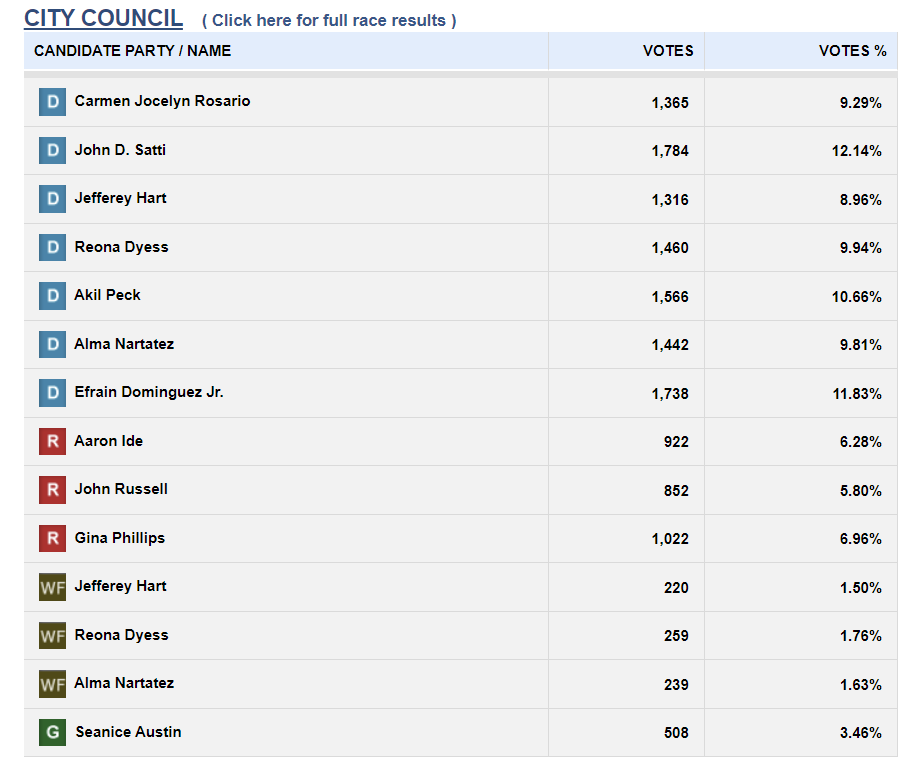
Maynard-Adams performed similarly to other candidates on the Board of Education that year. However, I would say the Row A endorsed candidates are favored in both of these primaries.
Race Rating (City Council) – Likely Row A (Party Endorsed Candidates)
Race Rating (Board of Education) – Lean Row A (Party Endorsed Candidates)
North Haven Democratic Primary
There is no competition in November for the position of First Selectman in North Haven. Incumbent Republican Michael Freda is running unopposed for another term.
How selectman boards work in North Haven (and in most towns) is that Democrats and Republicans run someone for both First Selectman and Selectman. However, three members form the selectboard. Whoever wins, the position of First Selectman is self-explanatory. The two positions of Selectman are slightly more complicated. The loser of the position of First Selectman can be a member of the selectboard if he received more votes than his party’s selectman candidate.
However, in North Haven, since no Democrat is running for First Selectman, all three members on the ballot for First Selectman and Selectman will win in November, so whoever wins the Democratic primary will be on the selectboard come November. Although Kamala Harris lost North Haven 45-53, Democrats are not putting up a candidate, despite it likely being a bluer year. This is likely because in the 2023 Local Elections, the Republican selectman candidate got over 64% of the vote, so Democrats don’t think they can compete for the position and would rather settle who wins the Select Board position in a Democratic primary.
Democrat David Cohen won a unanimous endorsement from the local party over longtime Selectwoman Sally Buemi.
Cohen is a North Haven volunteer firefighter, a local small business owner, and an in-house counsel for a CT-based Fortune 500 manufacturing company
Buemi, a 12-year incumbent, told the local party that she would primary the endorsed Democratic candidate, saying, “I am confident that I’m the most qualified candidate.”
Race Rating
Buemi faced a controversy in June dubbed “popsicle-gate” by locals. Some were unhappy that Buemi and Democratic Board of Finance member Nancy Barrett didn’t like the effort of the PTA selling free Popsicles to all residents during a recent budget referendum vote by town voters. The referendum passed by a 2-to-1 margin.
Buemi said the optics were poor, and she saw it as a commercialization of voters’ votes. Buemi, though, told a reporter that she was likely not to receive the town party’s endorsement in July, so it’s unlikely that this prompted the local party not to endorse her. A falling out likely happened before this.
Buemi was against the town referendum so which could have contributed to her not getting the town endorsement. Cohen was an outspoken supporter of the referendum, which provided funding for public schools, police and fire departments, and other town services and programs.
This primary feels like an instance where local Democrats want a change, a common sentiment among Democrats post the 2024 Presidential Election. Cohen told the local Democratic town committee after he won their endorsement, “Our party and our town are ready to move in a new direction…”
Cohen is likely favored, though Buemi’s long tenure should give her a fighting chance; she has frequently underperformed the partisan lean of the town.
Race Rating: Likely Cohen
Norwalk Democratic Primary
Along with Hamden, this is one of the primaries I will be paying most attention to on the 9th.
Longtime Incumbent Mayor Harry Rilling is retiring after 12 years as Mayor. Two Democrats are looking to succeed him. A Democrat is favored in a town that Kamala Harris won comfortably, 64-35. Though the 2023 Mayoral Race was much closer at a 55-45 win for Rilling, a Democrat is still heavily favored to lead the sixth most populous city in the state.
The primary election is between Common Council President Barbara Smyth and Common Council Member Darlene Young. Smyth won the endorsement of the town committee.
For additional information on Norwalk Politics, I highly recommend the publication Nancy on Norwalk for local coverage, but I’ll summarize some stuff here.
Common Council Member Darlene Young forced a primary against Smyth by gathering far over the required 1,033 signatures, with nearly 1300 sent to Norwalk’s Democratic Registrar of Voters.
Unlike some other primaries around the state, though an intense race, the local Democratic committee had no ill will towards Young. Chair of DTC Colin Hosten congratulated Darlene for meeting the signature requirement for the primary and said it’ll allow residents to hear from both sides. He also stressed party unity for the general election hoping not to have intra-party fights that can affect results.
It should also be noted that the DTC endorsement was very close between Young and Smyth. Young narrowly lost 25 votes to 29 votes. A close result that likely signals a close race.
Multiple committee members remarked that both women have the strength, dedication, and leadership needed to be mayor. Smyth is a retired teacher and four-term council member. Young is a seasoned city employee and incumbent council member.
This is a rare occasion in Norwalk; the city hasn’t had a primary in over a decade for local offices, so we don’t have much of a baseline to go off.
I would say this race is a toss-up despite Smyth’s endorsement. I don’t think she is favored that much, and Young could easily win. Both women have bases of support and elected experience, so I think residents would be similarly split between the two candidates.
There will be a debate on September 4th at Norwalk Public Library’s Main Branch from 6:30 pm to 8:00 pm.
Race Rating: Toss-Up
Oxford Republican Primary
Oxford, one of the redder towns in the state, has a primary election for the position of First Selectman and Selectman.
Incumbent First Selectman George Temple and Incumbent Selectman Arnold Jensen are challenging party-endorsed candidates Jeffrey Luff and Rob Boroski.
Longtime Incumbent George Temple expected to leave office on his own terms. Though at age 79, Temple was ready to run for an 8th term as First Selectman.
Temple found himself surprised that his challenger was his longtime protege Jeffrey Luff. Someone that Temple said was someone he saw as his successor. Luff, Oxford’s economic development director, discussed the importance of new energy and said that Luff “had lost his fastball”. Temple says the town continues to thrive.
Luff has served on various boards in town since 2006, though he announced his run earlier in February because he needed to gain some name ID. Temple feels strong about his accomplishments as First Selectman, including significant growth and development, says he’s still running again.
Temple also said that Luff’s selectman partner, Robert Baronowski, a local police officer, would need to “recuse himself” from a lot of town matters on police budgets and contracts, which is not helpful.
The Republican Party Endorsement in July was razor-thin. Luff won the endorsement by 6 votes, 157-151. This represents the close tension, not only between the longtime incumbent and his protege, but Republican primary voters. The race was even closer for Selectmen, where Luff’s running mate Borowski won an even narrower 155-153 victory over Temple’s running mate Arnie Jensen.
In a town that Trump won comfortably 60-39, the Republican primary will essentially determine who the First Selectman and Selectman of Oxford are.
I expect a razor-thin race here as Temple still seems to be popular, but some Republican voters want a change. I am leaning towards Temple retaining his job due to his long-time incumbency. Huff will give him the strongest challenge of his political career.
Due to the expected close nature of this race, I’m adding a toss-up as well to indicate it will be closer than other races I marked as Lean, but still used Lean to indicate who I think would come out victorious.
Race Rating: Lean Temple/Toss-Up
Plainfield Republican Primary
Similar to Oxford, Plainfield also has a Republican primary for the position of First Selectman and Selectman. Again, it’s a case of incumbents without the Republican endorsement against party-endorsed candidates.
Incumbent First Selectman Kevin Cunningham and Incumbent Selectman Arthur Gagne are challenging the endorsed party candidates, Paul Sweet and Michael Surprenant.
The big difference between Oxford and Plainfield is, as the publication The Day puts it, the continuing saga of a nearly 20-year-long political feud between Kevin Cunningham and Paul Sweet.
Paul Sweet, the former Democratic First Selectman of Plainfield, is making a comeback as a Republican. Sweet was the First Selectman from 1989 to 2001, and from 2007 to 2017. Sweet is now attempting his third non-consecutive tenure as First Selectman. He became a Republican in the spring, noting how the Democratic party “left” him long ago.
The surprising thing is, he isn’t the only former Democrat in this race. Lo and behold, the 2005 winner of First Selectman was Democrat Kevin Cunningham. You read that correctly, both Cunningham and Sweet are former Democratic First Selectmen and are now both Republicans, running against each other. I don’t know many examples in the state (or the country, for that matter) where this scenario has happened, but here we are.
Selectman Cunningham won in 2005 as a Democrat with only 42% of the vote, after the vote was split between a write-in Candidate and a Republican. In 2007, Cunningham ran for re-election on both the Democratic and Republican lines. However, he lost to Sweet, who ran as a petitioning candidate 47-53. Cunningham attempted a rematch against Sweet in 2009 as a petitioning candidate, though he lost in a landslide 19-81. A decade later, in 2019, Cunningham finally made his comeback, ousting Incumbent Selectwoman Democrat Cathy Tendrich in a narrow 48-44 victory. Cunningham has won comfortably ever since.
Race Rating
Sweet says he’s pulling out of retirement because he’s concerned the town is “compromising the integrity of the fund balance“. He also cites his dislike of Cunningham, saying he’s driving the town into the ground and people don’t see it.
Sweet didn’t run for re-election in 2017, saying he had a disillusionment with state and federal tape. He also noted the difficulty of the job. Clearly, the recent budget referendums have made him want to be back in the seat.
Recently, in a budget referendum, the Board of Finance and voters pulled $1.2 million from this balance to offset a tax rate increase. The largest appropriation in town history. Cunningham supported this, saying the new tax revenue from Uline and Amazon will supplant the need for this action again. The budget, however, took 4 tries by voters to pass in the end. All 3 amendments failed the first two times, and one failed the third time.
Cunningham got the 146 signatures needed to force a Republication primary.
Now I’m conflicted in this race. Sweet currently has the momentum in this race by garnering the town endorsement. He has also won a general election without a ballot line. However, he will need to win Republican voters as a former Democrat. I’m curious how he contends with that. Cunningham is a long-term incumbent who has already proven himself with Republican primary voters. But losing the primary endorsement isn’t an amazing sign for an incumbent. Honestly, it’s anyone’s race
Race Rating: Toss-Up
Stamford Democratic Primary
Note: The Secretary of State’s website oddly only lists the primary in the 8th District for the Board of Representatives. However, there are Democratic primaries confirmed in six districts.
Last week, I discussed a lot of context about the infighting between Stamford Democrats. The two factions have had many disagreements over many issues in the town, ranging from the town charter to the Democratic Town Committee position. More context for this race can be found in my article listed here.
In the article, I discussed a lot of context, but didn’t discuss the candidates too much, so I will do that here.
District 5
Incumbent Bonnie Kim Campbell will challenge party-endorsed candidates Nicole Beckham and Kierra Dorsey.
Campbell is a two-term incumbent who has served on the Land Use and Urban Redevelopment Committee, as well as committees on public safety, housing, and social services.
Beckham is a founder of the NorMel Foundation. She also has more than 30 years of experience in the human services field. Dorsey has worked for the Connecticut judicial branch for over 15 years. This information was found on the Stamford Endorsed Dems Website.
Campbell won a primary in this district in 2021, but she had the party endorsement at the time. Also, if she wins, she would have to beat one of the two endorsed Democrats, and neither has an edge over the other. At the moment, I would say these lean towards the party-endorsed candidates, but I would not be surprised by a win by Campbell.
Race Rating: Lean Beckham and Dorsey
District 6
Incumbent Denis Paterson and longtime former member of the Board Lindsey Miller will challenge party-endorsed candidates Ryan Hughes and Parker Johnson.
Paterson joined the board in 2015. He is a member of the Steering Committee and Personnel Committee. He is the owner of Diversified Ventures. Miller was a former member of the board in the 7th District. He was a member for over a decade; however, he resigned last year after moving into the 6th district. Miller is a retired IBM Financial Executive.
According to the 2025 Endorsed Democrats Stamford Website. Hughes was a policy analyst in the State Senate. He is also a member of CT’s Bipartisan Infrastructure Law Team. Johnson works in the renewable energy industry.
If there is any race in Stamford, I think the challengers can prevail over the endorsed candidates; I think it’s this one. As a longtime member, Paterson should have the name ID to hold his spot, and Miller’s long tenure on the board should also give him a leg up against the challengers. The party endorsement in Connecticut, though, is very valuable, however, so I expect this race to be very close. I will give the edge to Paterson and Miller, though.
Race Rating: Lean Paterson and Miller
District 8
Incumbent Anabel Figueroa is challenging the party-endorsed candidates in District 8. President of the Board Nina Sherwood and Theo Gross.
Sherwood was recently elected President by the Board of Representatives after former President of the Board Jeff Curtis died in July. Sherwood has been on the board since 2017. Sherwood has been seen as a consistent check against Mayor Caroline Simmons.
Gross is experienced in local campaigns and a statewide scheduler for Senator Richard Blumenthal (D).
Figeruoa has been on the board for over 20 years, winning a seat in District 8 in 2001. However, controversial comments that received national attention last year resulted in her having a brutal loss in the Democratic Primary against her opponent for her state House seat in the 148th district. I covered this in greater detail in this article.
Due to these comments and the fact that Democratic Primary voters already voted Figueroa out of office within the last year. She might have a loyal base, but I don’t think it would be enough for a victory on the 9th.
Race Rating: Likely Sherwood and Gross
District 10
Brittany Lawrence is challenging party-endorsed candidates Felix Gardner and Stephanie Sylvestre in a primary.
According to the Endorsed Democrats Website, Gardner is a software engineer. Sylvestre is an educator and social worker.
Lawrence, a resident of the BLVD apartment complex, was an outspoken opponent of turning the building into student housing.
There is no incumbent in this district, so no one has an advantage other than the party endorsement. Due to this, Gardner and Sylvestre are favored. But the lack of an incumbent could mean Lawrence could pull out a victory.
Race Rating: Lean Gardner and Sylvestre
District 13
Dave Adams is challenging party-endorsed candidates and incumbents Eric Morson and Amiel Goldberg.
Morson was elected to the board in 2017. Goldberg was elected in 2021. Morson, the vice chair of the Board’s safety and health committee. Goldberg is a member of a committee that deals with housing, community development, and social services.
According to the 2025 Endorsed Democrats Website, Goldberg has more than 35 years of experience in financial risk management. Morson has more than 30 years of experience as a financial advisor and has been a tax partner for over 20 years.
Adams is known to frequently attend meetings of the Board of Representatives and the city’s land use boards.
Due to their incumbency, I expect Morson and Goldberg to comfortably win this race.
Race Rating: Likely Morson and Goldberg
District 17
Incumbent Sean Boeger and Rosa Colon will challenge Party-endorsed candidates Lewis Finkel and Incumbent Bobby Pavia.
Pavia was first elected in 2021 and is the vice chair of the personnel committee. According to the 2025 Endorsed Democrats Website, Finkel is a retired CCSU adjunct professor of Construction Estimation.
Redistricting moved Boeger into the 17th district. Boeger was also elected in 2021 and is a Stamford Police Sergeant. He is co-chair of the fiscal committee. Colon is a 21-year-old veterinary student.
Boeger and Colon lost a recent election in 2024 to be members of the DCC in District 17. A race with a similar turnout to a primary, only a year ago. Because of this recent loss, I think Pavia and Finkel are favored.
Race Rating: Lean Pavia and Finkel
Stratford Democratic Primary
Mayor
For the mayoral race, Linda Manos is challenging party-endorsed candidate David Chess in the Democratic primary. The winner will have an uphill battle against Republican incumbent Laura Hoydick.
Despite Kamala Harris winning Stratford by a comfortable 59-40 margin. Republican mayor Laura Hoydick won a landslide 63-37 victory in 2021. She is running for a third 4-year term.
Hoydick was a former State Representative in the 120th district, before she won her first term in 2017 in a closer 50-44 win.
David Chess, a doctor and businessman, overwhelmingly won the support of the Stratford Democratic Town Committee, winning a vote of 53-7 over Manos. Manos, the former owner of Pepin’s restaurant and vice-chair of the town’s zoning commission, successfully gathered 650 signatures for the primary.
Despite her struggles with the Democratic Town Committee, Manos said she submitted over 1,000 signatures, indicating she clearly has support in the primary. Manos said it is important for voters to decide, and not appointed officials on the committee.
Chess and Manos are running on similar platforms. Chess’ website discusses expanding the economic base of the town and how to raise revenue to lower taxes. He also discusses investments in education and infrastructure.
Manos similarly discusses the issue of the tax burden on residents and hopes to attract business to reinvigorate the town’s economy. She hopes to use her 30+ years of business experience to facilitate this plan. Her plan includes a 10-point plan to revitalize Stratford.
For the Democrats complaining about the age of politicians this year. This is probably not the primary for you. CTInsider lists Chess as 72 and Manos as 77.
This race will likely be close. Two experienced people in their careers, Manos a long business career, and Chess, a longtime physician and founder of PriMed. Manos has a bit more political experience due to her vice-chair on the town’s zoning commission. However, I believe that Chess’s institutional support from the Town’s Democratic Town Committee would bring him over the top and give him the opportunity to face Hoydick in November.
Race Rating: Lean Chess
Town Council
District 3 and District 4
Stratford’s Town Council operates as individual districts, not at-large, like many other towns in the state. There are ten members on the legislative body. Some might recognize District 5’s Anthony Afryie, who ran in a special election in the 21st State Senate district earlier this year. There are two primaries, one in District 3, another in District 4.
In District 3, Incumbent Town Councilor Alvin O’Neal is challenging party-endorsed candidate William Boyd, a town constable member. The reported reason, according to the CT Post, is that members of the town committee are frustrated at O’Neal occasionally siding with Republicans on town council votes. So the committee threw their support to Boyd over O’Neal. O’Neal had the party endorsement in the 2023 primary, winning 63-37. However, with only 200 votes, the endorsement can flip the result against him this time around.
In District 4, Incumbent councilor Rene Gibson has received the party endorsement of the local town committee. However, he faces a challenge from former town councilor David Harden.
David Harden, a three-term member of the council, attempted to win his seat back in 2023 after a two-year absence from the council. Interestingly, Stratford Town Council Members only have a three-term limit; however, after a two-year break (one term), they can run again.
Harden is known to not have a great relationship with the local party. He failed to submit enough signatures to qualify in 2023, but he successfully did so this time.
O’Neal had the party endorsement in the 2023 primary, winning 63-37.
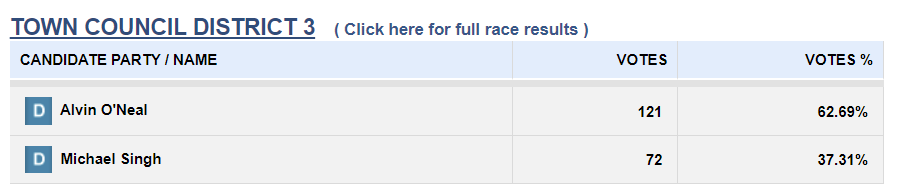
However, with only 200 votes, the endorsement can flip the result against him this time around. This is honestly what I expect, and I believe Boyd will win this election. In these types of elections, with fewer than 200-300 voters. It’s about turning out your supporters. Due to such low turnout, it’s unpredictable, but in this type of election, I usually lean towards the endorsed candidates.
Race Rating
Council District 3: Likely Boyd
Council District 4: Likely Gibson
Waterbury Republican Primary
A few weeks ago, I talked about with no mayoral race on the ballot this year, there is a lot of attention focused on the Board of Aldermen races.
There were challenges against both the Democratic and Republican candidates. However, surprisingly, all the Democratic challengers failed to gather enough signatures to force a primary. But all Republican challengers did gather enough signatures to force a primary.
Endorsed Candidates Have an * Next to Their Name. Incumbents have an (I) next to their name.
For more details on the context behind the primary. I will link the article I wrote here.
District 1
Michael Grosso*
Jameson Stock*
Mary Grace Cavallo (I)
Amanda Nardozzi
District 2
Andrew Clisham*
Ruben Rodriguez* (I)
Crystal Gordon-Diaz
Bryan McEntee
Joshua Brenner
District 3
John “Jack” Alseph* (I)
Adrian Sanchez*
Efrain Torres III
District 4
Abigail Diaz*
Kelly Zimmermann* (I)
Andre Michaud Jr
District 5
Allen Leon*
Reynaldo Melendez*
Paul Kondash
George Noujaim (I)
Race Rating
Waterbury GOP Chair Dawn Maiorano is hopeful that Republicans can whittle down Democratic majorities in November, as many incumbents are not running for re-election. Democrats have a maximum ten of the fifteen total seats on the board currently.
Two incumbents, both Cavallo and Noujaim, did not receive the town endorsement. GOP leaders felt they were too close and cooperative with the Democratic majority.
Cavallo, however, has won without the town endorsement before. In the 2023 Republican primary, she won a seat, beating one of the two party-endorsed candidates, Republican Gary Hychko.
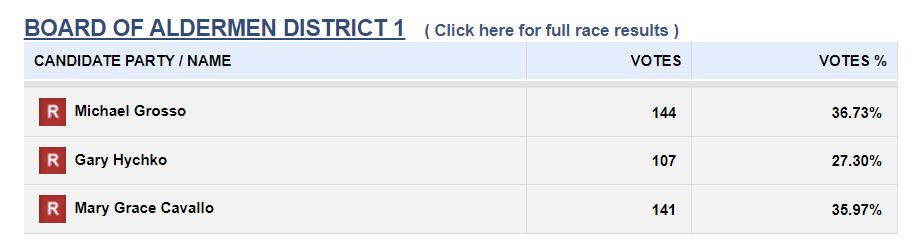
Though again, it is a low turnout race, I believe she could likely do so again. The problem is I’m not exactly sure which of the two candidates she could beat out, or if she could take her partner on the same slate as her over the line (the top two candidates move on in all five primaries).
Because of this, I’m listing District 1 as Lean Cavallo/Toss-Up (2nd Seat). In Districts 2-4, I believe the endorsed candidates will win easily. In District 5, it’s possible Noujaim has a chance, but I’m leaning towards the endorsed candidates. However, since all these primaries are low turnout, I’m expecting at least one of my predictions to be incorrect, and an upset to occur. Which one, I’m not sure, we will have to wait and see.
Race Rating
District 1: Lean Cavallo/Toss-Up (2nd Seat)
District 2-4: Likely Row A (Party-Endorsed Candidates)
District 5: Lean Row A (Party-Endorsed Candidates)
Wolcott Republican Primary
Wolcott has a unique Republican primary happening on September 9th.
11-term incumbent mayor Thomas Dunn is not on the ballot. This is not a surprise, as Dunn typically runs as an unaffiliated petitioning candidate in November.
However, his 4-term streak of unopposed elections will come to an end. He will face someone on the Republican ballot; however, they both have very different objectives in their candidacies.
Government Affairs Consultant James Paolino is seeking to block Sales Manager Paul D’Angelo from obtaining the Republican line on the November ballot.
Both Paolino and D’Angelo are not newcomers to Wolcott Politics. D’Angelo is a former member of the Town Council and Board of Education, and Paolino is a longtime member of the Republican Town Committee and the Water and Sewer Commission.
Paolino says he will not campaign if he wins the Republican Party nomination. Holding the Republican Town Committee endorsement, his sole goal is to ensure that D’Angelo does not receive the nomination and campaign against Mayor Dunn.
D’Angelo argues that there must be a candidate for mayor, and it would allow a serious conversation about the town. Essentially, D’Angelo wants to offer voters an alternative to the longtime incumbent mayor. He also notes that the town hasn’t nominated a Republican since 2001. D’Angelo is already on the ballot in November as a petitioning candidate, gathering the necessary 200 signatures needed to do so.
However, Paolino and local Republicans on the Town Committee see the situation differently. Paolino has long been a placeholder on the ballot, as no one has come forward to run as a candidate. He says that they don’t want D’Angelo representing Republicans due to an arrest he had last year stemming from a domestic dispute. In addition, he was sued by Wells Fargo for not making monthly payments. Paolino also says D’Angelo has changed his Republican affiliation multiple times.
D’Angelo argues back that there was no violence in the reported incident. He expected the charge of 3rd degree assault, for which he apologized on social media, to be dismissed. He also said he was a Republican before, but became an unaffiliated candidate when he won his town council seat in 2021.
An Op-Ed by UConn Professor Drew McWenney, published by CTInsider, accuses Paolino of saying anything to win the primary, and says his cheap smear tactics won’t work.
I think D’Angelo is trying to force a conversation on the incumbent mayor will work on Republican primary voters who haven’t had a choice in years on the ballot. Though Dunn is heavily favored in November, and despite the accusations, a campaign to block someone else, I’m not sure would work for Republican primary voters.
Race Ratings: Lean D’Angelo
Overall Race Ratings
| Race | Race Rating |
| Bloomfield Democratic Primary All Offices | Likely Row A (Party-Endorsed Candidates) |
| Bridgeport Democratic Primary Council Race District 137 Council Race District 138 | Likely Nieves and Valle Lean Pereria and Medina |
| Chester Democratic Primary First Selectman | Likely Lignar |
| Greenwich Republican Primary Board of Estimates and Taxation | Toss-Up |
| Griswold Republican Primary Selectman | Lean Canova |
| Haddam Republican Primary Town Clerk | Lean Siegrist |
| Hamden Democratic Primary Mayor Councilman At Large Seats Councilman District 6 Councilman District 7 Councilman District 8 Councilman District 9 | Lean Baez Likely Row A: Crouch, Foley, Hunt, and Kiely District 6: Lean Hoff District 7: Likely Webber District 8: Likely Stevens District 9: Lean Parks |
| New Britain Democratic Primary Ward 4 Alderperson | Likely McNamara/Lean Ortiz-Luna |
| New Haven Democratic Primary Ward 1 Alderperson Ward 3 Alderperson Ward 18 Alderperson | Toss-Up Likely Hubbard Likely Moore |
| New London Democratic Primary City Council Board of Education | Likely Row A (Party-Endorsed Candidates) Lean Row A (Party-Endorsed Candidates) |
| North Haven Democratic Primary Selectmen | Likely Cohen |
| Norwalk Democratic Primary Mayor | Toss-Up |
| Oxford Republican Primary First Selectmen Selectmen | Lean Temple/Toss-Up Lean Jensen/Toss-Up |
| Plainfield Republican Primary First Selectmen Selectman | Toss-Up Toss-Up |
| Stamford Democratic Primary Board of Representatives District 5 District 6 District 7 District 10 District 13 District 17 | Lean Beckham and Dorsey Lean Paterson and Miller Likely Sherwood and Gross Lean Gardner and Sylvrestre Likely Morson and Goldberg Lean Pavia and Finkel |
| Stratford Democratic Primary Mayor Town Council District 3 Town Council District 4 | Lean Chess Likely Boyd Likely Gibson |
| Waterbury Republican Primary Board of Aldermen District 1 Board of Aldermen District 2-4 Board of Aldermen District 5 | Lean Cavallo/Toss-Up (2nd Seat) Likely Row A (Party-Endorsed Candidates) Lean Row A (Party-Endorsed Candidates) |
| Wolcott Republican Primary Mayor | Lean D’Angelo |

Fazio is Launching an Exploratory Committee for Governor
State Senator Ryan Fazio (R-Greenwich). Source: CT Senate Republicans
Overview
State Senator Ryan Fazio (R-Greenwich) launched an exploratory committee for governor last Friday. The field of Republican field has many names, but no one seems to have a firm grasp on the nomination.
Fazio, who won his second full term in November, has to decide in the next few months if he wants to take on the difficult task of running for Governor. A serious campaign would involve strategic considerations and an intense amount of fundraising, especially if Fazio has to run against the well-funded Gov. Lamont. Fazio would also have to leave his Republican State Senate seat, which would be vulnerable to a Democratic flip in 2026, further pushing Republicans into a deep minority in the State Legislature.
Background
Born in Connecticut and grew up attending the Greenwich Public Schools. Fazio went to Northwestern University, where he studied economics, graduating in 2012.
Fazio spent most of his career working in commodity markets, specializing in renewable energy. This market included the movement of millions of tons of agricultural and energy goods around the world.
He has spent time volunteering in inner-city charter schools. Currently, he volunteers for the organizations Greenwich United Way and Meals on Wheels
Currently, Fazio is the Vice President of Growth Equity Firm. The firm invests in medium-sized businesses and advises their management to help them grow.
Political History
Fazio’s first elected office was as a member of the Greenwich Representative Town Meeting in 2019. As one of the members of the 230-member legislative body of Greenwich, Fazio served on the finance committee.
In 2020, Fazio attempted his first major run for office against Democratic Incumbent State Senator Alex Kasser. Kasser represented the 36th State Senate District. A district Kasser won in the 2018 blue wave against the Republican incumbent, L Scott Frantz, in an upset 50-49.
Fazio narrowly lost the seat 49-51, despite Biden carrying the district by nearly 20 points during the presidential election.
The 36th State Senate Seat, part of Connecticut’s Gold Coast, was long a Republican stronghold on the federal level until the mid-2010s. The seat had been in Republican hands from 1930 till Kasser’s win in 2018. The district took a massive shift to the left in 2016, voting for Mitt Romney by 10 points (54-44), to voting for Hillary Clinton by 18 points (57-39). However, Republicans have still done well in local and legislative elections in recent years.
Fazio, though, didn’t have to wait long for another chance. Kasser resigned from office in June 2021, leading to a summer special election. Fazio ran against Democrat Alexis Gevanter, and he prevailed 50-48.
Now an incumbent, Fazio still had a tough race in 2022, due to the Democratic lean of the district at the federal level. However, he came out the narrowest of wins against Democrat Trevor Crow, winning a 50.1-49.9 squeaker.

2022 36th State Senate Seat Election. Fazio narrowly held on by 89 votes. Source: CT Secretary of State Website
2024 Election
Democrats in Connecticut had their eyes set on taking out Fazio during the 2024 Presidential Election. Democrats heavily recruited and found a strong candidate in former Deputy Chief of Staff to Gov. Lamont, Nick Simmons.
Simmons boosted a great resume, including a bachelor’s from Yale, a Master’s in Public Policy from Harvard Kennedy School, and an MBA from Harvard. Simmons worked a short stint at the UBS Investment Bank before becoming a 7th-grade math teacher in Harlem, NY. Soon, Simmons was acting principal of the school at age 26, one of the youngest in New York. After a stint in the Biden administration as a senior advisor and in Lamont’s governor’s office, he gave Fazio a tough fight ahead of him.
Though Fazio proved he could win this district despite difficult headwinds, he still had to face heavy spending. Simmons not only had the resume but was able to fundraise well due to heavy political backing from his sister, Mayor of Stamford Caroline Simmons. This led to Fazio facing not only Simmons’s 500k fundraising but also nearly $400k in outside spending.
Simmons, knowing the blue leanings of the district, tried to associate Fazio with Trump, citing Fazio’s votes on guns, abortions, and reproductive healthcare on the campaign trail. Simmons campaigned as moderate, aligning himself with Gov. Lamont. Fazio, though conservative, was continually able to appeal to moderates, and he heavily avoided discussing Trump on the campaign trail.
Election day came, and Fazio emerged victorious over Simmons in a surprise 52-48 victory. This was despite the fact that Kamala Harris won the district by over 16 points. Fazio credited his win to a bipartisan record. Simmons noted he lost because voters were much more drawn to Fazio, and his incumbency advantage likely assisted him. Also, on many issues, Fazio and Simmons had similar positions, such as energy policy and lowering costs on electricity and gas for residents.
Who Is Running for the Nomination Currently
After winning multiple tough elections and holding Greenwich’s affinity for downballot Republicans, Fazio has a good base to start fundraising for a prospective campaign.
All the way back in March, I wrote an article about the Republican Primary, which included Westport First Selectwoman Jen Tooker, who was the first person to enter the race. Surprisingly, after nearly five months, not much has changed. Tooker is the only one still officially in the race, and New Britain Mayor Erin Stewart has continued to raise money in her exploratory committee.
Tooker, Stewart, and Fazio seem to be the major candidates for the Republican nomination. Some minor candidates have filed, including perennial candidate Peter Lumaj, but I don’t expect much from him.
All three major candidates have proven the ability to win on blue turf. Tooker and Stewart have won the top positions in their towns, both of which Kamala Harris won by over 20 points. The ability to win on Democratic turf is appealing for a general election in a state where Democrats have done well. However, all three candidates have to balance out their viewpoints to win a closed Republican primary.
On the fundraising side, Stewart has the most money on hand, at about $222,000. Tooker only has $50,000, with even Lumaj close behind at $46,000.
No one seems to be running away with the nomination, so Fazio can easily make up ground.
Strengths
Fazio’s strengths are his clear ability to win over Democratic voters, in addition to moderates.
Most importantly, Fazio has been able to maintain the backing of Trump’s MAGA wing of the party as well as pro-business Republicans and moderates. This is important in Greenwich, where the conservative faction of the party has taken over the local GOP committee, taking out anyone who wasn’t deemed loyal to the Republican cause. Fazio said he sees himself as uniting Republicans on all sides.
Fazio is also respected on both sides of the aisle, and many of his fellow legislators have been hoping for him to take charge. A member of both the Energy & Technology Committee and the Finance, Revenue, & Bonding Committee, he has many backers who believe he can give Lamont and Democrats a competitive race. Some believe he could actually win. State Senator Rob Sampson (R-Wolcott) was thinking of entering the race, but told CTInsider Reporter Dan Haar that he was working to persuade Fazio to run. He says that Fazio’s ability to talk policy and communicate would prove very beneficial. If he gets the backing of many of the Republican legislative members, which seems likely, it’ll help him in a race.
Fazio, who is only 35, if facing Lamont, would be able to sufficiently show a generational change and contrast from Lamont, who will be running for a 3rd term at the age of 72, meaning some voters might be feeling fatigued from Lamont’s candidacy.
Fazio, however, has created a moderate reputation by being able to avoid discussing Trump and where he aligns with the president. Though this was allowed by many MAGA faithful in a competitive race, Fazio, like many of his Republican opponents, will need to figure out how to preserve their moderate reputation while sufficiently proving their loyalty to Trump voters who tend to dominate the state’s closed Republican primary.
Troubles for Republican-Endorsed Candidates
The GOP has had a lot of trouble getting its endorsed candidates through the primary the last couple of years. House Minority Leader Thelmis Klarides lost to Trump-endorsed Businesswoman Leora Levy in 2022, despite having the GOP endorsement, as the small Republican primary electorate preferred Trump’s choice, despite Klarides being a way better general election challenger.
In 2024, the Republican endorsed Beacon Falls Selectman Gerry Smith lost the Republican primary to businessman Matthew Corey, who had enough name ID from his previous Senate run in 2018 (and other runs for office), to win the super low-turnout primary. Corey won’t be going anywhere with Republican voters as he is currently running for Lieutenant Governor. Connecticut is one of a handful of states, where the Lieutenant Governor runs a separate primary from the governor, but is elected on one ticket in the general election, akin to a “shotgun wedding”. We will discuss this more as we get closer to next year.
Convincing the electorate is everything, and though Fazio might be able to attract voters based on stances about taxes and electric bills, he needs to sufficiently prove the base that he is loyal, and that is easier said than done. He will also need to convince voters to move on from Lamont, who, despite his primary challenge, is still popular with a majority of Democrats in the state.
Fazio also isn’t known as a spectacular fundraiser (though sufficient), as he will need to generate a lot of funds for a statewide run. Being in elected office for 4 years, he is not well-known to voters and will have to do a lot of work to sufficiently increase his name ID for a run.
Fazio would also be leaving his seat in a very blue area during a midterm where Republicans hold all three pillars of national government, leaving his party to defend the seat or else face a smaller Republican minority in the legislature.
Overview
The Republican Primary is a fully open race, and no candidate is leading by enough to warrant anyone from dropping out. The 2018 Republican Primary was so crowded, victor Bob Stefanowski won the primary with under 30% of the vote. This race could be similar, though we will see if Republicans organize more and get behind one candidate, or allow a free-for-all for what is typically a late summer primary.
Fazio is definitely a good candidate for Republicans, someone who is young and has the proven ability to win over Democrats and moderates. He, most importantly, has been on the good side of the MAGA part of the base in Greenwich, and shows his ability to join some of the party’s factions together.
However, he’ll need to contend with low name ID, a lot of campaign fundraising, and how to sufficiently mention Trump to win the primary but maintain enough moderate credentials in what is looking like a blue Democratic year election. He can’t avoid the president in a primary of the party’s faithful.
How Fazio will contend with this, or how Republicans will organize this effort, we will have to wait and see!
Thanks for Reading!

A Political Bonanza in Waterbury Looks Like a “Family Feud”
A postcard of Waterbury City Hall. Credit to Jablonski Building Conservation, Inc. (JBC)
Overview
Over the past few weeks, I’ve focused on the elections at the top of the ballot in many local races across the state. This included the mayoral race in Hamden and the town council election in Bloomfield. What I wanted to remind readers about is the many other offices that are on the ballot. This ranges from town to town as each town has its own government structure and decides which committees include elected and appointed positions. This leads to a variety of positions on the ballot in November.
One city I wanted to focus on is Waterbury. In 2023, Waterbury had a competitive mayoral election for a open seat. Democrat Paul Pernerewski defeated Republican Dawn Maiorano in a close 50-45 victory.
Perenerwski is not on the ballot this year as Waterbury has a four-year mayoral term. However, there could be competitive races in both the primary and general elections. The Board of Aldermen could potentially have Republican and Democratic primaries in all five districts. There are likely Democratic primaries on the Board of Education.
Brief Background on Waterbury
Waterbury, known as the “Brass City” due to their historical dominance of the brass industry, is the fifth-largest city in the state.
In the 1920s, the Naugatuck Valley produced more than 1/3 of the brass manufactured in the United States. This brass was used in a wide variety of products, including screws, washers, toy airplanes, and cocktail shakers.
However, Waterbury and the surrounding area have watched the brass industry go overseas while local factories shut down in the following decades.
Currently, Waterbury has a growing downtown area with notable attractions such as the Mattatuck Museum and the Palace Theater.
Mayor Perenerswki noted that he wasn’t surprised by the 2024 presidential results. He explained that he felt National Democrats did not address the needs of the people in the community. In addition, Republicans were able to tap into the grievances and dispossession of the white working-class voters across the country.
Waterbury has an interesting and rich political past. Though there have not been any major controversies in the last 25 years, the 20th century past is a whole different story. T. Frank Hayes, the city’s mayor from 1930 to 1939, was convicted with 26 others for a conspiracy to defraud the city out of one million dollars. The city had years of serious financial strain due to mismanagement. In 1992, Mayor Joseph Santopietro was convicted in a payoff conspiracy where he received bribes and kickbacks disguised as loans. Mayor Phillip Giordano was found soon after his mayoral tenure convicted on child sex charges and possible political corruption.
The 2024 election results in Waterbury had Kamala Harris winning the town 55-44.
Waterbury System of Government
Waterbury has a town-council form of government.
The council is comprised of the mayor and 15 aldermen. The 15 aldermen are split among five districts, with the three highest vote-getters in each district winning a spot on the board.
The mayor and aldermen are elected biennially in odd years. The board of education also has staggered terms to ensure there are veteran members on the board.
A party cannot have more than 2/3 of the seats on the board of aldermen.
2023 Elections
Democrats have done well in local elections in Waterbury in recent years. In 2023, Democrats won the maximum number of Alderman seats they could have won (10). Democrats also won the Mayor Race, City Clerk, City Sheriff, and the majority of seats on the Board of Education.
The closest race on the Board of Aldermen was in the first district. The Board of Education results were also fairly close.


Board of Aldermen and Board of Education Results in 2023. Source: Secretary of State Website
Republican Board of Aldermen Primary Races
Despite this dominance from the Democratic party, and the unlikelihood of gains that can lead to a change of party control, City GOP chair Dawn Maiorano believes Republicans can whittle down Democratic majorities.
However, Waterbury GOP has to contend with infighting due to two Republican primaries in Aldermanic districts, and plausible challenges in all five, depending on candidates receiving the required signatures needed.
Maiorano describes the situation as “it’s the family fight“. She explained that once it’s over, everyone will unite behind the campaign. That wish might be far-fetched, however, as Republican factions accuse the others of not being sufficiently supportive of the party.
In District 2, Josh Brenner qualified for the primary ballot against endorsed candidates Ruben Rodriguez and Andrew Clisham.
In District 4, former Minority Leader George Noujaim and Paul Kondash have gathered enough signatures to challenge the endorsed slate of Allen Leon and Reynaldo Melendez.
In District 1, Alderman Mary Cavallo is running with Amy Nardozzi as a slate. They still have to finish gathering signatures. However, this is the second time Cavallo has not received the town’s endorsement, yet she made the ballot in 2023, and intends to again. Cavallo and Nardozzi will face the endorsed slate of Michael Grosso and Jameson Stock,
Both Cavallo and Noujaim have faced scrutiny from Maiorano, who says they are not reliable Republicans. They did not receive the endorsements due to GOP leaders feeling like they are too close and cooperative with the Democratic majority.
With all the infighting, it’ll be interesting to see how Maiorano can get the GOP back behind candidates they didn’t endorse if they emerge victorious in the primary. Primaries in the other Aldermen districts are possible.
Endorsed Candidates in Other Districts
District 3: Kelly Zimmerman, Abigail Diaz
District 5: Jack Alspeh, Adrian Sanchez
Board of Education: Thomas Van Stone Sr., Terrance Lott, Jr.
Waterbury DTC vs United Democrats of Waterbury
Democrats are not free from infighting. However, they face a slightly different situation.
The Democratic Town Committee (DTC) is facing challenges from the organization United Democrats of Waterbury. United Democrats of Waterbury believes the Waterbury DTC is a stagnant status quo and that they have concentrated power and limited transparency. They’ve also campaigned for a more diverse slate across every demographic.
According to a Facebook Post by the Waterbury Observer, the issues date back over a hundred years. When the city elected officials at-large, or across the city, power was concentrated among affluent white voters and not the Black and Brown populations of the city. When the Board switched to a district system, many felt that Waterbury Mayor Neil O’Leary neutralized this new system by exerting control over the board, ensuring everything went through him. The post continues that Mayor Perenerwski, a longtime Board of Aldermen member, continued the system. The United Democrats of Waterbury wants to bring power to the districts.
A slate of candidates led by Rafael Roman, who has recruited nine candidates for the Board of Aldermen and three for the Board of Education, will face off against the endorsed slate from the DTC.
Democratic Primary Races
However, it isn’t exactly a simple case of one side vs the other.
Some candidates are endorsed both both the DTC and United Democrats of Waterbury. This includes Nelson Roman, who is running in the 5th district. He was endorsed by incumbent Geraldo Reyes Jr., who has an independent streak as an alderman, meaning he is both a challenger and an endorsed member. Alderwoman Sanra McCarthy, the president pro tempore of the board of Aldermen, is also cross-endorsed by United Democrats of Waterbury
Ken Curran, the city chairman of the Democratic Party, is the endorsed DTC candidate along with Michael Rinaldi in District 1. They are facing a challenge from United Democrats Brenda Liz Cotto Figueroa and Denise Martinez.
The endorsed slate by the DTC includes
District 2: Belina Weaver, Ian Blake
District 3: Sean Mosley, John Drewery
District 4: Michael DiGiovancarlo, Jeffrey Hunter Sr.
Board of Education: LaToya Ireland, Kay Munoz, and Margaret Heyward
It’ll be interesting to see how the slates end up at the end from two different factions.
Offices Elected in Other Towns
This article should act as a reminder to everyone to look at other offices on the ballot that aren’t the mayor or town council races. In some towns, this is fairly simple.
In West Hartford, the only offices on the ballot typically are the Board of Education, Town Council, and Town Clerk.
Other towns, however, have a lot more to vote on. Some towns have ballot questions depending on the year. The Town of Brookfield in 2023 had the typical expected offices like First Selectman, Selectman, Board of Education, and Town Clerk. However, voters vote on other offices, including Town Treasurer, Board of Finance, Board of Assessment, Planning Commission, Zoning Commission, Zoning Board of Appeals, and four ballot questions.
The town of Orange in 2023 had to vote for Constables, and Amity Regional Board of Education, the Board of Education, Tax Collector, and more. The Town of Glastonbury elects a Board of Fire Commissioners. In 2021, the Town of Plainfield had 7 ballot questions and a two-page ballot for voters to vote on.
Though for many of these offices, most people who run win a seat, as the exact number of candidates running for the needed positions is. Some races hidden in the ballot can be competitive and potentially affect certain positions in your town that you didn’t know were so important.
It’s important to understand how these committees and boards work so one can better understand how the town and its services are run.
I highly recommend using the Secretary of State website prior to the primaries and the general election to get a good look at your ballot before you head to the voting booth, so you are fully aware of all the offices that are on the ballot.
Thanks for Reading!