Q3 Fundraising for 2026 Elections – How Much Money You Need?
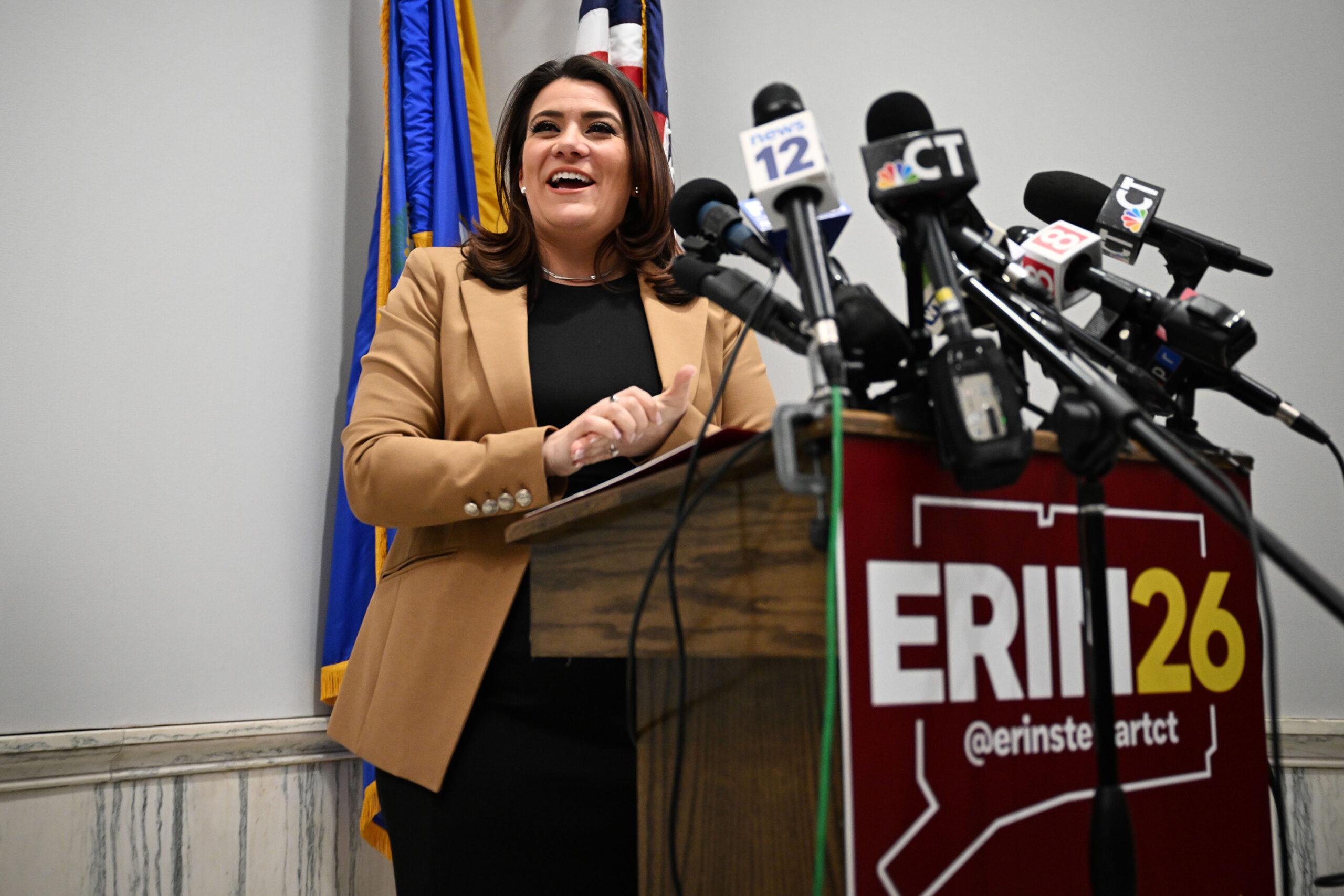
New Britain Mayor Erin Stewart announced her exploratory campaign for governor on Jan 28th, 2025, at New Britain City Hall. Source: Connecticut Public Radio
Table of Contents
Overview
Fundraising reports for Q3 were due in early to mid-October for both statewide candidates and candidates for federal office. Finance reports give credentials to more serious candidates, demonstrating they have funds for increasingly expensive primary campaigns, and for candidates to demonstrate they are the ones to take the mantle for the party.
Q3 Finance Reports allow voters to see how candidates for governor are faring, including what is looking like a competitive Republican primary between New Britain Mayor Erin Stewart and State Senator Ryan Fazio. We will also look at State Rep. Josh Elliott’s campaign for governor.
Additionally, we are looking to see how viable Democratic primary challengers to Rep. John Larson are in CT-01.
Q3 Republican Primary for Governor Fundraising
Erin Stewart – $102,000
Overall Campaign – $350,000+
Ryan Fazio – $157,769
Republican Primary Governor Discussion
When Fazio launched his campaign, I was curious how the Republican coalitions would react around the state. Would they split between Stewart and Fazio, or would they consolidate behind Stewart? Based on fundraising and endorsements, it seems to be the former.
Fazio now has the most money raised by a Republican for a single quarter in the history of the state’s Citizens’ Election Program for public financing. Though a very specific accomplishment that may not mean a lot in the long run, it shows that he is able to raise enough money to compete against Stewart.
He has raised money from more than 1,000 individuals across 114 towns across the state.
The race has turned into a head-to-head, as Westport Selectwoman Jennifer Tooker dropped out of the race last month, after struggling to raise funds. She did not rule out running for another office on the ballot, however.
Stewart’s exploratory campaign has raised over $350,000 since her entry into the race in late January. She is still the frontrunner, as she has far more name recognition than Fazio. Her run for Lieutenant Governor in 2018 and being a mayor for more than a decade mean voters are more familiar with her. She has also been expected to run for governor for years, keeping her name in conversations for a long time.
The question still is, who can win over MAGA voters? Stewart and Fazio have both expressed support for Trump. Stewart told members of the Republican State Central Committee in April that her campaign would get the endorsement.
Fazio, in particular, made it a point not to mention Trump in his campaign last year in his Harris +16 state senate seat. That’s not too surprising, but Fazio has been more willing to talk about Trump while pursuing statewide office. He told guests at a fundraiser for Republican candidate for New Haven Mayor Steve Orosco last month that he voted for Trump, but emphasized a focus on local issues. Fazio’s endorsements from the state legislature, including firebrand Rob Sampson, show that Fazio also has some institutional support from conservative
As we have mentioned before, both Fazio and Stewart are aware of the power of a Trump endorsement, even in a blue state like Connecticut. In addition to how the CT Republican Party has failed to get their preferred candidates over the line in a Republican primary. Trump’s late endorsement of businesswoman Leora Levy in the 2022 US Senate Race gave her the necessary boost to beat out State House Minority Leader Themis Klarides.
Fundraising has shown it will be a competitive race, as we head into next year, we will get a clear look to see at how voters feel between the two candidates.
Q3 Democratic Primary Governor Fundraising
Josh Elliott – $45,834
Is Elliott Viable against Lamont?
State Rep. Josh Elliott has raised just above $45,000 in his campaign for governor. Governor Ned Lamont has not confirmed he would run for a 3rd term, though he is expected to announce his campaign after local elections on November 4th.
Lamont garnered the ire of statewide progressives when he vetoed two bills, one that would provide funds for striking workers, and an affordable housing bills over concerns about how local control would work. Progressives, angry about the bill that was expected to pass, told the media that Lamont would get a challenge from the left.
Elliott, who entered the race in July, has not garnered a lot of attention in his bid, however. Though there is still plenty of time before the late-summer primary, Lamont’s veto did not lead to an overwhelming string of donations protesting him.
A poll from UNH in September demonstrated some of Elliott’s struggles. 71% of voters did not know about him to give an opinion. And the ones that did, his approval was -6, with 5% approval, 11% unfavorable.
Polling has shown that Lamont is still popular, with the same UNH poll showing Lamont with a +18 Job Approval rating.
Elliott also needs to change the narrative, as only 20% of voters said that Lamont’s views were to the right of their own. This included a majority of both socialists (82%) and progressives (53%). On the question if Lamont deserves to be re-elected, it was 43% yes, 40% no. But 62% of Democrats said that Lamont deserves to be re-elected, only 19% said he doesn’t.
It is important to note that this was only one poll, but it reinforces the narrative that Lamont will be difficult to beat.
What Josh Elliott still has in his favor is some support from the state legislature, notably from many other progressives. Looking through his donation list, Elliott has received donations from 1 state senator and 11 state representatives.
The list includes
State Sen. Saud Anwar (D-South Windsor)
State Rep. Mary Fortier (D-Bristol)
State Rep. Nick Gauthier (D-Waterford)
State Rep. Eleni Kavros DeGraw (D-Avon)
State Rep. Sarah Keitt (D-Fairfield)
State Rep. Renee Muir (D-Deep River)
State Rep. Jillian Gilchrest (D-West Hartford)
State Rep. Laurie Sweet (D-Hamden)
State Rep. Robin Comey (D-Branford)
State Rep. Frank Smith (D-Milford)
State Rep. Anne Hughes (D-Easton)
State Rep. Mary Welander (D-Orange)
The 2026 Environment
The 2026 environment for Democrats seems to be leaning more towards anti-establishment/anti-incumbent. There is definitely an energy for a more aggressive posture from some Democrats. But Elliott needs to find a way to garner more attention, either through social media or otherwise. He also needs to find more national or statewide groups to endorse him, as they might be able to help him out with fundraising. It might be a long shot, but even trying to get an endorsement from a progressive member in Congress. Anything to bring some momentum and attention to his campaign.
Elliott will need a lot of money if he faces the wealthy Lamont. Elliott did tell the New Haven Independent in an interview in early September that he has enough delegates to force a primary and that Lamont is not as popular as people believe. He also mentioned he won’t pursue a primary “if he fails to win the convention outright”. He noted he promised his family that he wouldn’t go through a Line B candidacy unless the results are close.
It’s hard to say how much it matters if Elliott does not fully commit to a primary. It is not uncommon for legislators to form exploratory committees and not go to the primary if they don’t think they can win. Elliott faced the same issue when he ran for Secretary of State in 2022. Once he lost at the convention and didn’t have enough delegates to make the primary. Elliott was able to run for his state house seat, as town committee endorsements for his state house seat took place after the convention. A similar thing can happen in 2026.
Elliott also said he didn’t want to risk his legislative position in the State House, so we will see if the race gets closer for Elliott to change his mind.
Q3 Fundraising Democratic Primary in CT’s 1st Congressional District
Luke Bronin – $1,192,798 (In 8 Weeks)
John Larson (Inc.) – $804,557
Jillian Gilchrest – $54,392 (In 4 Weeks)
Ruth Fortune – $41,353
Jack Perry – $28,810 (Did Take Out a $500k Loan) (9 Weeks)
Bronin Emerging as Main Challenger
Bronin’s fundraising brought him ahead of incumbent John Larson. Both have been trading barbs with each other.
Bronin has attacked Larson for taking PAC money and encouraged him not to do so. Larson has attacked Bronin for not actually representing a change at all. Larson and his team continue to say that Larson is the best person to represent the district.
He hasn’t exactly been enthusiastic about the prospect of fundraising. Something he hasn’t been forced to do for decades. He has complained that the money spent in Connecticut should be spent in swing districts across the country, not wasted here.
Bronin, however, raised $500,000 on the first day of his campaign and over a million for the quarter, putting him on par with many competitive campaigns across the country. With his fundraising, Bronin has established himself as Larson’s primary challenger.
Larson received $495,057 from individuals. He raised the additional $309,500 from PAC money. Bronin has raised all of his money from individuals. He has not spent much of his money yet.
Larson’s fundraising is expected to increase in Q4, and Bronin said he will likely be behind. He did say early fundraising shows “we’re going to have what we need to compete and make a powerful case for change,”.
Jillian Gilchrest’s Op-Ed
State Rep. Jillian Gilchrest said in a statement, “This fundraising pissing contest doesn’t surprise me, but bragging about how much money you can drag into politics is completely out of touch.” She also marked how the money should be used for other causes. She spent her first month in the race talking to voters.
Her comments did make sense, considering her paltry $54,000 fundraising. The amount is not nearly enough for a competitive Democratic primary in the Hartford Media market.
Though Gilchrest makes good points about the issues of how expensive it is to run for office. She also brought up the importance and need of public financing in Congressional Campaigns. Both her major opponents, Larson and Bronin, said they agree that the system needs to be reformed.
In her Op-Ed, Gilchrest notes that she would not have been able to run for office, especially against a 23-year incumbent, without Connecticut’s public financing system, the Citizens’ Election Program. She explains how the wealthy control our government, and the continuation of corruption, and how billionaires avoid paying taxes, making the rest of us pay more. Gilchrest also said she understood the importance of fundraising as a means to compete, but she won’t run playing by “old rules that got us in this mess in the first place”. She will raise money in a way that fits the character of the campaign.
Gilchrest has noted that instead of fundraising, she has spent her time going around the district and talking with residents. She did not ask people for money during her conversations, marking to change how politics works, “we need to elect people who think about politics differently”.
This contrasts with Bronin’s approach so far. Bronin isn’t a progressive insurgent in the mold of Gilchrest or Elliott, but he’s playing the traditional political game effectively — raising large sums quickly, cultivating credibility with national donors, and leveraging institutional networks. He’s not rejecting the system, just adapting it to appear reform-minded, notably by rejecting PAC money, unlike Larson. Ideologically, he’s not as left-leaning as Gilchrest, but sits somewhere between the state’s moderate establishment and its progressive base.
The Reality of Fundraising
Gilchrest is notable in her cause; she makes great points about the difficulties faced by first-time candidates. This is also why Gilchrest is still a dangerous candidate; she has the makings of what the Democratic Primary electorate is looking for in 2026, a progressive anti-establishment candidate. This is a mantle that she can take from Bronin, but the primary will come up quickly. They are also likely to split the vote at this rate from Larson.
However, she can’t ignore the realities of congressional fundraising. When Congresswoman Alexandria Ocasio-Cortez pulled off a shocking upset in 2018 against No. 4 House Democrat Joe Crowley, she raised around $300,000, less than 1/10 of Crowley’s chest.
AOC set up a shockwave of progressive challengers to come, a model that many hope to replicate. Though none have come near the scale of AOC’s upset, you need a few things to happen. Joe Crowley openly admits that he was not tuned into his district in 2018 and did not actively campaign during his primary campaign.
John Larson, on the other hand, has been barnstorming the district. Larson told the Courant that the challenges have made him more energetic, and have led Larson to frenzied campaigning, unlike he has done in years.
The point is, Gilchrest cannot ignore the realities of fundraising. Donors and national fundraisers need to hear about the candidate and their ideas. Also, understand that the candidate’s campaign is to be taken seriously. Gilchrest has the endorsement of Indivisible CT, a notable progressive group.
But despite her complaints about money, Democrats have notably outraised Republicans across the country in many races. Democrats know that backing down from spending would only fail to get their message out. For Gilchrest, I would argue that Progressive organizations, especially national ones, are stockpiled with money ready to spend on upstart progressive candidates, who would love a candidate like Gilchrest. They also have far more resources and can help nationalize the race.
AOC, who struggled fundraising in 2018, has raised nearly $10 million in Q1 of this year (nearly $21 million for the year) as a well-known figure going against President Trump. The opportunity is there.
Similar to what I explained about State Rep. Josh Elliott (who Gilchrest gave a donation too), she needs to tap into national groups and endorsements to garner some attention and momentum. Though it is good that she is communicating with people, garnering attention is important, and that will lead to funds without having to force the conversation.
Scenairos
Both Jack Perry and Ruth Fortune raised similar numbers. It is not too surprising that Gilchrest, Perry, and Fortune are struggling. They are not as well-known and represent local town offices. Though Gilchrest is a state representative, the issue is that Connecticut has some of the smallest state house districts in the country by population. Only 23,000 residents live in each district. Scaling up an effort to a 700,000+ person Congressional house district is not easy; it becomes an issue of name ID, especially as she is not that well-known outside of her hometown of West Hartford.
Fortune’s $40,000 is not bad, and honestly, more than I expected from Fortune, who only came into office as an appointed candidate last year. Perry has taken out a $500,000 loan, but how he will use his money will be the deciding factor for him. I have doubts that Fortune and Perry can make the ballot, but we will see what happens on that front.
There is still plenty of time for this race to change. All candidates will have to face a very energetic Larson and prove to voters that age concerns are enough to take out an incumbent. Gilchrest needs to garner attention and try to get more progressive groups to seize on the opportunity to back her, instead of Bronin, as Larson’s main challenger, and Larson himself, who is fairly progressive himself. The federal delegation is backing Larson, so they need to look to the state legislature, local offices, or start going to House or Senate members.
Bronin needs to continue fundraising, attacking Larson, but also come up with some policy points, as his name seems to be mentioned more in the national political media as a Democrat primarying an incumbent (Downballot and Former White House Press Secretary Jen Psaki’s Podcast, as some examples). He has to capitalize to ensure that he remains Larson’s main challenger. For Perry and Fortune, they need to garner more attention and differentiate themselves from other challengers.
It’s Larson’s race to lose! He’s the frontrunner.
It could be a two-way race, a three-way race, or even a larger field. But it seems highly unlikely that Larson won’t have at least one challenger on the ballot. We are still more than 6 months away from the convention and 9 months away from a primary, so a lot can change.
Thanks for Reading!

Fazio is Launching an Exploratory Committee for Governor
State Senator Ryan Fazio (R-Greenwich). Source: CT Senate Republicans
Overview
State Senator Ryan Fazio (R-Greenwich) launched an exploratory committee for governor last Friday. The field of Republican field has many names, but no one seems to have a firm grasp on the nomination.
Fazio, who won his second full term in November, has to decide in the next few months if he wants to take on the difficult task of running for Governor. A serious campaign would involve strategic considerations and an intense amount of fundraising, especially if Fazio has to run against the well-funded Gov. Lamont. Fazio would also have to leave his Republican State Senate seat, which would be vulnerable to a Democratic flip in 2026, further pushing Republicans into a deep minority in the State Legislature.
Background
Born in Connecticut and grew up attending the Greenwich Public Schools. Fazio went to Northwestern University, where he studied economics, graduating in 2012.
Fazio spent most of his career working in commodity markets, specializing in renewable energy. This market included the movement of millions of tons of agricultural and energy goods around the world.
He has spent time volunteering in inner-city charter schools. Currently, he volunteers for the organizations Greenwich United Way and Meals on Wheels
Currently, Fazio is the Vice President of Growth Equity Firm. The firm invests in medium-sized businesses and advises their management to help them grow.
Political History
Fazio’s first elected office was as a member of the Greenwich Representative Town Meeting in 2019. As one of the members of the 230-member legislative body of Greenwich, Fazio served on the finance committee.
In 2020, Fazio attempted his first major run for office against Democratic Incumbent State Senator Alex Kasser. Kasser represented the 36th State Senate District. A district Kasser won in the 2018 blue wave against the Republican incumbent, L Scott Frantz, in an upset 50-49.
Fazio narrowly lost the seat 49-51, despite Biden carrying the district by nearly 20 points during the presidential election.
The 36th State Senate Seat, part of Connecticut’s Gold Coast, was long a Republican stronghold on the federal level until the mid-2010s. The seat had been in Republican hands from 1930 till Kasser’s win in 2018. The district took a massive shift to the left in 2016, voting for Mitt Romney by 10 points (54-44), to voting for Hillary Clinton by 18 points (57-39). However, Republicans have still done well in local and legislative elections in recent years.
Fazio, though, didn’t have to wait long for another chance. Kasser resigned from office in June 2021, leading to a summer special election. Fazio ran against Democrat Alexis Gevanter, and he prevailed 50-48.
Now an incumbent, Fazio still had a tough race in 2022, due to the Democratic lean of the district at the federal level. However, he came out the narrowest of wins against Democrat Trevor Crow, winning a 50.1-49.9 squeaker.

2022 36th State Senate Seat Election. Fazio narrowly held on by 89 votes. Source: CT Secretary of State Website
2024 Election
Democrats in Connecticut had their eyes set on taking out Fazio during the 2024 Presidential Election. Democrats heavily recruited and found a strong candidate in former Deputy Chief of Staff to Gov. Lamont, Nick Simmons.
Simmons boosted a great resume, including a bachelor’s from Yale, a Master’s in Public Policy from Harvard Kennedy School, and an MBA from Harvard. Simmons worked a short stint at the UBS Investment Bank before becoming a 7th-grade math teacher in Harlem, NY. Soon, Simmons was acting principal of the school at age 26, one of the youngest in New York. After a stint in the Biden administration as a senior advisor and in Lamont’s governor’s office, he gave Fazio a tough fight ahead of him.
Though Fazio proved he could win this district despite difficult headwinds, he still had to face heavy spending. Simmons not only had the resume but was able to fundraise well due to heavy political backing from his sister, Mayor of Stamford Caroline Simmons. This led to Fazio facing not only Simmons’s 500k fundraising but also nearly $400k in outside spending.
Simmons, knowing the blue leanings of the district, tried to associate Fazio with Trump, citing Fazio’s votes on guns, abortions, and reproductive healthcare on the campaign trail. Simmons campaigned as moderate, aligning himself with Gov. Lamont. Fazio, though conservative, was continually able to appeal to moderates, and he heavily avoided discussing Trump on the campaign trail.
Election day came, and Fazio emerged victorious over Simmons in a surprise 52-48 victory. This was despite the fact that Kamala Harris won the district by over 16 points. Fazio credited his win to a bipartisan record. Simmons noted he lost because voters were much more drawn to Fazio, and his incumbency advantage likely assisted him. Also, on many issues, Fazio and Simmons had similar positions, such as energy policy and lowering costs on electricity and gas for residents.
Who Is Running for the Nomination Currently
After winning multiple tough elections and holding Greenwich’s affinity for downballot Republicans, Fazio has a good base to start fundraising for a prospective campaign.
All the way back in March, I wrote an article about the Republican Primary, which included Westport First Selectwoman Jen Tooker, who was the first person to enter the race. Surprisingly, after nearly five months, not much has changed. Tooker is the only one still officially in the race, and New Britain Mayor Erin Stewart has continued to raise money in her exploratory committee.
Tooker, Stewart, and Fazio seem to be the major candidates for the Republican nomination. Some minor candidates have filed, including perennial candidate Peter Lumaj, but I don’t expect much from him.
All three major candidates have proven the ability to win on blue turf. Tooker and Stewart have won the top positions in their towns, both of which Kamala Harris won by over 20 points. The ability to win on Democratic turf is appealing for a general election in a state where Democrats have done well. However, all three candidates have to balance out their viewpoints to win a closed Republican primary.
On the fundraising side, Stewart has the most money on hand, at about $222,000. Tooker only has $50,000, with even Lumaj close behind at $46,000.
No one seems to be running away with the nomination, so Fazio can easily make up ground.
Strengths
Fazio’s strengths are his clear ability to win over Democratic voters, in addition to moderates.
Most importantly, Fazio has been able to maintain the backing of Trump’s MAGA wing of the party as well as pro-business Republicans and moderates. This is important in Greenwich, where the conservative faction of the party has taken over the local GOP committee, taking out anyone who wasn’t deemed loyal to the Republican cause. Fazio said he sees himself as uniting Republicans on all sides.
Fazio is also respected on both sides of the aisle, and many of his fellow legislators have been hoping for him to take charge. A member of both the Energy & Technology Committee and the Finance, Revenue, & Bonding Committee, he has many backers who believe he can give Lamont and Democrats a competitive race. Some believe he could actually win. State Senator Rob Sampson (R-Wolcott) was thinking of entering the race, but told CTInsider Reporter Dan Haar that he was working to persuade Fazio to run. He says that Fazio’s ability to talk policy and communicate would prove very beneficial. If he gets the backing of many of the Republican legislative members, which seems likely, it’ll help him in a race.
Fazio, who is only 35, if facing Lamont, would be able to sufficiently show a generational change and contrast from Lamont, who will be running for a 3rd term at the age of 72, meaning some voters might be feeling fatigued from Lamont’s candidacy.
Fazio, however, has created a moderate reputation by being able to avoid discussing Trump and where he aligns with the president. Though this was allowed by many MAGA faithful in a competitive race, Fazio, like many of his Republican opponents, will need to figure out how to preserve their moderate reputation while sufficiently proving their loyalty to Trump voters who tend to dominate the state’s closed Republican primary.
Troubles for Republican-Endorsed Candidates
The GOP has had a lot of trouble getting its endorsed candidates through the primary the last couple of years. House Minority Leader Thelmis Klarides lost to Trump-endorsed Businesswoman Leora Levy in 2022, despite having the GOP endorsement, as the small Republican primary electorate preferred Trump’s choice, despite Klarides being a way better general election challenger.
In 2024, the Republican endorsed Beacon Falls Selectman Gerry Smith lost the Republican primary to businessman Matthew Corey, who had enough name ID from his previous Senate run in 2018 (and other runs for office), to win the super low-turnout primary. Corey won’t be going anywhere with Republican voters as he is currently running for Lieutenant Governor. Connecticut is one of a handful of states, where the Lieutenant Governor runs a separate primary from the governor, but is elected on one ticket in the general election, akin to a “shotgun wedding”. We will discuss this more as we get closer to next year.
Convincing the electorate is everything, and though Fazio might be able to attract voters based on stances about taxes and electric bills, he needs to sufficiently prove the base that he is loyal, and that is easier said than done. He will also need to convince voters to move on from Lamont, who, despite his primary challenge, is still popular with a majority of Democrats in the state.
Fazio also isn’t known as a spectacular fundraiser (though sufficient), as he will need to generate a lot of funds for a statewide run. Being in elected office for 4 years, he is not well-known to voters and will have to do a lot of work to sufficiently increase his name ID for a run.
Fazio would also be leaving his seat in a very blue area during a midterm where Republicans hold all three pillars of national government, leaving his party to defend the seat or else face a smaller Republican minority in the legislature.
Overview
The Republican Primary is a fully open race, and no candidate is leading by enough to warrant anyone from dropping out. The 2018 Republican Primary was so crowded, victor Bob Stefanowski won the primary with under 30% of the vote. This race could be similar, though we will see if Republicans organize more and get behind one candidate, or allow a free-for-all for what is typically a late summer primary.
Fazio is definitely a good candidate for Republicans, someone who is young and has the proven ability to win over Democrats and moderates. He, most importantly, has been on the good side of the MAGA part of the base in Greenwich, and shows his ability to join some of the party’s factions together.
However, he’ll need to contend with low name ID, a lot of campaign fundraising, and how to sufficiently mention Trump to win the primary but maintain enough moderate credentials in what is looking like a blue Democratic year election. He can’t avoid the president in a primary of the party’s faithful.
How Fazio will contend with this, or how Republicans will organize this effort, we will have to wait and see!
Thanks for Reading!