
Ryan Fazio Leads a GOP Slate Facing an Ironclad Challenge
Republican Ryan Fazio heads for the stage with his fiancée Amy Orser after earning his party’s nomination for Governor at the Connecticut Republican Convention on May 16, 2026, at Mohegan Sun. Source: Mark Mirko at Connecticut Public
Overview
State Sen. Ryan Fazio (R-Greenwich) leads a Republican slate of statewide challengers in November, facing a difficult challenge in a state dominated by Democrats in both the legislature and statewide.
Republicans have not won a statewide race in Connecticut since Governor Jodi Rell’s 63-35 landslide victory in 2006. Republicans have not won one of Connecticut’s row offices since 1994, when Republican Chris Burnham defeated Democratic incumbent Joseph Suggs Jr in a 53-45 victory for Treasurer.
The State GOP dominated the governor’s office from 1994 to 2010. Since 2010, Republicans have had numerous close races, including three consecutive governor’s races decided by less than 4 points in 2010, 2014, and 2018. In 2016, Republicans managed an 18-18 tie in the State Senate, and only a 72-79 deficit in the State House.
We covered in our State Senate Ratings Forecast last month how these numbers have dwindled in past cycles, where Democrats now hold supermajorities in both chambers of the Connecticut General Assembly and every statewide office. How do Republicans gain back some relevance in the state? It starts with the statewide slate, notably with the candidate leading the ticket. We will go through a brief biography of Fazio, and then discuss if he has a chance in November.
Let’s get started!
Fazio Personal Background
Ryan Fazio was born in Norwalk and grew up in Greenwich, where he graduated from Greenwich High School in 2008. He later earned a BA in Economics from Northwestern University in 2012. He is a known New York sports fan.
Fazio’s professional background includes time in the private sector as a former renewable energy professional and shipping professional. The company is a large ethanol biorefinery facility where he managed commercial operations, logistics, and market risks. The company processed, stored, shipped, and traded energy worldwide. Fazio also worked at a small venture capital firm that invests in small and medium-sized businesses, where he advises their management to help them grow. He resigned from the firm in February to devote himself full time to his gubernatorial campaign.
The senator has also spent several years volunteering at an inner-city charter school. Fazio served on the leadership of the Associate Council of the KIPP Charter school network. Locally, he has volunteered for Greenwich United Way and Meals on Wheels.
Political Background
State Sen. Ryan Fazio (R-Greenwich) has made a rapid rise in Connecticut politics. At 36, he will be the youngest major party nominee for Governor in the country. In addition, he is the youngest candidate to win the Republican Party endorsement since John Rowland won the endorsement in the 1990 Governor’s race.
Fazio won 92% of the convention vote in May after a scandal derailed frontrunner Erin Stewart. Many expected him to face a tough primary in August against Stewart, but the scandal caused many Republicans to coalesce around him.
Fazio, like many Greenwich politicians, got his start in politics as a member of Greenwich’s Representative Town Meeting, where he served in District 12, winning his first term in 2019. In 2020, he won the Republican Party endorsement in the 36th State Senate seat to face Democratic Incumbent Alex Kasser. Fazio lost narrowly 49-51.
However, in 2021, Fazio received an unexpected opportunity after Kasser resigned, triggering a special election. He won the special election 50-48 against Democrat Alexis Gevanter. In 2022, Fazio won his first full-term by a mere 89 votes in a 50.1-49.9 victory against Democrat Trevor Crow. In 2024, Fazio faced heavy spending and a difficult challenge from Democrat Nick Simmons, resulting in one of the most expensive state legislative contests in state history. Even though Kamala Harris carried his district by a 58-41 margin, Fazio won 52-48, his best performance yet.
Main Campaign Issues
When Fazio ran in the special election for his State Senate seat in 2021, he named public safety as his most important campaign priority. He followed up with reducing taxes, cost of electricity, and improving access to health care through state regulation improvements. He also wanted to reduce state control over local school and town planning and zoning.
His gubernatorial campaign hits on many of the same points. Fazio, a ranking member of the Energy & Technology Committee in the state legislature, had focused a lot of his campaign on the state’s high energy costs. Fazio argues that Democrats’ policies have led to high electric rates imposing $1 billion in ‘public benefits” onto our residents. Fazio’s plan to cut electrical bills by 20% is to eliminate the public benefits charge, expand natural gas capacity, cut renewable energy subsidies, limit government contracts, and end “inefficient programs” on electric vehicles such as the EV Charging Program and the heat pump installation subsidy.
Fazio, who voted against last year’s passage of HB 8002, a reworked housing bill that would increase the state’s housing supply, was asked at a forum how he would implement the new law he opposed. Fazio said he would focus on cost controls, adding housing supply, and working to respect local control in housing construction.
He also offered a plan to ease CT’s property tax burden. Connecticut’s cities and towns rely heavily on property tax as a major revenue stream. Fazio did not give specific fiscal projections for his plan. A main point of his plan is to tie Connecticut’s chief operating grant for local schools to the rate of inflation and to cap municipalities’ ability to boost local taxes by 2% or the inflation rate (whichever is greater), saying the legislature should not pay for those directives out of the state budget.
The Lamont campaign told the CT Mirror that Fazio and other minority Republicans in the State Senate did not offer a plan to balance state finances and remain cap-compliant within the fiscal guardrails. Fazio argued his plan is achievable by spending less, specifically on Medicaid benefits for undocumented children and allowing the state’s universities and community college system to hold huge reserves. He also added that he could channel millions annually by curbing or ending longstanding tax breaks for nonprofit universities and hospitals.
On immigration, Fazio is in favor of reversing Connecticut’s sanctuary state policy, the 2019 Trust Act, which restricts state and local law enforcement from cooperating or communicating with the Immigration and Customs Enforcement (ICE). Fazio says the issue is that law enforcement should have discretion over people who are here illegally with Class C, D, and E felonies and misdemeanors, and the current law prevents the state from working with federal authorities. He also aims to cut hundreds of millions of dollars he says are being spent on “illegal immigration programs“.
Fazio has proposed overhauling the 2020 police accountability legislation, which he says led to a surge of violence. Fazio hopes to restore standard enforcement and proactive policing capabilities.
Does Fazio have a Chance in November?
During his 2024 campaign, Fazio spent most of his campaign avoiding mentioning Trump in any capacity. If a voter asked how he voted in the previous three presidential elections, Fazio politely declined. The strategy worked out well for Fazio, who won many voters who voted for Kamala Harris in the concurrent presidential election.
While running in the primary for Governor, Fazio said during an interview, “I would love the President’s endorsement.” Fazio stated, I have a great deal of respect for his public service and his willingness to step up.” During a statewide campaign, Fazio will have a lot more trouble distancing himself from Trump. His opponents will be airing that quote all throughout election season.
During his 2024 re-election bid for the State Senate, Fazio focused on bipartisanship and on local and state issues. This is something doable in a local race, much harder to do when you’re the party’s candidate for Governor. It’s a difficult needle to thread.
To broaden his appeal, Fazio will likely have to reassure moderate and independent voters on issues where Connecticut’s electorate differs from the national Republican Party. Fazio has said he supports the status quo on Connecticut’s existing laws protecting abortion access, but he will need to offer some other core issues against Connecticut’s blue-leaning electorate.
He could also emphasize how he will have a Democratic legislature in both the State House and State Senate, and how he intends to work with them to solve the state’s issues. A similar approach has been used by Republican governors including Phil Scott, Charlie Baker, and Larry Hogan. But a charged Democratic electorate in November is unlikely to have similar sentiments in a midterm election against a rather unpopular Donald Trump.
The general election opponent is also important to any path Fazio has in November. One would think, and some Republicans agree, that they would rather face State Rep. Josh Elliott than Governor Ned Lamont in November. The two democrats face off in a primary on August 11th. Lamont is heavily favored, but Elliott has been making gains in recent polling. If Elliott is the Democratic nominee, his more progressive and ambitious platform may allow Fazio a better contrast in the general election. Elliott supported calls to abolish police departments during the 2020 debate over policing, a message that will also be on the air everywhere if Elliott bests Lamont in the primary.
Josh Elliott is also known as one of the most left-leaning members in the legislature, but is also not well-known to a majority of the state’s voters. This would offer an opportunity for Fazio’s campaign to define him quickly. Also without Lamont, Fazio can compete for the Fairfield County base that has heavily split-ticketed for legislative races in past cycles.
If Fazio faces Lamont, the most likely scenario, he will have a lot more trouble trying to define Lamont as the two-term governor. He would have to attack him on the issues, while Lamont can easily point to his accomplishments over his time in office. Also, voters see Lamont as pragmatic and likeable, a difficult quality to change voters’ opinions on.
Conclusion
In any scenario, the Democratic nominee will be heavily favored in November. Fazio has a tough challenge ahead in November. He qualified for public financing earlier this year, and will have an $18,000,000 grant to spend in the general election. How he decides to spend his grant money will be important for leading the Republican slate.
In the 2022 elections, some voters split-ticket on other statewide offices. The best-performing Republican by margin was State Rep. Harry Arora, who lost by 7 to Democrat Erick Russell in the race for Treasurer. In the Governor’s race, Ned Lamont beat Republican Bob Stefanowski by a larger 56-43 margin.
Stefanowski’s 43% is the baseline for Fazio. He will need to do much better in Fairfield County and the state’s suburbs while also increasing turnout in Republican areas.
Whether Fazio can exceed recent Republican performances will largely depend on his ability to appeal to independent and moderate suburban voters while navigating the national political environment. Even under the most favorable circumstances, Connecticut’s Democratic lean means Republicans enter the race as clear underdogs.
Thanks for Reading!
Follow us on Twitter/X for Election Updates: https://x.com/ctelectionguide
Contact the blog at contact@ctelectionguide.com for inquiries, questions, or tips!
Connecticut Senate Race Ratings – The GOP’s Looming Fight for Survival
Overview
In 2016, Connecticut Republicans were doing pretty well. With Donald Trump winning the presidency, they managed to get an 18-18 tie in the State Senate and were only down 72-79 in the State House. This amount of power allowed the CT GOP a fair amount of power in the state legislature, culminating in a 2017 budget deal with fiscal restraints that Democrats agreed to.
However, within a decade, things had changed. President Donald Trump transformed the image of the Republican Party. Some states have shifted greatly to the right. However, in Connecticut, old-school moderate Republicans weren’t keen on MAGA, or Trump’s level of populism. This shift towards the Democrats, most prevalent in upper-middle-class suburbs and wealthy Fairfield County, has culminated in Republicans in a superminority position in both the State Legislature and State Senate.
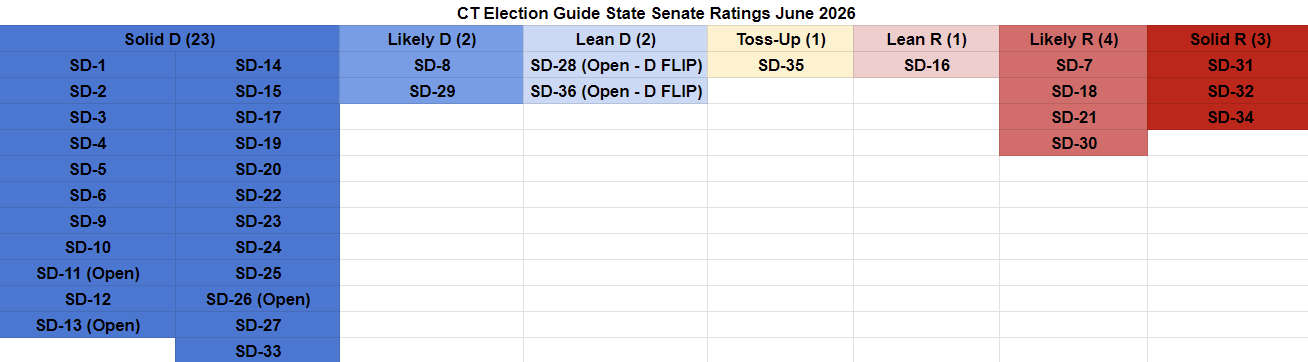
Things aren’t looking great heading to November for the GOP in the State Senate, headlined by two open Republican-held seats that Kamala Harris won by more than 16 points. If Republicans lose these two seats, they will only have 9 seats in the State Senate. This would be the worst result for the CT GOP since the 1974 election cycle, where the Watergate Scandal led Democrats to a 29D-7R Senate and a massive 118D-33R House.
The Possible Flips – Lean D
Democrats shouldn’t be too cocky with SD-28 and SD-36. Democrats thought they were going to take out State Sen. Tony Hwang (R-Fairfield) numerous times over the years. They spent heavily to oust State Sen. Ryan Fazio (R-Greenwich) in 2024, but fell short.
Fairfield County Republicans have split-ticket their ballots, voting blue federally, and red in the state legislature. However, both incumbents are retiring. Both Republican nominees running, Amybeth Laroche (SD-28) and Joe Kelly (SD-36) will outrun the federal lean of their seats easily. But the deep blue federal lean of the seats is likely too much to overcome in November’s expected national environment. Kamala Harris won SD-28, 58-40, and SD-36, 58-41.
Hwang is retiring. Despite Hwang’s success in holding the seat, his poor relationships with local Republicans led to Laroche entering the race last December, with numerous endorsements, before Hwang announced his plans. In addition, Hwang lost a special election for Fairfield First Selectman earlier this year, signaling he didn’t have much intention of staying in the State Senate. Also an indication of the dire environment he would have faced in November, despite carrying Fairfield multiple times during his re-election bids. Democrats will be running Rob Blanchard, who also ran as the nominee for the seat in 2024.
Fazio is retiring, but he is looking for a promotion and is officially the GOP’s nominee for Governor in November. After former New Britain Mayor Erin Stewart’s campaign blew up after reports of her using taxpayer money from a city P-Card for personal purchases during her mayoral tenure, Fazio was able to easily win at the party convention, avoiding a primary from former NY Lt. Gov. Betsy McCaughey.
Fazio can likely help bolster performance in his seat in both the governor’s race and the State Senate race. However, SD-36 flipped the last time Democrats had a similar expected national environment. Democrat Alex Kasser flipped the seat from Incumbent Scott Frantz in 2018, and held it in 2020. When Kasser resigned, Fazio won the seat in a special election in 2021. In addition, during his 2022 re-election, Fazio won by 89 votes, indicating the close nature of the seat. He won a 52-48 victory in 2024.
Therefore, I believe both seats are favored to flip this cycle, but are not guaranteed. Spending will be heavy, and the races will likely remain competitive until November. They are rated as Lean D.
Solid D Seats
Not much to discuss for most of the State Senate’s Democratic caucus. Out of 25 incumbents, no one is really in danger of losing unless a surprise scandal or October surprise occurs. Out of the seats I rated Solid D, a few were notably close on a federal level in 2024. SD-14 (Harris +3), SD-15 (Harris +6), SD-19 (Harris +7), SD-24 (Harris +6). However, all four incumbents (James Maroney, Joan Hartley, Catherine Osten, and Julie Kushner) are running again. In 2024, Hartley had no Republican opposition and Maroney and Osten both won by double digits comfortably.
Likely D Seats
Both incumbents I’ve rated here are likely safe, but do notably represent seats that are a bit closer than the Solid D seats.
In SD-8, State Sen. Paul Honig (D-Harwinton) knocked off State Sen. Lisa Seminara in a 50.3-49.7 victory in 2024, the lone flip of the cycle in the State Senate for either party. Honig is likely to do better in this Harris +10 seat in November than he did in 2024. But being a relatively new senator, in one of the few likely targeted races in the state, made me mark this race as Likely D.
In SD-29, State Sen. Mae Flexer (D-Windham) won a competitive race against Republican Chris Reddy, by a 49.8-48.4 margin in 2024. Kamala Harris won this seat 51-47 in 2024. Flexer has faced numerous close races over the years. The district is notably Democratic due to the presence of the UConn-Storrs campus, despite the red lean of surrounding towns. Similar to Honig, Flexer is likely to do better than 2024, and win an expected rematch against Reddy, but the close nature of the district, and Flexer’s lack of overperformance in recent cycles have me mark this race as Likely D.
An Intriguing Toss-Up
SD-35 is an interesting case study. State Sen. Jeff Gordon (R-Woodstock) won a comfortable 53-47 victory in 2024 against Democrat Merry Garrett. However, in 2022, Gordon won a narrower 50.6-49.4 victory in this seat. With a 2026 environment, this puts Gordon in a precarious position. I believe this puts Gordon as the most vulnerable Republican incumbent.
In addition, the previous incumbent to this seat, Republican Dan Champagne, won two narrow races in both 2018 and 2020. In 2018, he won 51-49, and in 2020, he won 50.5-49.5, under district lines that remain fairly similar.
With Democrats likely focusing on flipping SD-28 and SD-36, it’s unlikely Democrats will spend a lot of money in SD-35; it’ll be a seat that is determined by the November political environment.
Gordon faces Democrat Ethan Werstler, a UConn grad, who has no competition for the nomination. Werstler ran in the 52nd State House Seat in 2024, against State Rep. Kurt Vail, losing 42-58. However, the 52nd State House Seat is the 11th most Republican seat in the state, where Trump won by 15 points. The 35th State Senate seat, on the other hand, is one of the six Republican-held Senate seats won by Kamala Harris. Kamala Harris won here 51-48 in 2024. This will a close race in November.
Lean R
Normally, State Sen. Rob Sampson would not be in a competitive race in SD-16. He won a large 57-43 victory in 2024, running 4 points ahead of Trump in the most Republican Senate district in Connecticut. Trump won here 54-44 in 2024. Sampson won an even larger 59-41 victory in 2022.
However, the closer-than-usual race in this district this year is due to his opponent. Sampson’s closest race in his State Senate career was in 2020 when he won 53.8-46.2 against Democrat Jack Perry.
Perry, who ran for Congress in the 1st Congressional District last year, decided to drop down and face Sampson again. Perry, a former member of Southington’s town council, will give Sampson likely the most competitive race of his career.
Sampson is still favored in this Republican district, but Perry’s strong performance in 2020 with a favorable environment could give an opening.
Likely R
Republicans are favored in SD-7, SD-18. SD-21, and SD-30. The reason these races are marked as Likely R is due to the federal lean of the seats. Though Connecticut Republicans have been able to outrun the federal lean of their seats by large margins in previous cycles. Connecticut’s 2025 local election proved to be difficult for many Republican incumbents as Democrats flipped 27 towns from Republican to Democratic control, indicating that many Democrats weren’t as willing to vote Republican on the local level in Trump’s second term. Many residents found themselves unable to separate local and national politics.
3 of the 4 seats listed here voted for Kamala Harris on the federal level, SD-7 (Harris+2), SD-18 (Harris+5), and SD-30 (Harris+0.91). SD-21 is a narrow Trump seat (Trump +0.54). Republicans will likely hold onto these seats, but I wouldn’t be surprised for closer margin of victory compared to 2024.
However, many incumbents in this category have outrun the federal lean by a large margin. Even though Kamala Harris winning her seat by 5 points, State Sen. Heather Somers won a large 59-41 victory. Despite large Democratic overperformances in special elections, Jason Perillo won 53.5-46.5 in SD-21’s special election last year, a 6.5-point overperformance, one of the few Republican overperformances this cycle in a special election. Finally, many of these incumbents have performed well in unfavorable environments like 2018 where there weren’t many close races in these districts.
Solid R
An absolute disaster at all levels would have to happen for Republicans to lose any of these three seats. Though everyone will face a Democratic opponent. Democrats are contesting all 36 seats this year.
Though Democrats may be able to flip some Trump-won seats in the State House, it seems unlikely to happen in the State Senate. The three seats here are some of the most Republican leaning in the state. Though due to political geography, in Connecticut, you won’t find many heavily Republican seats, like in other states where Trump +50 seats are common in rural areas.
SD-31 (Trump +8) , SD-32 (Trump +9), and SD-34 (Trump +5) are all solidly R in November. The two of the three incumbents here, Eric Berthel and Paul Cicarella, won by at least 13 points in 2024, outrunning Trump by a couple of points. Henri Martin in SD-31 didn’t even face a Democratic opponent in 2024. Since 2016, Martin has won all his races by at least 16 points.
Overview
Democrats are favored to make gains in the State Senate in November. We will make updates to race ratings as needed later in the summer. We will see if Republicans can hold onto their seats despite the unfavorable national environment. The goal for them will be to separate local and national politics, something the Connecticut GOP has struggled with in the Trump era.
Thanks for Reading!
Follow the blog on Twitter, @ctelectionguide, for CT Election News and Updates
Email contact@ctelectionguide.com for questions, inquiries, or tips.
Find more articles at ctelectionguide.com