
The Ultimate Primary Guide for Connecticut Primaries Part 1
Rep. Josh Elliott celebrates at the state Democratic Convention, Saturday, May 16, 2026, in Hartford, Conn. Credit to: Jessica Hill / CT Mirror
Overview
Welcome to the CT Election Guide’s August 11th Ultimate Primary Guide.
In Part 1 of the guide, I will cover statewide and congressional primaries. In Part 2, I will cover primaries in the state legislature.
There are four primaries to cover. We will start with the Democratic primaries for Governor and the 1st Congressional Distrct. Governor Ned Lamont and Rep. John Larson face challengers for renomination. Than we will cover two Republican primaries where Republican challengers hope to challenge Democratic incumbents in the 4th and 5th Congressional Districts
I will also give a rating for each race and a prediction of who I think will emerge victorious on the 11th. There are several competitive races on the ballot, so expect some fascinating results.
Let’s get started!
Voting Information
Per state rules, Connecticut is a closed primary state. This means only registered voters of that party can vote in a primary election on August 11th. In Connecticut, a plurality of voters are registered unaffiliated (about 42.2% as of 2025); that proportion of state voters will be unable to vote in the election. However, unaffiliated voters have until August 10th at noon to register with a party, if they plan to vote on primary day.
If a voter wants to switch parties to vote in a primary (From Democratic to Republican, or vice versa), they had to do so by May 11th. If a voter wanted to vote during early voting and they are unaffiliated, they had until July 31st at Noon. A new voter can file a voter application in person with the registrar of voters in their town by noon on the business day prior to the day they want to vote.
In Connecticut, only contested primaries take place on the ballot. If a race is uncontested, there is no primary in that district. Due to a Democratic primary for Governor, every registered Democrat in the state can vote in the primary.
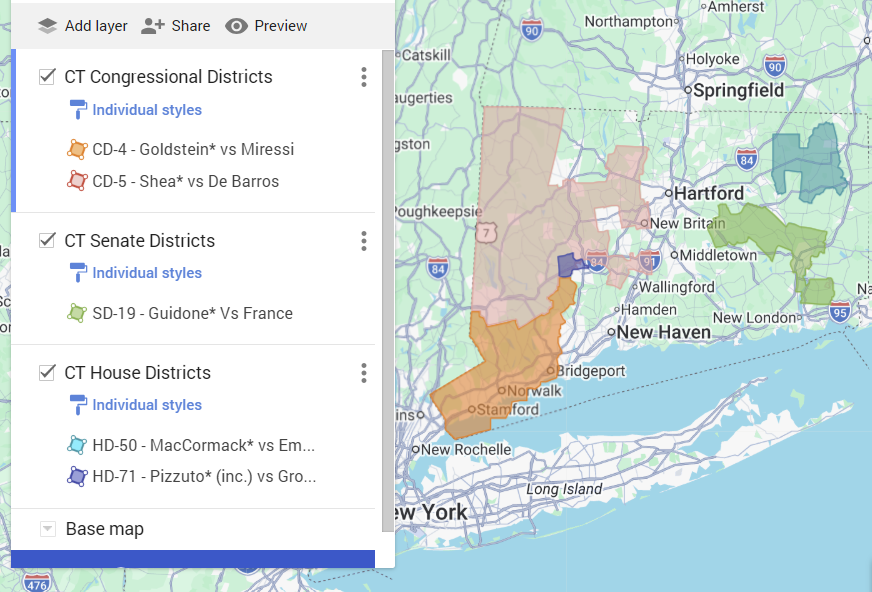
There are no statewide primaries for Republicans, as all statewide offices were decided at the May Convention, and no challengers met the requirements or attempted to force a primary. There are primaries in some congressional districts and legislative seats. If you’re a Registered Republican looking to vote, you can use this map to see if you live within the district boundaries. There are primaries in the 4th and 5th Congressional Districts, the 19th State Senate Seat, and the 50th and 71st State House Seats.
Early voting is available for this election. Early voting takes place from August 3rd to August 9th. Extended voting hours will take place on the 4th and 6th.
Monday, August 3rd – 10:00 am to 6:00 pm
Tuesday, August 4th – 8:00 am to 8:00 pm
Wednesday, August 5th – 10:00 am to 6:00 pm
Thursday, August 6th – 8:00 am to 8:00 pm
Friday, August 7th – 10:00 am to 6:00 pm
Saturday, August 8th – 10:00 am to 6:00 pm
Sunday, August 9th – 10:00 am to 6:00 pm
Voters must vote in the assigned early voting location for their town of voter registration. The list of early voting locations can be found here. The majority of the early voting locations are in Town Hall, community centers, or the library.
Absentee ballots are also available for this election. One can request a ballot at the online portal here. Starting this cycle, after a 2024 voting referendum passed, voters no longer need to provide a specific excuse to vote in any election. Voters can request an absentee ballot for any reason. If voters need a paper application for an absentee ballot, use this link and scroll down to print a paper application. The deadline to request an absentee ballot is August 10th.
If you need to hand out an absentee ballot application to someone, please follow the state’s strict rules concerning this action. There are limits on who you can get an absentee ballot application for (immediate family), and the number of ballots you can request.
CT Election Guide Race Rating System
These ratings represent my assessment of each race based on available polling, fundraising, endorsements, campaign activity, geographic strengths, and the overall political environment. They are forecasts—not guarantees—and races can shift before Election Day.
- Solid – Expected margin of 15% or more
- Likely – Expected margin of 8–15%
- Lean – Expected margin of 3–8%
- Toss-Up – Expected margin of less than 3%
Statewide Primaries
Governor – Democratic Primary
Incumbent: Ned Lamont
Candidates: Gov. Ned Lamont (Inc.) vs State Rep. Josh Elliott
Type of Primary: Incumbent vs Challenger
2022 Election Result: Lamont +13 – Ned Lamont (D) – 56.0%, Bob Stefanowski (R) – 43.0%
2024 Presidential Results: Harris +14.5 – Kamala Harris (D) – 56.4%, Donald Trump (R) – 41.9%
2026 General Election Rating: Solid D
Background
On March 13th, 2006, a wealthy businessman from Greenwich, Ned Lamont, launched a primary campaign to challenge sitting Senator Joe Lieberman for his seat in the U.S Senate. Lieberman was heavily criticized for his support of the war in Iraq and his close relationship with President Bush at the time. This challenge would start the beginning of Ned Lamont’s prominent place in Connecticut politics.
Lamont’s candidacy at the time became more of a single-issue primary against the War, and Lamont was able to seize the progressive energy of the 2006 cycle, culminating in an upset win over Lieberman in the primary. He later lost the general election that November. Lamont was able to grasp the state’s progressive flank; his challenge to the left of Lieberman was notable in a state that rarely saw contested primaries against incumbents.
Now, two decades later, Lamont, the two-term governor, is attempting a third four-year term in this solidly Democratic state. Lamont now finds himself as part of the “establishment” facing the irony of being challenged to his left by State Rep. Josh Elliott (D-Hamden). The first primary against an incumbent Governor since 1978.
Who is Josh Elliott?
State Rep. Josh Elliott first came into the legislature after winning a seat in the legislature in 2016. Elliott holds a BA from Ithaca College and received a JD from Quinnipiac School of Law. He entered the race before House Speaker Brendan Sharkey announced his retirement. Elliott’s campaign says he is the reason he pushed Sharkey into retirement, which is prominently claimed on his website, though Sharkey disagrees with that assertion in strong terms.
Elliott is a founder of the Progressive caucus in the legislature, which has slowly grown over the last few cycles. Elliott has played a large role in supporting economic and labor protections. Two of the bills he sponsored were for Paid Family & Medical Leave and for Paid Sick Days. He has pushed for Connecticut to be the first state to remove the cost for incarcerated individuals to make phone calls to loved ones. He currently serves as Deputy Speaker and Majority Caucus Co-Chair.
This is not Josh Elliott’s first attempt at higher office. In 2022, Elliott ran for the open Secretary of State race. It did not go so well for him. He was the only candidate who failed to qualify for the ballot at the convention. Elliott was also running to maintain his seat in the legislature during that race. He bowed out, electing not to gather signatures to petition, and ran for re-election to his state house seat. Candidates returning to their state legislative seats around convention time when they don’t do well is common in Connecticut.
However, during Elliott’s second attempt for higher office. Elliott is simultaneously running for both his State House Seat (88th District) and the Governor’s Race. Elliott was noncommittal about his run for governor for most of the cycle. He at one point said he would only challenge Lamont only if he won the party endorsement at the convention, saying he didn’t want to run a Line B candidacy. Earlier this year, however, Elliott decided that he spent so much time on his campaign that he has to see it all the way. He also did not risk losing his House seat, something Elliott said is important to him to help make change in the state.
Elliott successfully raised the $335,000 needed to qualify for public financing. This qualified him for $3.75 million grant. He got the money about 5 weeks before the August primary, leaving him a quick turnaround to get his message on the airwaves. Though he was allowed to run for both his State House seat and Governor at the same time, he could not spend any of his grant money on his State House seat. To avoid any issues with campaign finance rules, Elliott hasn’t even formed a campaign committee for his State House Race, as he plans to spend no money. Elliott doesn’t face any Democratic opposition in the primary and was nominated for another term at the convention for his seat. Though he faces a Republican opponent, Elliott’s 88th State House Seat is one Kamala Harris won 70-28, so he doesn’t need to spend much of anything in the general.
Campaign Issues
Elliott’s campaign has been defined by anger towards Lamont’s refusal to tax the rich more. Progressive anger towards the Governor also increased when Lamont vetoed two bills during the 2025 legislative session. One on affordable housing, and another on benefits for striking workers. Elliott’s vowed that the Governor would face a challenge after those vetoes, and eventually he became the candidate to challenge the Governor. Lamont did pass a version of the affordable housing bill later in 2025, though some argue the bill wasn’t as strong as the initial one. Though many agreed it was still beneficial. Lamont did not pass the bill for striking workers.
Elliott has proposed a similar millionaire tax to Massachusetts, though at it’s core Elliott hopes for a “fair tax structure” that taxes those who make $1 million annually. Elliott also does not support the state’s fiscal guardrails, enacted in 2017 to force the state to pay down pension debt. He believes it should be changed to allow easier investments for infrastructure, investment, and housing. Elliott has also proposed less reliance on local property taxes.
One of Elliott’s more aggressive proposals is to take on Eversource by allowing towns to individually own their utility infrastructure. To allow a public option that can allow municipalities cheaper rates, or for towns to form or join electric utilities in an effort to cut Eversource’s power away. The governor has argued that this proposal will cost tens of billions of dollars that the state does not have.
Elliott has also attacked the Governor in more personal terms, saying “his campaign is where good ideas go to die”. He also has advertisements on air attacking Lamont’s wealth and how his family has been rich for generations. Due to his personal wealth, Elliott says Lamont cannot understand the state’s affordability. He also heavily critiqued the governor for taking credit for policies passed by the legislature, saying the Governor didn’t actually do anything. “That’s what a billionaire does. They take other people’s ideas and say ‘Well, this was his all along.’” Elliott said. He also called the Governor “dangerously naive” during the debate, and said Lamont’s campaign is the “Temu version” of his. Elliott did attack Lamont as a billionaire a few times, though the very wealthy Ned Lamont is not known as a billionaire specifically.
Ned Lamont spent the majority of the cycle ignoring Josh Elliott, trying to avoid pushing attention to his challenger. However, Elliott slowly gained some momentum and qualified for a primary with 25% of convention delegates. Lamont has had to be more on the defensive end.
The Governor has touted his accomplishments during his tenure as Governor, including a minimum wage increase, actions to replace SNAP benefits, and investments in early childhood education. The governor has also emphasized fiscal responsibility as he has focused on paying off the state’s heavy pension debt. Lamont, in the last few weeks, has ramped up his attacks on Elliott, specifically at the debate, dismissing Elliott as someone full of sound bites and no accomplishments. In the final week of the campaign, Lamont has started to go more negative on Elliott, attacking him for missed votes during his campaign.
Race Rating
Nationally, primary season this cycle shows there is an energy in the Democratic Party for more progressive policy and overall change. In addition, any person running for a third governor term is likely to face some level of opposition for “overstaying their welcome”. I believe this race will be closer than many people expect.
Governor Lamont is favored in this race. I see him winning by around 20 points. I do believe Elliott will win Hamden and likely New Haven. He will maintain steady support around the state, with a few pockets of winning towns. It’ll be interesting to see how Elliott does in the Farmington Valley, with a lot of upper-middle-class Democratic voters showing more progressive bona fides; Elliott may be able to get some strong performances in towns like West Hartford, Glastonbury, Farmington, and Avon. Connecticut hasn’t had too many primaries with a clear “establishment vs progressive” battle. The closest was the 2018 Lt Gov Democratic primary between former Secretary of State Susan Bysiewicz and labor organizer Eva Zimmerman. Bysiewicz won 62-38, but Zimmerman was commended for a great performance against a longtime statewide figure. I think Elliott will have a similar performance and pattern: outright winning a few towns, but holding a steady 35%-40% in a majority of towns.
Lamont holds very strong support from the legislature, though a few members of the progressive caucus back Elliott, including State Rep. Jillian Gilchrest and State Rep. Laurie Sweet. This is the only race with a substantial amount of recent polling (for a Connecticut race at least). The latest poll from Impact CT had Lamont leading Elliott 48-21. A decrease for Lamont, who led their earlier poll 58-20, but notably didn’t show much of an increase for Elliott. Many voters are undecided, and I suspect many of those voters will go to Elliott.
The governor does have a few things in his favor; all polling indicates a stark age divide. Elliott does very well with younger voters; Lamont dominates with older voters. The latter come out at much higher rates in late summer primaries. In addition, Lamont still remains popular with Democratic primary voters overall, holding a 63% favorable, 20% unfavorable rating in the same poll.
Most polling has shown Lamont in the 48-55% range, though Elliott has steadily risen from 7% in the first UNH poll in November to 23% in the one from Late June. Lamont led 53-23 in that poll. A final poll from Sacred Heart University/WFSB/CT Insider showed Lamont with a massive 57-22 margin over Elliott.
Lamont is heavily favored, but don’t count out a strong performance from Josh Elliott. An outright win would break CT politics, but stranger things have happened.
Race Rating: Solid Lamont
Prediction: Lamont +20 (Lamont 60%, Elliott 40%)
Congressional Primaries
1st Congressional District – Democratic Primary
Incumbent: John Larson
Candidates: Rep. John Larson (Inc.) vs Luke Bronin vs Jillian Gilchrest vs Ruth Fortune
Type of Primary: Incumbent vs Challengers
2024 General Election Result: Larson +28.3 – John Larson (D) – 63.1%, Jim Griffin(R) – 34.8%
2024 Presidential Results: Harris +22.9 – Kamala Harris (D) – 60.6%, Donald Trump (R) – 37.7%
2026 General Election Rating: Solid D
Background
For the first time in modern state history, an Incumbent member of the U.S. House of Representatives faces a battle for renomination. Connecticut was the last state to adopt legally regulated primaries, which passed in the legislature in 1955. However, this method only allowed a challenge based on convention delegates, not signatures. In 2003, the General Assembly ruled that candidates can petition their way onto the ballot if they fail to meet the convention delegate threshold.
Rep. John Larson of East Hartford has had nothing much to worry about electorally after he won his primary in 1998 in an open seat by a close 46-42 margin against Secretary of State Miles Rapoport. A primary challenger has never made the ballot against Larson, though former Capitol Hill Staffer Muad Hrezi made a solid attempt in 2022. He fundraised over $500,000, but did not gather enough delegates or signatures to make the ballot.
Larson, a mainstay of Connecticut politics, has held top positions in the House of Representatives during his nearly three-decade-long tenure, including a stint as the Chair of the House Democratic Caucus from 2009 to 2013. His main issue has been Social Security, an issue he has worked hard to promote with his landmark bill Social Security 2100 Act.
The congressman now faces three challengers looking to deny him a 15th term in Congress.
Candidates
Larson’s most prominent challenger is Former Hartford Mayor Luke Bronin. Bronin, who was the mayor of the capital city from 2016 to 2024, won his 2015 Democratic primary by knocking out the incumbent Mayor Pedro Segarra by a 55-45 margin. He easily won his 2015 and 2019 mayoral races in a deep-blue city.
Bronin is known for his high-profile background. A BA and JD from Yale University, Rhodes Scholar, a deployment in Afghanistan where he worked on the US Military Anti-Corruption task force. He was Deputy Assistant Secretary of Terrorist Financing and Financial Crimes at the US Department of the Treasury during the Obama Administration. Before launching his mayoral campaign, he served as Chief Legal Counsel to Governor Dannel Malloy.
Larson’s other opponents include State Rep. Jillian Gilchrest (D-West Hartford) and Hartford Board of Education member Ruth Fortune.
Jillian Gilchrest entered the political scene in 2018 after she ousted 12-term incumbent State Rep. Andy Fleischmann in a Democratic Primary in a 52-48 victory. Gilchrest is known as one of the most progressive members in the Connecticut Legislature, championing reproductive freedom and establishing Connecticut’s paid family and medical leave program. Before she entered state politics, she worked in women’s health, safety, and social justice organizations in leadership and advocacy roles. She also has previously served on the West Hartford Board of Education and works as an adjunct faculty member at the University of Saint Joseph and the University of Hartford.
Ruth Fortune was the first person to enter the race to challenge Larson. Appointed to the Hartford Board of Education in 2024, she came to the United States from Haiti as a young undocumented immigrant. She testified in favor of financial aid for undocumented students before the General Assembly in 2016. Fortune, a graduate of UConn School of Law, is an associate at Wiggin & Dana. She specializes as a trust and estate lawyer.
Campaign
John Larson thought Luke Bronin was kidding when he told him he was planning to run for his congressional seat. Bronin told Larson to reconsider seeking a term at his age. Larson told him that he would run for another term. The formerly close allies have headed towards a brutal primary.
The race didn’t receive a ton of attention until Bronin upset Larson at the convention for the party endorsement. After Larson’s allies maneuvered to ensure Jillian Gilchrest made the ballot with 15% of delegates, an effort to hopefully split the challenger vote, Bronin took a lead in the second round in a room with about 400 delegates and won the party endorsement 52-48 over Larson. This meant that Bronin would appear on top of the ballot in the primary. Challengers are sorted alphabetically, which meant Larson would appear at the bottom.
Fortune had to take the difficult path and gather signatures to qualify for the ballot as she did not receive enough delegates. She successfully did, and made history as the first person to successfully petition onto the ballot against an incumbent member of Congress.
In a race where candidates agreed on the majority of issues, the campaign focused on the few differences they had in policy. Overall, the candidates are all progressives, though Gilchrest and Fortune are to the left of Bronin and Larson.
Campaign fundraising emerged as a main issue in the primary. Larson has attacked Bronin for being a “corporate moderate” candidate of the billionaires, saying Bronin is there to their bidding. Bronin fought back, saying he is progressive, saying he wants to tax the rich and abolish ICE, attacking Larson for also taking donations from billionaires, and saying he’s not there to do anyone’s bidding. Bronin has attacked Larson for fundraising with PACs money, which is about half of Larson’s fundraising. With Larson and Bronin dominating fundraising, Gilchrest has attacked both of them for having big money in politics, saying she is the only candidate working to get “big money out of politics”.
Though Larson argued for months that his challengers weren’t different from him on policy, running on his experience and his leadership on Social Security. He has changed his argument to position Bronin to the right of him, saying he’s the true progressive. His initial argument led Bronin to focus his bid on a generational argument for change, as Bronin hasn’t staked out any major issue different from Larson’s record. Bronin says in his ads that John Larson is a good man, but “I’m running for Congress right now because I think we’ve got to bring a whole different type of energy to this fight…” Bronin says in one of his ads.
Race Rating
Gilchrest and Fortune have struggled to fundraise in this race. Both have raised $160,000 and $105,000 respectively over the course of their campaigns. Though admirable, both have focused on grassroots efforts and talking to voters. The issue is they’ve been drowned out by the $3,000,000 fundraising of Bronin, and $2,700,000 fundraising of Larson, leaving this race as between two candidates.
Larson has the endorsements of the federal delegation and House Minority Leader Hakeem Jeffries. He has focused on his labor support, touting endorsements from Labor, Trade, Planned Parenthood, Etc. Larson also holds many endorsements from his hometown of East Hartford and from multiple state legislative members.
Bronin did get a national endorsement from former South Bend Mayor Pete Buttigieg. In Connecticut, Bronin has received local endorsements from several elected officials in Hartford, including Mayor Arunan Arunanpalam and Council President TJ Clarke. Bronin has also received endorsements from Newington Mayor Jon Trister, Rocky Hill Mayor Allan Smith, Cromwell Mayor James Demetriades, and Wethersfield Mayor Ken Lesser.
Gilchrest has received a number of endorsements in the State Legislature, including a group endorsement signed by 18 of her female legislative colleagues. Gilchrest also holds endorsements from progressive groups such as Indivisible CT and Citizens Impeachment.
My expectations for the primary are a narrow win for Larson. I 100% believe a Bronin upset is possible. Larson, however, has an edge due to the opposition vote being split between three candidates. There were only two polls in the race. One was a Larson internal from January (Larson 49-26), and one was a VoteVets poll (an organization that supports Bronin) that had Bronin leading Larson (Bronin 38-30), but both are months old. Although private polls have shown Bronin with a lead, nothing has been publicly released in months. One thing Bronin has going for him is that, unlike the Governor’s race, the VoteVets poll had him doing well with both older and younger voters, indicating, unlike Elliott, he doesn’t need to rely on younger voters for victory.
Larson will get a large margin out of East Hartford. Bronin will likely win Hartford. The question is how the rest of the 27-town district will go. West Hartford is a bit of a toss-up as Gilchrest will get a fair amount of the vote in her hometown. Larson will do well in towns like Bristol with a large working-class population. The more rural towns in the northern part of the district will likely favor Larson, though Bronin has been making a play there as well. Middletown is a toss-up with a mix of both progressive university voters (Wesleyan) and working-class voters. Expectations from polling are that Ruth Fortune will get about 5% of the vote, and Jillian Gilchrest will get about 10% of the vote.
Overall, this appears to be a highly competitive primary between Larson and Bronin. Larson enters Election Day with a slight advantage due to his established political network and the likelihood that the anti-Larson vote remains divided among multiple candidates. However, Bronin’s fundraising, endorsements, and reported private polling suggest an upset would not be surprising. The race is likely to be decided by turnout and the margins in the larger towns in the district (away from the candidates’ bases), including West Hartford, Middletown, Manchester, Windsor and Bristol.
Race Rating: Lean Larson
Prediction: Larson +3 (Larson 45%, Bronin 42%, Gilchrest 9%, Fortune 4%)
4th Congressional District – Republican Primary
Incumbent: Jim Himes (D)
Candidates: Michael Goldstein vs Daniel Miressi
Type of Primary: Opposition Party Nomination
2024 General Election Result: Himes +23.8 – Jim Himes (D) – 61.1%, Michael Goldstein (R) – 37.3%
2024 Presidential Results: Harris +23.4 – Kamala Harris (D) – 60.9%, Donald Trump (R) – 37.5%
2026 General Election Rating: Solid D
Candidates
Michael Goldstein, a physician and attorney from Greenwich, faces Daniel Miressi, a hockey coach and former professional hockey player, for the right to take on Democratic Rep. Jim Himes in the 4th Congressional District in November. No Republican has won the district since former Rep. Chris Shays won the district in 2006. Himes would unseat Shays in 2008.
Goldstein was the 2024 Republican nominee in the District. He also ran for the nomination in 2020 and 2022. In 2020, he did not qualify for the primary after forming a campaign committee. In 2022, Goldstein lost the Republican primary to party-endorsed Jayme Stevenson by a 40-60 margin. Goldstein has the party endorsement for the second time in a row.
Miressi qualified for the primary at the party convention. Miressi considered running in the district in 2024, but ultimately did not. He was also the Republican nominee for the 25th State Senate against Connecticut State Senate Majority Leader Bob Duff in 2022. He lost the general election 35-61 to Duff
On his campaign website, Goldstein emphasizes his experience as both a doctor and lawyer to pinpoint issues residents face. He also proposes the Goldstein Plan on issues he supports and opposes. Some of these include restoring the SALT deduction, ending cashless bail, focusing on parental rights, unwavering support for Israel, securing our borders, and protecting the Second Amendment.
On his campaign website, Miressi first explains that Republicans are the “big tent party” in Connecticut. His campaign platform is Family, Community, and Economy. He says Himes has forgotten what it means to be a “Nutmegger”. He says he will fight to lower the cost of living, parental rights, and will focus on election integrity and trust, while focusing on accountability in Washington.
Race Rating
Due to two recent primaries in this district, we do actually have some information on how a primary could go. Goldstein is favored due to the party endorsement and name ID from repeated runs in the seat. Goldstein’s primary victory in 2024 was supported by winning 79% of the vote in Greenwich, which made the margin of difference in the race.
It should be noted that turnout has been very low in recent primaries in the seat. Low-profile primaries in a Safe Democratic district likely contributed to low turnout. Only 16,517 ballots were cast in the 2022 Republican primary, and only 8,025 ballots were cast in the 2024 Republican primary. This could lead to an unexpected result.
Neither candidate has raised much money. Goldstein has raised 21k, and taken a 25k loan, and Miressi has raised 10k. Goldstein’s numerous runs may lead voters to want a different alternative, especially as this is his fourth run for this office. Despite having the party endorsement in 2024, Goldstein only won 54-46. Due to this, Miressi may have a chance at an upset, but Goldstein is favored.
Race Rating: Likely Goldstein
5th Congressional District – Republican Primary
Incumbent: Jahana Hayes (D)
Candidates: Chris Shea vs Jonathan De Barros
Type of Primary: Opposition Party Nomination
2024 General Election Result: Hayes +6.8 – Jahana Hayes (D) – 53.4%, George Logan (R) – 46.6%
2024 Presidential Results: Harris +6.2– Kamala Harris (D) – 52.0%, Donald Trump (R) – 46.4%
2026 General Election Rating: Solid D
Candidates
Chris Shea, a firefighter and retired Navy Seal, faces community leader Jonathan De Barros for the right to take on Rep. Jahana Hayes in Connecticut’s most competitive congressional seat. After almost unseating Hayes in 2022, the CT GOP spends most of their limited resources in the 5th District.
Chris Shea is the preferred candidate by the CT GOP. He has fundraised far more than any other Republican congressional candidate in the state, raising $311,000 this cycle. He did raise about the same amount of money as Rep. Hayes in Q1 this year, 163k to 166k. Shea founded the organization Hero to Hero, a nonprofit that encourages military veterans to consider second careers as first responders. Since retiring from his military career, Shea works as a firefighter lieutenant at the North Haven Fire Department. His military career started when he joined the US Navy in 1991. His time in service included operational tours with deployments and various joint special operations in Sarajevo, Afghanistan, and Mexico.
Jonathan De Barros is the founder of the Phoenix Youth Foundation, a nonprofit that works to mentor at-risk youth, promote vocational training, and teaching conflict resolution. De Barros has received attention for his role in the shooting and killing a young man in October 1996. De Barros was convicted of murder, attempted murder, and assault with a firearm. In 2000, the Connecticut Appellate Court overturned his original murder conviction, ruling that a trial judge blocked critical evidence supporting De Barros’s claim of self-defense in the shooting.
His manslaughter charge went to trial again, but ended in a hung jury. De Barros eventually accepted a plea bargain under the Alford Doctrine, which stated he could maintain his innocence, but the state had enough evidence to potentially convict him. The Connecticut Board of Pardons and Paroles issued De Barros an absolute pardon in 2022. De Barros says he was wrongfully incarcerated for 19 years due to flawed prosecution and maintains his self-defense view.
De Barros filed a defamation suit during his campaign against four supporters of Shea for allegedly calling him a “murderer”. Shea is not a defendant in the suit. The suit seeks a gag order to stop the four defendants from repeating statements about him being a murderer. De Barros says the supporters said those statements on Facebook Live broadcasts, social media, and during the Republican nominating convention.
Campaign Issues and Race Rating
Both Shea and De Barros align themselves as conservative Republicans. De Barros calls himself a “MAGA patriot”. De Barros has heavily critiqued other Republicans in the state. Last year, the Capitol Police investigated him for social media posts about Republican State Chair Ben Proto, Senate Minority Leader Stephen Harding, and Sen. Rob Sampson, but the Capitol Police determined nothing De Barros said was a threat.
Shea’s campaign website shows issues focusing on protecting families. Specifically, stopping illegal immigration and “standing against woke ideologies that threaten our children’s future”. He also emphasizes lowering the cost of living by reducing the tax burden and promoting practical housing solutions. He also says America should stand with Israel, advocates for American military strength, and will fight to improve the VA.
De Barros stakes out similar positions on immigration, dedicating effort to keep borders secure. He does add more specific positions, adding that any governor or elected official who obstructs immigration and customs enforcement should be removed from office and arrested by Homeland Security. He also takes positions on improving the VA and wants to enact laws that would prevent bills in Connecticut that allow parents not to be informed. De Barros promotes charter schools as an alternative to a failing education system. He stakes out his plans as a “New Reconstruction for the 5th district,” akin to the Reconstruction after the Civil War to rebuild trust in institutions.
Shea is favored here on Tuesday. His strong support from local officials and strong fundraising should give him a solid victory. However, similar to the 4th Congressional District, turnout will be low, so an upset isn’t impossible depending on who can get their base out.
It’s unknown how the defamation lawsuit will play out with voters. It is one of the few things in this primary that has broken into the news cycle. De Barros may be able to generate some excitement among his base supporters. Also, with Shea being stronger with party support, De Barros may be able to generate an “Establishment” vs “Outsider” message, which can be effective in a Republican primary where many primary voters are unhappy with the state party leaders for continued losses in the state.
De Barros has to use more of a grassroots approach, having fundraised only $25,000 this cycle, about 1/12 of Shea’s haul. The money Shea has will likely allow him to get his name more in front of voters. Shea’s profile is also appealing for a district close to the federal level that may attract voters.
Race Rating: Solid Shea
Summary
Connecticut’s August 11th primaries offer a snapshot of where both parties head going into the general election. Notably for Democrats, the Governor’s race will test the strength of the party’s progressive wing against an incumbent who remains broadly popular. The 1st Congressional District could produce one of the most watched contests of the night. Luke Bronin can truly upset Rep. John Larson, but structural advantages remain for both incumbents. If Bronin wins, it would create a shock for incumbents across the country, as Congressman Larson has faced no scandals or a prominent reason to be out of office. In addition, this is not a race that has faced an ideological argument for change. Races on generational change on its own rarely take out incumbents.
Primaries for prominent offices in Connecticut are a rare occasion, and against incumbents is almost unheard of. An incumbent Governor hasn’t faced a primary since 1978. An incumbent member of the House in Connecticut has never faced a primary at all. It’s no secret that we are in a political environment where we may see more primaries in Connecticut’s future.
Low-turnout primaries in the 4th and 5th Congressional Districts could lead to unexpected results, and upsets have been common in recent Connecticut Republican primaries. Whether these contests reaffirm the political status quo or signal shifting coalitions within Connecticut’s parties, the results will provide valuable insight into the state’s political landscape heading into November.
As always, these ratings are forecasts based on the information available before Election Day—not guarantees. I’ll be following the results as they come in on August 11 and will revisit these predictions afterward to evaluate what I got right, what I got wrong, and what the outcomes reveal about Connecticut politics. Stay tuned for Part 2, where we cover legislative primaries.
Thanks for Reading!
Follow me on Twitter for Connecticut Politics Updates and Live Election Analysis – https://x.com/ctelectionguide
If you have a question, tip, corrections, or want to contact me for any reason. Please email contact@ctelectionguide.com